What is Technology For, Exactly?

Tags

, , , , ,

One idea I cannot get out of my head is the notion that our technology-driven society is falling apart and technology gets none of the blame. Instead, the solution posed is always more, more, more technology!

Groceries are unaffordable and the response? Dynamic pricing, where automated technology recognizes who can afford to pay more and charges them more for the same product. This is something to celebrate?

This is one example, and I doubt the creators of this technology would frame dynamic pricing as a response to the soaring price of groceries. But that’s how I see it and don’t really care how the grocery tycoons caught red-handed colluding to raise bread prices for 1.5 decades want people to see it.

From where I’m sitting, digital technology only exists so its creators can become middlemen taking a cut from every purchase. It’s like this in every industry. I don’t see how life has improved from decades ago in any meaningful way.

Obviously we have phones now and before we didn’t. So what? Now you can tap a screen and send an errand boy to courier food to your door. Great. Increasingly, with digital culture and xenophobia on the rise, the food courier’s a young South Asian man who can’t afford city life delivering food to someone who wants them deported. Every digital service pitches itself as modern magic, when really it is just a system for dispatching disposable butlers to your door, making them deal with the horrors of traffic so you don’t have to. It’s so hard to find good help. That’s the problem digital technology answers.

Of course digital technology is interwoven through every industry, not just groceries and restaurants. There are a million digital apps for banking and commerce, and what’s the result? Service deteriorates and executives pocket money laid off employees once got. Maybe it goes to shareholders, or it’s used for stock buybacks.   

Put another way, given how everybody technology famously drives our society, and how much people love technology, you’d think that society was going well! It’s broken. Totally broken.

Everyone’s miserable and many are poor. The left know this is true because they’re the ones who are poor, and the right and far right know this too because the wealth is mostly transferring from everybody else to them. Frankly, they’re miserable too. Everyone is. The mood is very bad right now, everywhere.

The fascist right definitely knows society is hopelessly broken, they campaigned on it. Even back in 2015, Trump ran on “Make America Great Again,” the again screaming the US was no longer great. US presidential hopefuls traditionally wrap the flag as tightly around themselves as possible and campaign on three things: U-S-A, U-S-A, and U-S-A. Running on “America is not great!” is a euphemism for “America is fucked.”

Which is true, but sounds like bullshit coming from a mega-corrupt oligarch who as much as anyone else on earth represents what broke America and works everyday to break it further.

It feels like technology once served a clear cut purpose. Phones let us speak to people, they were undeniably, plainly good. Planes make travel easier, or possible. That’s good. What is all this for?

There’s a circularity to it. Technology creates jobs! OK, but what is it all for? All people want is their basics met and some time to relax with friends and loved ones without feeling like making ends meet is hopeless.

Phones make people miserable, depressed, anxious, and for this, people pay out of their own pocket! If digital technology keeps us so connected, as people assume, why are we all so disconnected? Technology is the force atomizing people, keeping us sequestered and separated. It feels to me like people are subsidizing the tech industry, keeping it afloat, with their money and misery, all to keep the economy churning without no other real benefit. The costs are numerous and enormous, the perks are mostly, at best, vulgar distractions. At worse, horrors.

I don’t see how technology helps people.

For what it’s worth, there are certain forms of technology I love. Sun Ra experimented with every new synth and keyboard he could get his hands on. He played with all kinds of strange recording techniques.

I resent that broadly criticizing Silicon Valley can be construed as being opposed to the very idea of innovation. If you want innovation, read James Joyce! Listen to John Coltrane! Those gentlemen innovated. These modern digital putzers are all looking to make money and invent pretexts pitched with elaborate marketing budgets for why their useless creations are not only useful, but essential, revolutionary. The glowing terms they use for this crap are in proportion to how useless it all is.

There’s another cycle worth describing here too. In the way that laundry machines are an unbelievable technology that save people time…OK, but where exactly does that time go? I struggle to reconcile this. It feels like anything that really does save a person time, the person never gets to keep that time. It gets allocated elsewhere before they can blink. Given all the technology surrounding us, you’d think people have nothing but spare time! They don’t.

If technology was merely useless, I could cheerily laugh at it from a distance and go on with my life. But we’re invading countries to take their minerals to keep building this stuff. The labour exploitation, the climate and ecological destruction…all of that is horrible. And on a basic level, it all strikes me as useless and profoundly boring. On a purely aesthetic sense, it’s all dogshit.

Things were fine before digital technology took over. Better! Now every company is looking to be the Uber of whatever, when really the best way to get around a city is walk or take transit or bike, and Uber’s model was only sustainable because it coasted on vast private funding from Saudi Arabia, and operated with impunity facilitated by ultra-elite lobbying (within like three days of living in New Delhi, I met ex-Obama aide David Plouffe at the Habitat Centre at a talk he was giving about Uber in his capacity as a lobbyist…he didn’t answer my question about Uber operating in legal grey zones to my satisfaction, but tried to), and for years never turned a profit.

I just want to play guitar and read some books and listen to music with people. Watch some movies. Digital technology brings nothing to my life. There are some excellent YouTube breakdowns of music and stuff like that. Of course these platforms support cool cultures: anythign that connects people is cool, because people are cool. But overall, the costs greatly outweigh the benefits. I really think it’s healthier for people to get their life’s satisfaction from artists, not the self-interested leaders of boring exploitative corporate junk. Check out Tolstoy and Gogol, not Mark fucking Zuckerberg, Peter fucking Thiel, or any of those titans of dorkdom.

I don’t care which streaming platform offer movies someone else made years ago, before Netflix even existed. For people to act like these platforms created the art, when really they’re just digital middlemen, strikes me as sad and even pathetic. Worshipping Netflix instead of people like Scorsese is like loving Fender, not Jimi Hendrix. (Actually to be fair, Fender contributed much more to Hendrix’s music than Netflix does for cinema, and I do respect and love that company. But it’s not Jimi!).

Maybe some cultural snobbery is bleeding into this, but if so, it’s because the digital world only has room to promote itself and leaves little space for others. The digital kingpins like ruling the roost, they make the country’s policies. They believe, with justification, that presidents and prime ministers work for them, and a world where people are fulfilled by something they have nothing to do with is not a world they want us to live in. And sure enough, we don’t.

So it’s hard for me to get behind digital technology. There isn’t a perspective where I care about it or respect it even a little. Nobody needs a fucking smart fridge! It’s all just excuses to increase our exposure to advertising and mine our data. Frankly somebody needs to put these fuckers in their place. If anything, I think Rogers should pay us to suffer the burdens of phone ownership, though if the Blues Jays sign Bo Bichette and Kyle Tucker I could change my view on this.

Doug Ford Scandals: Skills Development Fund, the Family Dentist

Tags

, , , , , ,

Last week I wrote about Doug Ford’s Development Skills Fund scandal, mostly a brief outline. To quickly recap, Doug Ford’s $2.5-billion “Skills Development Fund” is ostensibly meant to help Ontario residents get and retain jobs by boosting their skills and training. Nobody denies that’s a good goal, not even partisan critics.

Except it’s gradually being revealed how many recipients were Doug Ford’s friends and donors, and whose applications were low enough to be disqualified, but were approved nonetheless by a hand-picked minister citing “minister authorization”, David Piccini. In October, Ontario’s Auditor General found that Ford’s political staff chose recipients in a way that wasn’t “transparent, fair, or accountable” more than half the time, concerning grants worth more than $750-million.

The latest scandal is a doozy: Ford’s family dentist received $2 million from the Skills Development Fund fund.

The relationship here is unusually close. A November 29 CP24 article noted that Ford’s dentist boasts of being the Ford’s dentist on his website. “We want you to feel as comfortable and relaxed as the Ford family has during their visits with us.”

While the wording didn’t mention Doug Ford by name, there are multiple direct connections between Doug and the primary dentist at the practice that received $2 million, Dr. John Maggirias:

  • The Conservative party posted a photo of Doug Ford and Dr. John together at an event in 2023
  • Dr. John donated just over $20,000 to Doug Ford and his candidates
  • CP24 reported that Dr. John posted photos of Rob Ford on his website (Note: it’s Dec 2, I can’t find any photos of Rob on the site)

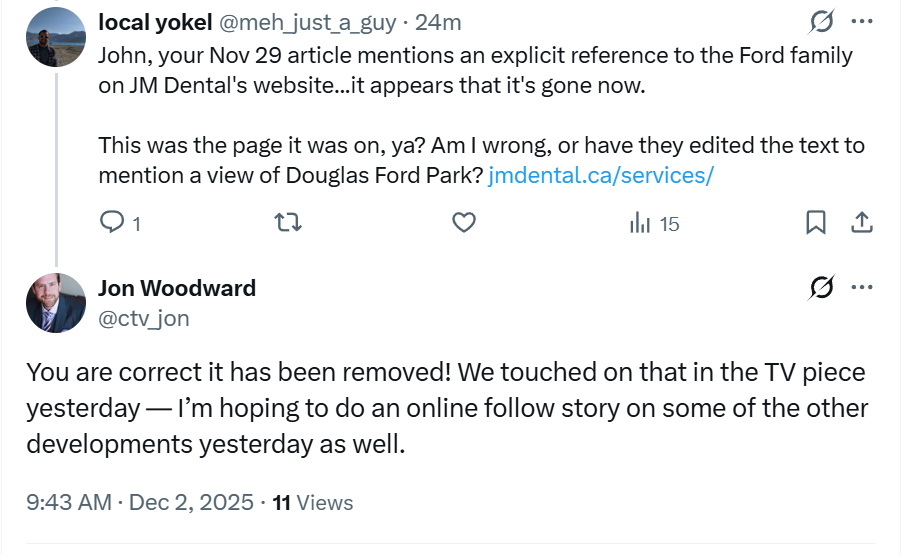
Actually, to write this post, I clicked the link inside the CP24 article to find the dentist’s website itself, and noticed the sentence directly mentioning the Ford family had been removed, which was confirmed by Jon Woodward from CTV, the reporter who wrote the original article:

Here is how Dr. John’s website looked before media reports connected the dentist to Doug Ford, as per the Wayback Machine (which pulls up how websites used to look):

For himself, Doug Ford denies ever being there! He issued a firm denial. As of last Friday, November 29, the premier’s office didn’t say whether any of the Fords had been there. Doug said that he’d ask his family if they had, but he insisted his dentist is in Scarborough. On the opposite end of town. OK.

We have several direct connections between them, and explicit denials. Maybe they don’t know each other, maybe they do. Who can say?

Well, here is a video from a 2022 fundraiser of Doug Ford together with Dr. John, telling the audience, “I have a 1-800 number…my 1-800 number is, 1-800-CALL-DR-JOHN.”

It’s amazing how openly chummy the two were before $2 million in taxpayer money changed hands from Ford to Dr. John, and how, once this $2 million transfer was reported on, suddenly they don’t know each other.

Ford’s government has already had to refer a forensic audit about one of the companies he gave SDF money to over to the OPP, to see if a criminal investigation is warranted. He’s currently being invetigated criminally by the RCMP over the $8-billion Greenbelt scandal. Red flags abound, an MO has been clearly established, and the opposition smell blood, as they’re still calling for David Piccini to resign.

This is not the first Doug Ford friend, donor, or ally to receive millions from the Skills Development Fund, despite several of them submitting mediocre to poor applications. It doesn’t feel like a coincidence and it feels like this will get worse soon.

Doug Ford Caught Giving Your Money to Insiders

Tags

, , ,

Doug Ford’s latest scandal is a doozy! Ford’s government has been caught red-handed giving millions away to unqualified personal friends and relatives of government ministers.

The Skills Development Fund, a pool of $2.5 billion, is ostensibly meant to support worker training in in-demand sectors. Ford is using this lots of this money as a slush fund, handing out millions to people only because they have personal connections to the party.

Here’s how it’s supposed to work. Companies submit applications for funding, then the government ranks these applications internally according to formalized criteria, and funding is doled out based on these scores, which the companies never see. The higher the ranking, the higher and likelier the funding. Not complicated.

Except the Toronto Star acquired the government’s own data they meant to keep secret, covering the first four months of the SDF, and the picture is ugly. 26 recipients who scored 50% or lower on their application received over $36 million. Any grant over $5-million needs to be personally signed off by the Labour Minister, David Piccini, who the NDP is pushing to get fired for his role in this. When a dubious application got funding, the reasoning provided was “minister rationale,” so in their mind, Piccini owns this.

Sometimes the applications weren’t even submitted with detailed plans or budgets, but Ford’s government still approved their funding requests anyway. Let’s look at some of the dodgiest applications to get a sense of why this seems like pure, outright corruption scandal:

The church that married a Doug Ford cabinet minister received more than $2.8 million from the government, including two SDF grants.

The gurdwara that endorsed Ford in the election received $950,000. Three high-ranking members of the gurdwara supported a PC fundraiser months before the election.

Postmedia, the parent company of the National Post and Toronto Sun owned by a US-hedge fund, received over $1 million, supposedly to train staff in Artificial Intelligence

A Brampton e-scooter company, Scooty, whose application received a failing grade of 42, also received $1 million to teach 100 workers about the “transformative impact of AI in fintech.” Scooty hired David DiPaul, a former Ford staffer, as a lobbyist to “identify and assist Scooty in navigating various grant and funding opportunities that may be available for a growing Ontario business.” Sure enough, even though ministry staff said the company has “no prior experience,” a budget that “needs to be reexamined,” and that their application has “more risks than strengths,” the government still approved the funding.

The Carpenters’ Council of Ontario supported Doug Ford last election, and they received $14 million though their proposal score was only 52%.

The International Union of Operating Engineers also openly supported Doug Ford last election, and they received about $7.5 million, though their score was 43. The union denies there was any quid pro quo, and said they received the funding before endorsing Ford.

Ontario’s auditor general has called this process “troubling,” noting that as many as 64 projects ranked low or medium that the government chose to fund had hired lobbyists, creating the appearance of “real or preferential treatment.” No kidding.

Ontario used to leave impartial civil servants to allocate this funding, not a hand-picked MPP who has “minister’s rationale” authority. This very much creates the impression of a system where Ford’s government is giving money to friends and relatives and those with inside connections. It’s the same MO as the greenbelt scandal and Ontario Place.

The SDF scandal started weeks ago after a couple of high-profile incidents. One Ford-connected lobbyist for Keel Digital Solutions, which has received SDF funding twice, had a very expensive wedding in Paris near the Arc de Triomphe attended by Labour Minister David Piccini, the same duo pictured together sitting front row at a 2023 Leaf game (Willy Nylander scored a beauty in OT to help the Buds win 6-5 over Florida).

Doug Ford’s Skills Development Fund Giveaway and ‘Minister’s Rationale’

Doug Ford’s latest scandal is a doozy! Ford’s government has been caught red-handed giving millions away to unqualified personal friends and relatives of government ministers.

The Skills Development Fund, a pool of $2.5 billion, is ostensibly meant to support worker training in in-demand sectors. It appears that Ford is using this lots of this money as a slush fund, handing millions out to people only because they have personal connections to the party.

Here’s how it’s supposed to work. Companies submit applications for funding, then the government ranks these applications internally according to formalized criteria, and funding is doled out based on these scores, which the companies never see. The higher the ranking, the higher and the likelier the funding. Not complicated.

Except the Toronto Star acquired the government’s own data they meant to keep secret, covering the first four months of the SDF, and the picture described here is ugly. 26 recipients who scored 50% or lower on their application received over $36 million. Any grant over $5-million needs to be personally signed off by the Labour Minister, David Piccini, who the NDP is pushing to get fired for his role in this. When a dubious application got funding, the reasoning provided was “minister rationale,” so in their mind, Piccini owns this.

Sometimes the applications weren’t even submitted with detailed plans or budgets, but Ford’s government approved their funding requests anyway. Let’s look at some of the dodgiest applications to get a sense of why this seems like pure, outright corruption scandal.

The church that married a Doug Ford cabinet minister received more than $2.8 million from the government, including two SDF grants.

The gurdwara that endorsed Ford in the election received $950,000. Three high-ranking members of the gurdwara supported a PC fundraiser months before the election.

Postmedia, the parent company of the National Post and Toronto Sun owned by a US-hedge fund, received over $1 million to train staff in AI.

A Brampton e-scooter company, Scooty, whose application received a failing grade of 42 also received $1 million to teach 100 workers about the “transformative impact of AI in fintech.” Scooty hired David DiPaul, a former Ford staffer, as a lobbyist to “identify and assist Scooty in navigating various grant and funding opportunities that may be available for a growing Ontario business.” Sure enough, even though ministry staff said the company has “no prior experience,” a budget that “needs to be reexamined,” and said their application has “more risks than strengths,” the government approved the funding.

The Carpenters’ Council of Ontario supported Doug Ford last election, and they received $14 million though their proposal score was only 52%.

The International Union of Operating Engineers also openly supported Doug Ford last election, and they received about $7.5 million, though their score was 43. The union denies there was any quid pro quo, and they say they received the funding before endorsing Ford.

Ontario’s auditor general has called this process “troubling,” noting that as many as 64 projects ranked low or medium that the government chose to fund had hired lobbyists, creating the appearance of “real or preferential treatment.” No kidding.

Ontario used to leave it to impartial civil servants to allocate this funding, not a hand-picked MPP who has “minister’s rationale” authority. This very much creates the impression of a system where Ford’s government is giving money to friends and relatives and those with inside connections. It’s the same MO as the greenbelt scandal and Ontario Place.

This started weeks ago after a couple of high-profile incidents. One Ford-connected lobbyist for Keel Digital Solutions, which has received SDF funding twice, had a very expensive wedding in Paris near the Arc de Triomphe David Piccini attended, the same duo pictured together sitting front row at a 2023 Leaf game (Willy Nylander scored a beauty in OT to help the Buds win 6-5 over Florida).

The NDP is adamant that they believe in the idea of the program, which is meant to help retrain, retain, and generally help businesses grow. The NDP have called Piccini a “dark cloud hanging over the Doug Ford government.” True, but Doug Ford is the weather system. I’m not sure why they’d target Piccini, not Ford, especially considering that Piccini’s predecessor Monte McNaughton also doled out millions in Skills Development Funds to dubious people close to him, including his wife’s colleague, before ducking out of politics.

David Piccini isn’t the mastermind behind this.

Even this Skills Development Funds scandal comes amid the wake of another possibly larger scandal. Doug Ford’s office referred a forensic audit to the OPP over concerns that a company, Keel Digital Solutions, received millions in public dollars from more than one ministry.

The OPP Anti-Rackets Branch is assessing it now to determine whether a criminal investigation is warranted. Note, the OPP recused itself from the ongoing criminal investigation into Doug Ford’s handling of the Greenbelt scandal, passing it onto the RCMP instead.

Doug Ford has been caught giving government money to weak applicants with inside connections. That’s not in dispute. Whether Ford can outrun these scandals, and whether these scandals are actually crimes, are the only things left to determine.

David Piccini isn’t the mastermind behind this.

Even this Skills Development Funds scandal comes amid the wake of another possibly larger scandal. Doug Ford’s office referred a forensic audit to the OPP over concerns that a company, Keel Digital Solutions, received millions in public dollars from more than one ministry.

The OPP Anti-Rackets Branch is assessing it now to determine whether a criminal investigation is warranted. Note, the OPP recused itself from the ongoing criminal investigation into Doug Ford’s handling of the Greenbelt scandal, passing it onto the RCMP instead.

Doug Ford has been caught giving government money to weak applicants with inside connections. That’s not in dispute. Whether Ford can outrun these scandals, and whether these scandals are actually crimes, are the only things left to determine.

You Have a Sacred Responsibility to Blow Your Own Mind

Tags

, ,

How do you know that there aren’t artists out there who you’d love more than the artists you currently love the most? This is a very important question people need to take seriously!

People have a sacred responsibility to blow their own minds. Who else will? Why go through life without encountering the best, coolest, most challenging stuff out there? Not what some insufferable dork at a party describes this way, but what you think. What epiphanies and revelations are you leaving on the table?

This question should frighten you into action!

One thing I keep coming back to is: how do I know when my obligations to myself are over? How does a person know when to say, “That’s enough, nothing still out there is worth seeking out!”? I get FOMO from this.

Life is largely mental; we all live inside our own heads 24/7. Literature and music are centuries old. Film is newer but what a vast rich fun world. There’s a lot out there! It feels like looking out at an endless ocean vista, only to remember the real ocean is under the water’s surface.

Obviously personal relationships are the fundamentals of life, not just this art stuff, and travel is another surefire way to blow your mind. But personal relationships are unique and complex, while travel costs time and money. In the streaming era, many great works of art have never been more accessible.

If you don’t make a genuine attempt to explore and wrestle with the deeper ends of this stuff, as far as you’re concerned, it may as well not exist. That’s sad to think of, in a way. But it’s also amazing to think that there’s such a wealth of beautiful priceless culture surrounding you, you could spend your whole life exploring it and not get to everything.

But imagine what life would be like if you had never encountered your favourite artist. Emptier. It’s like being without a best friend. Maybe you can’t really imagine never having heard of Bob Dylan because he’s just so famous, but there are artists out there just as talented and visionary whose name you don’t know. Me too! It’s true for everybody.

In my experience, blowing your mind with art comes in cycles and waves because you keep thinking, this is the best, surely it’s over now, this is as good as it’ll get, but then there’s more! It’s always in flux.

But let’s be practical here too though. Life is busy and expensive and who has time for all this? On the other hand, why even be alive only to miss so much joyful and inspiring human activity, especially when it’s potentially only a click away?

If you’re grinding and tired and saddled with major responsibilities like a demanding job and/or kids, it can be difficult to hear from somebody with spare hours to prattle on about their precious art! I get it.

The subtext of this conversation may sound like, “listen to how much free time I have!” or “look how much deep shit I know, and how cultured I am!” It may seem like the person preaching about this stuff is trying to make an exhibition of their brain or their lofty soul, rather than being driven by pure high-minded motives like love of beauty and a desire to spread it.

I urge people not to think of it this way! It’s better to endure several pompous weenies than risk not paying attention to the one person who gets it, whose tip or insight could change your life. It’s about you not them.

Of course, I have my own personal agenda here too, and I’ve yelled at friends, acquaintances, and strangers on the street to familiarize themselves with different artists I love. Personally, I really do love these writers and musicians, they mean so much to me!

I just want more people to be on that level, where they’re happy and excited and surprised by what’s out there. I can only advocate for the artists who’ve made me feel that way. (Music: Sun Ra Arkestra, Parliament Funkadelic, Miles; Literature: Bolano, Gogol). But really what I’m pushing here is not these specific artists, it’s the idea of people pushing themselves to get the most from culture.

I get why sometimes you just want to turn your brain off after a long day, rather than wrestle with Deep Shit, but to bring it back to the beginning, the obligation is to yourself. Enthusiasts like me might push this or that on you, sometimes obnoxiously and with a crazed glint in our eyes, and god knows algorithms will push their agenda on your under the guise of neutrality or serving you personally, but ultimately this is entirely in your own hands.

When you’re on your deathbed one day hopefully many years from now, talking to yourself in your final moments about the meaning of life and all that, you’ll need to be at peace with your relationships, what you’ve accomplished and left behind, but also what it was all for. You may not mentally rifle through all the highbrow art stuff you investigated in life and say to yourself, “thank god I listened to the Heliocentric Worlds of Sun Ra, Volume 2!” But the artists we love are life companions that help us find meaning and joy, bliss and purpose and inspiration. If you look around now at how depressed, angry, anxious and sad people are, surely we could use more of that. I don’t trust algorithms. You must take it into your own hands and take it seriously, you have a responsibility to yourself.

Assessing “Socialism’s 0% Success Rate”

Tags

, ,

Congrats, Zohran Mamdani! A 34-year-old Muslim socialist is now mayor of New York City, and, while they have a lot to say, one of his critic’s throwaway lines is that socialism has a 0% success rate. It’s never worked anywhere, apparently.

Forget for now that the US, capitalism’s heartland, has never been more completely and utterly broken, sold off for parts by a mafia-connected reality TV actor. I’m not even looking now at Mamdani’s platform or promised policies.

Forget all this for a moment. I want to pull back and assess the idea that socialism has never worked and that capitalism always has using a metaphor that for me explains why this criticism is not just untrue, but childish and simple.

To hear people tell it, perceived quality of life alone determines whether or not socialism/capitalism is good or bad. For many this is self-explanatory, and they don’t have to actually inspect or compare anything, because it’s self-evident that socialist countries are shitholes while capitalist countries aren’t.

I don’t see how this verdict can be reached so automatically in a country like the US, where school shootings and medical bankruptcies are routine everyday occurences, and for the first time in years the life expectancy is dropping.

Capitalism has a higher PR budget and its mythology has a stronger hold on people here, which is natural and unsurprising. Wealthy people love saying that our society is broken, but curiously none of them blame capitalism, even though all our national leaders in power have been capitalists.

But that still doesn’t get to the point. The real point is that capitalism has spread globally mostly because of the CIA, not the CEOs and all the supposed trickle-down wealth that follows in their wake.

In my view, this topic gets discussed like people watching a chess game, trying to determine who’s the stronger player solely by examining the pieces on the board. At first, it seems like a reasonable way to determine who is better at chess, right?

Maybe the observers understand the full depths of the position perfectly. Maybe they’re just middling amateurs. In either case, the pieces alone are what inform their verdict of who is stronger at chess.

In reality, if you pull back and look away from the board for a moment, you’ll see that one of the chess players is holding a loaded gun to the other’s head. Is the player holding the gun really winning the chess game because they have better tactics and skill? Or is their opponent throwing the game trying not to get killed?

Any chess analysis that ignores the gun is irrelevant, no matter how strong the chess analysis is. The observer could be Magnus Carlsen, but if he doesn’t know there’s a gun to one player’s head, his chess analysis will be missing the point.

When the US says their military exists to protect “America and her interests” they are talking about a system of global military reach that extorts or forcefully replaces duly-elected foreign governments on behalf of US tycoons across industries.

Nobody can accurately say how many foreign governments the US has undermined or replaced. The left doesn’t have the final tally because the number is very high, many coups are still secret or denied, and it’s easy to lose track of them all, while the right also doesn’t know because they seem to genuinely have no idea this is how the world actually works, and they’re very emotionally invested in believing that Western wealth is driven by the ambition and intelligence of its industrialists, not international military fuckery and subterfuge.

Capitalists act like capitalism has spread naturally because it’s so mutually beneficial, not because it was forced at gunpoint. If they were being honest and thoughtful, anybody stating that “socialism has never succeeded” would ask, “If capitalism is so wonderful, why can’t it spread without the US military forcefully intervening to spread it?”

Even economists seem to me now like grandmasters doing expert chess analysis while ignoring the guns over the board that really lead to checkmate.

So even if we allow that quality of life is better in capitalist countries like the US and Canada (which could very well be true, even if right-wing people in both places never tire of saying they’re hopelessly broken; trump ran on the US no longer being great anymore back in 2015, while Canada’s decline is assumed in political ads across parties), it’s not for the reasons most people say it is.

We’ll see if Mamdani remains committed to curbing the establishment’s influence once he’s in office. If he was a national leader in a faraway country that, say, discovered mines with valuable rare minerals Silicon Valley needed, US reps would fly over and pay him a visit, offering wealth and protection for him and his family in exchange for control of the mines. And if he refused, they’d replace him with someone who would sell out his people and cooperate with the US. But because he’s mayor of New York, the establishment will probably just undermine him at every turn and spend untold millions to smear him. Then, whether he succeeds or fails in office, they’ll say he failed very badly and deny their involvement entirely, as if his performance and not their actions are the only thing they’re assessing.

I wish him luck because he has a serious fight ahead.

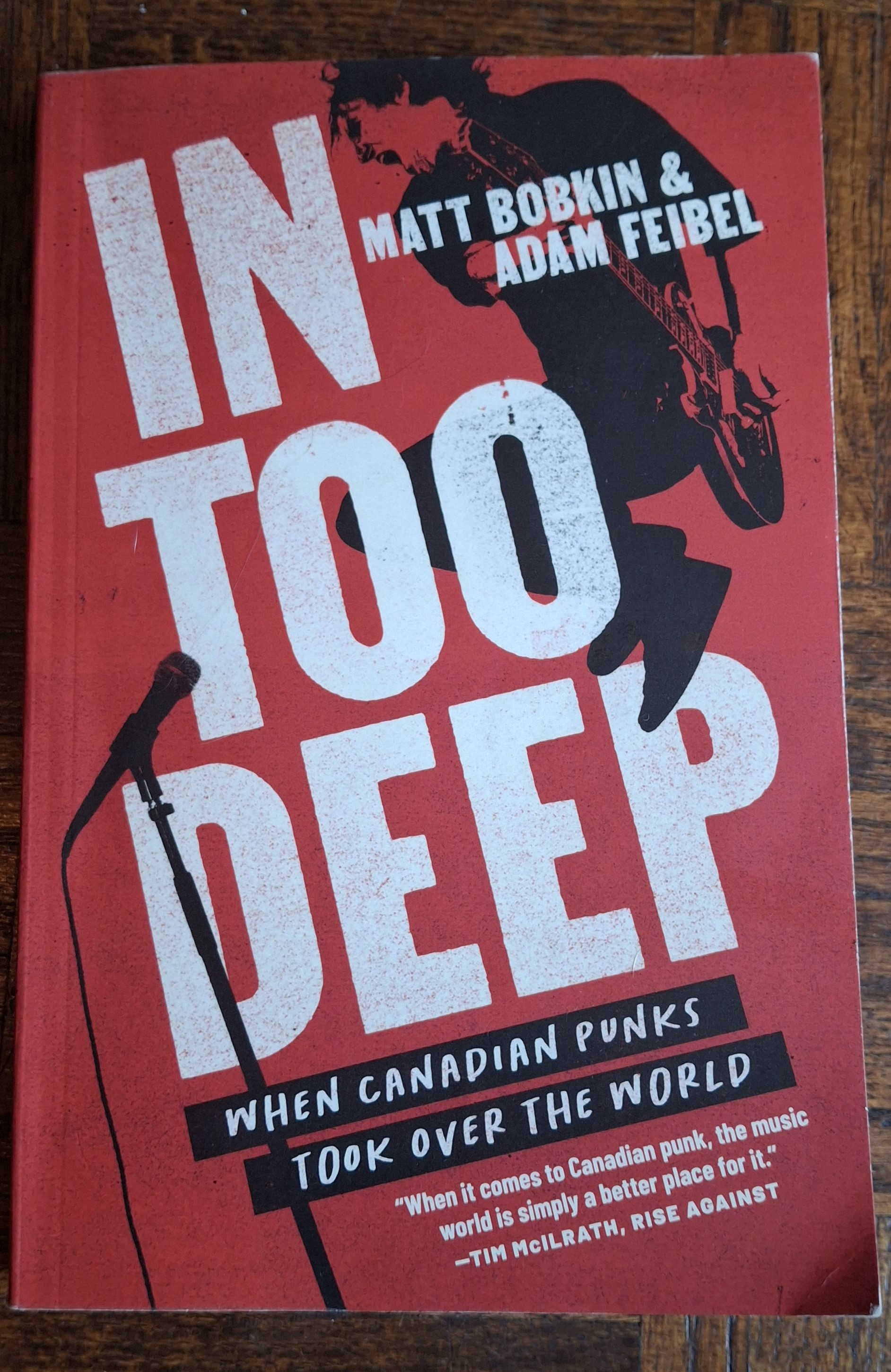
In Too Deep: When Canadian Punks Took Over the World, by Matt Bobkin and Adam Feibel; Book Review

Tags

, , , , , ,

In Too Deep was a pleasure to read and made me rethink music I didn’t care for much when it came out. I was 16 in 2000, listening almost exclusively to the Grateful Dead, then had a years-long hip hop phase. Billy Talent, Sum 41, Avril Lavigne, Alexisonfire…I remember not thinking very much about any of them at the time, but I guess I was glad they were there. At least skaters and punks had something unique and cool they were into and stirred up public culture, even if I wasn’t drawn to this music.

In Too Deep has a very local sense of place involving cities not just outside the US, but outside Toronto. The authors do a wonderful job conveying what GTA cities were like for young, ambitious musicians trying not just to make it big, but just play their music for people. There’s a really sweet purity here. Before they wanted to ascend the charts, they just wanted to perform.

Bobkin and Feibel zoomed out on the scene but zoomed in quite closely on the different cities in question. There’s a real keen sense of how each group managed to find their secret sauce, balancing the sound and musicianship on one hand, and attitude and energy on the other. Creating a band isn’t just about writing original songs. There’s also practical questions of finding money for gear, postering for upcoming concerts, finding somewhere in town to play.

Reading about 9 punk Canadian bands from the 2000s was surprisingly cool because, when you get into their origin stories, their success feels far-fetched, even sitting here now in 2025, knowing that they succeeded. Even record company scouts become recurring story characters, which I didn’t expect. You can feel the authors’ appreciation for the artists and different punk scenes in the writing that struck me as surprisingly earnest. I didn’t know what screamo was.

From a musical standpoint, these bands translated something about their life, an attitude they held at a young age, into a sound. It’s less about taking music theory forward or redefining what has been done before and more about finding the right sounds of a vibe, in a way. I don’t mean to sound patronizing or belittling, I think finding the sounds of an energy is a wonderful achievement! Teenage angst, anti-authoritarianism, or the adolescent urge to just fuck around and cause a little mayhem…what do these sound like? The answer, or one of them, is Sum 41.   

Music is never just about music. Fans of commercially successful music tend to get uncomfortable with the idea that something other than music is driving their favourite band’s commercial success. Even musicians themselves think along these lines. Are certain musicians really punk, or are they just contrived industry plants? Are the musicians play-acting punk musicians, or are they the real deal? That sort of thing.

Every genre faces this dilemma of street cred. Musicians get accused of imitating a type of lifestyle on stage or in the studio versus living it day in, day out. Producing sounds or music isn’t enough. Musicians are often expected to be something. Drake faces this in hip hop. Country has it, too, from what I understand.

When the musician in question is an industry plant, when their music genuinely is reverse-engineered by focus groups and executives, the question of authenticity feels essential—it protects the music and the culture. When an artist is sincerely grappling with their own feelings and instincts, and reconciling these with the conventions of the music and the culture they love, having to prove and demonstrate “authenticity” feels unfair and even silly. This books tackles these tensions in a punk context with a deft touch. It’s about the genuine sensitivities of these artists, who they are, and how they fit into a growing and changing punk world dealing for the first time with commercial success and all that comes with it.

Co-authors Bobkin and Feibel address these questions head on without dismissing the very idea of them, which I found refreshing. Questions of authenticity don’t tend to arise unless there’s big money around, and for years, punk wasn’t commercially popular. In Too Deep is also a story about a relatively new type of music coming into its own. If some new popular and successful artists like Avril Lavigne had their punk bonafides questioned unfairly, punk fans of course come from a genuine place. Feibel told me about what these bands meant to him when he was a teenager:

“Several of these were among my earliest favourite bands that got me into playing. I can distinctly remember writing songs at age 13 or 14 that were blatant ripoffs of Sum 41 or Alexisonfire.”

Hearing tales of very young people so determined to do their thing and be themselves, and have this new commercial space open up for them just at the right time…it was a nice story that played out similarly but differently for each artist. The older punks who made it and the younger punks inspired to make noise in their garage feel extremely connected to each other, as do the musicians in the book and the authors, who are also punk musicians. I found this to be very touching and even hopeful. Music is so vital in so many ways! As therapy, to help people understand who they are, whether musician or listener.

Hardcore fans of these bands will enjoy the authors’ in-depth research, expanding on known lore. Feibel told me that was what excited him, too.

“We knew a lot of their stories pretty well, but the level of previously uncovered detail that we were able to dig up from our research and interviews was fun and validating. There was lots of behind-the-scenes stuff that had only previously been summarized in, like, a paragraph on Wikipedia. Telling these stories in full like this had never really been done before, and we were thrilled to do it.”

I see these bands very differently now than I did at the time. The macro perspective you get looking back at things is a trippy concept. I’m 41 now, these people were teenagers when they broke out, but I’m also more or less the same age as the musicians. Avril Lavigne is a few months younger than I am. Am I reading about kids or adults? Both.

The section on Fefe Dobson I found sad and stirring! I didn’t understand how she was held back at the time, typecast, and am glad she’s enjoying a resurgence. I hope that’s consolation for her.

I learned a lot about punk. In Too Deep also made me appreciate how different groups of my youth, all from within like 100 kilometres or so, weren’t isolated acts but formed a musical continuum I didn’t know about despite living through. Who knew that while I was listening to Jerry and De La Soul, Canadian punks took over the world.

Cars Take Up More Space Than They Take Up: Clear Zones

Tags

, , ,

When people talk about how cities can relieve congestion, it’s essential to think about our physical spaces in ways people aren’t really accustomed to thinking about them. We get used to the world around us, and things that are problems seem normal and acceptable. Cars are so ubiquitous, their presence everywhere so natural, that we seldom question just how much space they take up and how this contributes to congestion.

I’d like to explore this question more to show the problem clearly.

I recently finished a wonderful book called Killed By a Traffic Engineer, written by traffic engineer Wes Marshall, about how the underlying assumptions engineers make are the root causes of many safety problems we have on the roads and, therefore, in our cities.

The book is made up of 88 small chapters, usually four or five pages. One section I found devastating was about “clear zones,” the phrase given to the space on the road outside the laneways that needs to be cleared of any physical objects for “safety” reasons. The specifications are strict, even if the underlying assumptions are dubious.

A 1963 roadside design guidebook called the Automotive Safety Foundation (ASF) said that since so many accidents involve vehicles leaving their travel lanes, accounting for 30-35% of fatalities at the time, it was essential for roads to have a certain amount of free space outside the lanes for errant vehicles, so that a car leaving its lanes wouldn’t crash into anything.

On a certain level, this makes sense. If there’s nothing there, there’s nothing to crash into! Anyone imagining a car swerving out of its lane understands that it’s safer for there to be no physical object outside.

But the ASF determined that 25% of crashes involved trees, so what did they do? They cut down all the trees beside roads. This, even though the ASF guidebook recognized that no research proved that proximity to a fixed object increased the likelihood of a crash. In other words, in the event of a crash, it’s safer to have a clear zone than not to, but no research confirms that clear zones make a crash less likely. If anything, there’s evidence they make crashes more likely. Nonetheless, clear zones became the norm moving forward. Often, big ones.

In 1967, 30 feet of clearance space on either side of the road was considered appropriate. The engineers had a different set of fatality reduction at every 5-foot interval, so a 5-foot clear zone led to a 13% reduction in fatalities, a 10-foot 25%, 20-foot 44%.

On rural highways, this makes sense. The problem begins when cities started turning urban streets into rural highways. Do you want a city with trees in it? Because you can’t have tree-less arterial roads and an abundance of trees. How do you create a 30-foot buffer on either side of the road in a world with thousands of pedestrians and cyclists? A city without trees and human beings is sad indeed.

On a fundamental level, there’s an error in the assumptions going on here. Giving drivers an impossibly wide, undisturbed road may make them drive faster than they would if laneways were narrower, increasing the danger. That’s why the clear zones might increase the danger. If stats show there are fewer pedestrian collissions on such streets, it may be because fewer people walk around highway-like streets in cities.

Wes Marshall points out that urban roadways had a lower fatality rare than rural ones according to Traffic Quarterly data from 1959 and 1963. Crash injury rates were also double in rural environments than urban ones.

It turns out that the “hazards” alongside the road may also encourage safer driving habits. People behind the wheel tend to slow down when less room is available to them, and this leads to real increased safety. Empirically, there’s no proof that “clear zones” improve road safety.

There’s nothing innately safer about removing all potential obstacles. If cities were to make walking on city streets illegal–if Toronto outlawed walking on the sidewalks and roads–then you’d have stats showing there were no pedestrian deaths. Does this mean the city is safer for pedestrians? Causality is very murky here.

Trees are beautiful things that clean the air, absorb rainwater. We’re happier around them. Cities need them. Trees can also be deployed for safety reasons, such as to separate cyclists and pedestrians from cars. Instead, cities built streets with “clear zones” that include not just shoulders but bike lanes and auxiliary lanes in them. We have intentionally designed cities that place cyclists in precisely the space we want errant vehicles to go, for them to be “safe.”

When it comes to cars, engineers can’t just say “this is your designated space, this space is not yours.” A 5.8-foot-wide car needs a lane that’s 9-15 feet wide, for buffer. A four-lane arterial street in the city, which has say two driving lanes and another two lanes for parking, could be 30-feet wide, but then the “clear zone” adds say ten feet in each direction, totalling 50-feet. Most cars have only one person in them, the driver. The driver’s ass might only be a couple feet wide, but the city gives them 50 feet (one 15-foot lane for driving + one 15-foot lane for parking + one 10-foot clearance zone on either side)!

Car lanes take up way, way more space than cars take up.

So when the topic of congestion relief arises and we’re all looking for ways to efficiently free up space, we need to peel back some of our assumptions behind how our world is designed. Seen from this way, encouraging modes of transportation that don’t take up extra space is of critical importance.

Most bike lanes in Toronto aren’t even real bike lanes, there’s just a certain amount of buffer space or the “clear zone” between car lanes and the sidewalk that arises naturally, and we paint a stencil of a bike in there and call it a “bike lane.” Bikes are narrow! They aren’t clunky. Unlike cars they are slight and don’t need much more room than they take up, a major tactical advantage when considering how people can move quickly all at the same time.

At least three people can fit shoulder to shoulder on a sidewalk, which is much narrower than a car lane and doesn’t require a “clear zone.”

Marshall’s focus on clear zones here was about safety, and that’s pertinent too, but it also nicely illustrates the wasted space we give cars. The point is to shrink the gap between how much space a physical thing takes up and how much space cities give it.

The Most Divisive Topic Today: Priority Bus Lanes

Tags

, , , , ,

The surest way to make somebody instantly furious? Bring up the topic of priority bus lanes. It’s unbelievable, but no topic makes more people madder quicker than taking away any space from private vehicles.

On a macro level, sure, the idea that freeing up arterial routes to move people rather than accommodate the largest vehicles not moving (ie, parking) makes perfect and total sense. The Dufferin and Bathurst bus routes move 75,000 people daily according to Shawn Micallef’s Sunday op-ed in the Star, more than the entire transit systems in many North American cities move, yet they’re extremely prone to bottlenecks.

The idea is to remove street parking along Dufferin from Eglinton down to King Street, and along Bathurst, from Eglinton down to the Lakeshore. In no sane world does a system trying to move people devote about half the available street space to the largest vehicles not moving instead of working to help the packed vehicles doing all the heavy lifting.

What’s at play here is that many people accustomed to the status quo of abundant parking are livid and mobilized. Not all–some residents are eager for proper bus lanes–but a significant number. An anonymous website pledging to “Save Dufferin” has sprung up, as if freeing up the street so riders can travel on it is a threat.

Once again, a business owner worries that the inability to park in front of their stores will harm business. This happens every time a change to parking is proposed. Studies across time and space show that business owners vastly overestimate the percentage of customers arriving by car and underestimate how many arrive by transit, bike, or foot.

That studies show this over and over is so well known by now that I literally said that out loud in a room by myself while reading Micallef’s op-ed, before I saw him write it himself in the article. On the page opposite was a different article about some fears over the bus lane, where the local councilor Dianne Saxe also repeated what Shawn wrote and what I thought and also said. But people get into patterns and habits of mind and it’s hard to shake these. No amount of very real studies can make them believe the studies are real!

I don’t want to diminish their fears or antagonize them. Their voices should be heard and their anxieties quelled, but I worry that their fear will dominate the discussion and shut down any chance of progress on a simple aspect of modernizing the city.

The tens of thousands of riders who get routinely ignored, who struggle on underfunded and neglected buses every day, should also be heard from. In fact, their needs should be addressed without them having to say anything, which is what’s happening here now.

We’re talking about two bus lanes! That’s it. Without having to utter a peep, drivers get many billions to repair old highways and build new ones nobody even asked for. The Doug Ford government wants an underground mega highway beneath North America’s widest highway, and refuses to say how many tens of billions that alone will cost. It’s insane. He’s rushing to build the 413 highway, which his donors just happen to own great swathes of property alongside that will all rise in value dramatically if a highway is built.

And somehow two bus lanes are a mega problem?

For what it’s worth, I live a 3-minute walk from Dufferin now, and for years took the 7 bus up and down Bathurst when I taught guitar lessons along that route. I still take transit and drive up these roads, so I’m quite familiar with them. I was astonished to read a business owner at Dupont and Bathurst deny that roads get congested there, because they very much do! The bottlenecks are shocking and they happen nearly every day.

Try driving north up Bathurst from Dupont to St. Clair on a week day between 3-6 pm. A 3-minute drive can take 20 minutes or more. The Bathurst bus is a nightmare, and this is the stretch between the Bloor subway and the St. Clair streetcar.

They call the Dufferin Bus the Sufferin Bus for a reason. Doug Ford radically underfunds schools and hospitals but will proudly spend billions to save drivers 30 seconds on their commute? He’s micromanaging Toronto and screwing the city on a macro level too. He went from giving fellow conservative John Tory “Strong Mayor” powers when he presided over Toronto to running roughshod over Olivia Chow. The Dufferin bus lanes were first proposed by the TTC in 2019. Tory voted to nix them.

The speed of the average TTC bus has declined from 17.2 km/h in 2024 from 20 km/h in 2013. Meanwhile, the Bathurst bus averages 13 km/h. The problem is real, dire, and growing.

If it’s government overreach to consult citizens merely before potentially removing 138 parking spaces from major arterial streets to free up space for buses, what is forcing an astronomically expensive underground mega highway nobody asked for? I don’t see why people are relatively up in arms about the first, but silent about the second.

The details are always tricky. Dufferin and Bathurst are major downtown arterials but they also have homes on them and people reasonably expect a certain amount of parking near where they live. There are also laneways behind these homes with parking potential. Congestion is the bigger problem and that needs to be addressed first.

The city is doing more consulting and outreach for bus lanes than Doug Ford is for his outlandish and obscenely expensive underground mega highway, yet I’m seeing more people angry at Chow for pushing forward on what is undeniably a much, much smaller project than Doug Ford’s.

Has Doug Ford requested feedback from the public before trying to push his outlandish mega project? 

To me this illustrates the way our government instinctively coddles and pampers motorists while forcing transit riders to beg for scraps. The funny thing is that RapidTO is considering a bus lane on these streets mostly in anticipation of hosting a few 2026 World Cup games.

How will visitors without cars get around? Of course the city isn’t planning this because it’s a sensible thing for residents—if we do something good here, it’s usually for tourists.

De-prioritizing motorists is something every sensible modern city is doing now. It’ll be a fight because people get livid at the idea of taking an inch away from cars. The city is right to consult with people about their reservations, but it needs to move ahead on this. The data is too settled.

If Bike Lanes Cause Traffic, Where is the Data?

Tags

, , ,

The frothing hatred many people have for bike lanes comes with an untrue assumption; whaters say bike lanes increase traffic for cars, without a shred of evidence. To them, seeing any unused space on the road that doesn’t have a car on it is all the proof they need. If there was no bike lane there, they could drive there! But there is, so they can’t!

On this level, it seems like anybody who can’t manage to wrap their head around this simple concept must be either a very stupid person or an ideologue, a guerilla fighting against cars in the War on Cars because they hate the freedom and innovation cars represent, or something like that.

If you’ve spent any time in these conversations you’ve heard things like this. I’m sympathetic to it! To the naked eye this is really how it all appears. To get a sense of why this isn’t how it really works, let’s consider it from a different angle.

In Toronto, somewhere between 25-30% of the city itself is devoted to car lanes and car parking. Between one quarter and one third of the city, roughly. Let’s imagine there were no bike lanes, or even that bikes didn’t exist.

The city is finite, physically speaking. It cannot grow because you cannot add more land within the same boundaries. Any additional roadways you add necessarily takes away from some other land use, whether it be residential homes, commercial properties, a park, sidewalks…whatever.

If you keep adding more and more cars within the same finite space, traffic will only get worse and worse as a result. That is the root cause of traffic: more cars.

If your task is to relieve congestion and get more people moving more efficiently, quicker, and more reliably, the last thing you’d do is any action that added private cars to the mix. Nothing is more efficient and effective than public transit. On the average work day, the TTC moves 2.5 million+ people. There are 2 million car trips a day in Toronto by commuters, as of May 2023.  

If roads seem congested now, imagine how much worse they’d be without public transit. You cannot understand this topic by looking at the problem through your windshield. You need to pull back and realize the only way to “solve” traffic is by reducing the number of cars on the road, since that what traffic is. Making other modes of transportation more attractive accomplishes that.

It seems a little paradoxical! Fixing traffic by ditching your car eliminates the benefits of fixing the traffic, since you aren’t there to benefit. So drivers hear this and assume it’s communist gobbledygook designed for some ulterior, nefarious motive. When people like me say “we need fewer drivers on our roads,” many people hear “you must stop driving.”

Let’s be clear: even the most adamant bike lane proponents understand that there will always be cars on the road and nobody is trying to remove them all. The point is to reduce reliance on cars, so people who don’t want to drive can stop driving.

You can gauge our city’s devotion to serving the private automobile by how we bend over backwards again and again, sacrificing nearly unlimited physical space and unlimited money to build roads, street, avenues, and highways for cars. If building more roads reduced traffic, Toronto wouldn’t have any traffic!

At some point, cities run out of more space for private cars because a city needs other things in it. I’ve joked in a tongue in cheek way about “fixing” traffic by razing hospitals, schools, homes, sidewalks, parks, and businesses and replacing them with roads. But actually, this is historically pretty much what we’ve done!

Entire communities were eliminated to make way for highways and onramps. Some 50s politicians were militantly opposed to sidewalks in the city, specifically because they took space away from cars to drive. This kind of blind, devouring entitlement is related to the blind spot many drivers have today, where they blame traffic woes on a streetcar carrying dozens of people, but one lone driver holding up a busy streetcar because they’re turning left is never responsible for any delays.

So what we have is an endless tussle between cars and everything else. Drivers expect infinite space and infinite money in a world that is physically and financially finite. Where will it end?

In a world where politicians spend billions to allegedly shorten a driver’s commute by 30 seconds, drivers are accustomed to this whole conversation revolving around them, so much so that they are very confident that the data from scholars and engineers is on their side.

It isn’t! Not even close!

Study after study in multiple cities across North America and elsewhere show that business improves after bike lanes are installed. Crucially, they also show that local business owners routinely overestimate how many of their customers arrive by private car and underestimate the percentage arriving by transit, bike, or foot.

In Toronto, the Bloor-Annex BIA representing 250+ local businesses is fighting to keep the bike lanes installed under John Tory, a conservative insider who is anything but a crazed bike lane guy. Doug Ford swooped in unbidden with $40 million to remove the bike lanes, which were only installed after years of studies and consultations. He’s openly defying local residents and local businesses without invoking one shred of evidence. For the Ontario premier to override the municipality and force his personal whims on the entire city is anti-democratic. For him to do it without any evidence is sheer stupidity.

If I’m wrong, please show me the data! I’ve read a few books on this lately that delved deeper into these types of questions. Killed By a Traffic Engineer; Urban Mobility: How the iPhone, Covid, and Climate Changed Everything; Shrink the City. They were great, especially the first one.

None of these books found any study claiming what Doug Ford and millions of people in Toronto assume to be true, namely that bike lanes increase traffic.

Following the data leads to the exact opposite conclusion they’ve reached: bike lanes help local businesses. Taking this logic to its natural conclusion, excess road space for cars is an attack on local business. The anti-bike lane people identify as pro-business, so hearing this point makes them go nuts. They want comfort and the intellectual high ground.

The reason congestion seems so intractable is that selling vehicles is a pillar of our economy, and it’s impossible for masses of people to both buy enough vehicles to keep the economy rolling without having to encounter each other while driving them. More cars is more traffic. The number of cars you need to sell to boost the economy is the root cause of traffic jams, not bike lanes. Put another way, our economy and our lifestyles are at odds with each other.

Think about it this way: If you think bikes clog streets, imagine how much worse they’d be if bikes were physically the size of cars or trucks! How could opposing what’s small, nimble, and effective fix congestion? To get a sense of how vehicles’ physical size and cumbersome nature is the root cause of traffic, imagine if pedestrians had to line up behind each other if one person walking in front of them was making a left turn, or even a right turn. Cars are uniquely prone to stopping and starting and creating bottlenecks.

Drivers have this idea that there’d be no traffic if only everything was optimal. If the traffic lights were set properly, if every driver drove and parked perfectly, if construction wasn’t excessive, then there’d be no traffic. There’s only traffic because some people are idiots or the city screws everything up!

Let’s be clear: it’s physically impossible for millions of cars to all drive quickly on the same roadways at the same time without crashing into each other. That’s what people expect their drive to be, and they are shocked, shocked when they never ever encounter these impossible optimal conditions. There would have been no traffic except for ___, and the ___ is never all the other cars. This blint spot is captured in the common urban planning refrain, “you’re not in traffic, you are traffic.”

“Induced demand” is the bedrock of urban planning because the phenomenon has been proven real over and over again. Basically, if you try to ease gridlock or congestion by widening the road by a lane, it will only work very briefly, until additional drivers incentivized or “induced” by the newly-built road space erase any gains made in congestion improvement, and soon you’re back where you started. This is captured by another common and funny refrain, “just one more lane, bro!”

We’ve known this for decades! Any urban planning that still ignores induced demand is fireable, shameful negligence and on a basic level doomed to fail.

Improving non-car travel options is the best way to “fix” traffic because it lets people who don’t want to drive leave their cars at home. Some people currently attached to their cars in our car-centric world may also decide to stop driving once presented with safe and attractive alternatives.

It’s a chicken and egg thing. Saying “nobody bikes in Toronto!” misses the point. Bike infrastructure here is abysmal, why would they? It’d kind of be like pointing at a forest with no roads in it, and therefore no cars, to prove that nobody likes driving. People adapt to what’s in front of them.

Want traffic to get worse? Here are some sure ways to do it. First, build a mega parking lot for 2,000+ cars beside a congested waterfront highway commuters use daily that’s also prone to flooding. Then, pour untold billions into building an underground mega highway underneath North America’s widest highway, Highway 401. Next, invest millions into destroying newly built cycling infrastructure, while also refusing to adequately fund what actually relieves traffic because it represents competition for the auto industry, public transportation.

Naturally, Doug Ford is committed to worsening car traffic in all these ways that will cost us billions of dollars and who knows how many lives. Streets will be more congested and dangerous instead of safe and vibrant. When Ford’s plans do absolutely nothing to relieve congestoin, his supporters will use Bike lanes as a scapegoat.

The Bloor bike lane was selected specifically to connect local cyclists to Canada’s busiest subway line. Ensuring safe and seamless connectivity between public transit and active transportation is sensible urban planning 101. Why wouldn’t Canada’s busiest subway line be connected to bike lanes?

The opponents of bike lanes feel no reason to read about this at a planning level at all because this bungling incompetent and corrupt premier acts on all their assumptions and desires before they can even write him a strongly-worded email. There’s no guarantee that urban planners will get all or even any of the details right and I’m not saying every recommendation they make in Toronto is automatically the right decision, but the anti-bike lane people are objectively wrong, yet feel very above needing to hear or read about any other opinion.

Maybe I’m just another crazed downtown yahoo in the war against the car! But let me ask: if we all agree planning shouldn’t be emotional and we all support following the data wherever it leads, what data justifies ripping up bike lanes? What data suggests that bike lanes worsen traffic?

When they produce real studies with real citations and not torqued, cooked numbers to merely give the appearance of relying impartially on data, I’ll shut up. I suspect I’ll be waiting forever.

Jazz On Vinyl

Tags

, ,

For people who stream music and don’t understand all the hoopla and money spent on collecting records, few things can make you sound like a bigger douchebag faster than saying “jazz on vinyl.” It’s not a new trope. Jerry Maguire (1996) nailed it with that jazz keener babysitter character, and the phrase “hipster doofus” goes back to the days of Charlie Parker.

The way I see it, anything cool gets mocked if it’s too cool, and sometimes people lay cool things on a little heavy. I get that the trappings of a record collection are ripe for mockery, but put on a great copy of a killer album on a system with good speakers, and tell me you’re having a bad time!

If there’s one key way music sounds better on vinyl than on digital formats, it’s that the high and the low ends have more room to breathe. Those sounds are clearer. When you hear it, you notice, even if you didn’t think you would. I suspect if you were to do a test, most people would hear the difference. That’s how palpably different it is. The audio quality depends on a few things, like your speakers, the receiver or pre-amp, the album pressing, and the way the album was engineered. When all these things align, the results are magic.

I’m not sure I’d recommend anybody to start a record collection today. Records are prohibitively expensive. When I started years ago, I worked at a music store that sold used records. They were inexpensive to start with and I got 50% off.

Even a few years ago, a new reissue of an old album might cost $20-25 or so. Today, it’s more common to find them at $35-40 or more. Some brand new albums are $50. Meanwhile, vintage jazz records can be very expensive. You’re lucky to find an old Blue Note album for $80, depending on the condition.

A few years ago when I was really buying albums, I didn’t much care for whether it was an original from the period or a reissue. I didn’t have a streaming platform and the only way I could hear the album was on record, or with commercials on YouTube.

I maintain that records do sound better, but that’s not the only reason they’re worthwhile. Holding such a large thing in your hands, looking at the album cover, makes it an artifact. The tangible experience of playing the record, even flipping it half way through, adds to the ritual enjoyment. Some records really are one of a kind. Sun Ra Saturn records were individually painted by band members around their kitchen table, so if you have one of these records, it’s not just that the physical record itself is like an artifact or a part of a ritual; it very much is a piece of history.

The point isn’t to be a snob about collecting records and look down on anybody for however they listen to music, it’s just to spread some joy and maybe musical understanding.

Personally, bass was the thing I heard least in music growing up. McCoy Tyner, Elvin Jones, and of course John Coltrane were recorded very prominently, but Jimmy Garrison was lower in the mix. I don’t know if this was just my ear, if I honed in on what I wanted to hear most, or if the technology itself was slanted this way.

Imagine watching a movie without seeing 20% of what should be on the screen, but without knowing you’re missing anything. This might be an oversimplification, but what digital music does is compress the high and low sounds: the less music there is, the more it can store on a file. MP4s, the common music file, are different this way than FLAC files, which are larger and truer but therefore a larger storage burden. The point isn’t that digital music can’t also be great, just that the way almost everybody listens to it isn’t.

Listen to Art Blakey on record! I really can’t emphasize how different it can be. When the different factors align, it feels like the musicians are in your living room.

Where does this leave us? If money is no issue, collect away. If you really love music, and you can’t stop yourself from getting the best version of the music you love most, do that.

It’s difficult to express how important and unimportant this conversation is! A few records I have are cherished, treasured belongings, sacred relics for a part of my life so spiritually important that owning a portion of the divine feels like a heretical lapse into idolatry. At the same time, just loving music is enough, and the difference between having an album on vinyl and streaming it is isn’t worth the money.

I don’t have all my favourite albums on vinyl (Discipline 27-ii is very rare and costs $1,200), I just stream them and don’t love that music any less. There isn’t a hobby on Earth that’s immune to being misunderstood, with people laughing at what they think it’s all about. Books aren’t for reading, they’re just rarified status symbols! Sports are just braindead macho crap for bros! Stuff in this vein.

I know the stereotypes surrounding record collecting, especially jazz. It’s funny, but now that records are popular again and sold in places like Indigo, we’re developing new stereotypes, like the vinyl nube paying $40 for a 2025 reissue of Fleetwood Mac’s Rumours.

There’s nothing wrong with jazz and there’s nothing wrong with Fleetwood Mac! I don’t want to be a gatekeeper: come on in, everybody! Chill, listen to some music. Just cost it out before buying a system is all.