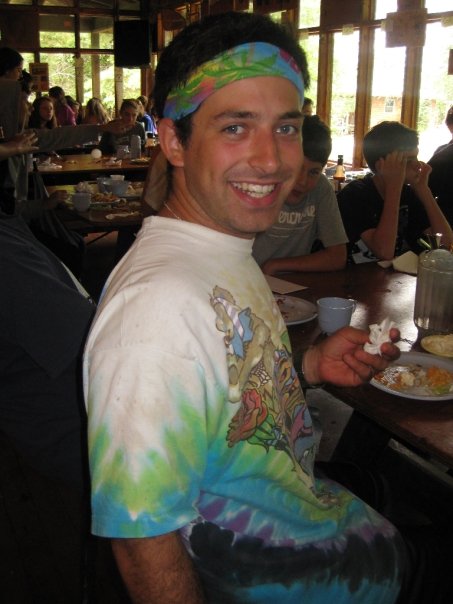
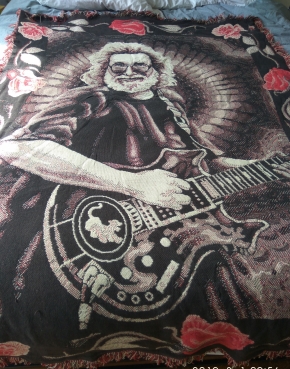
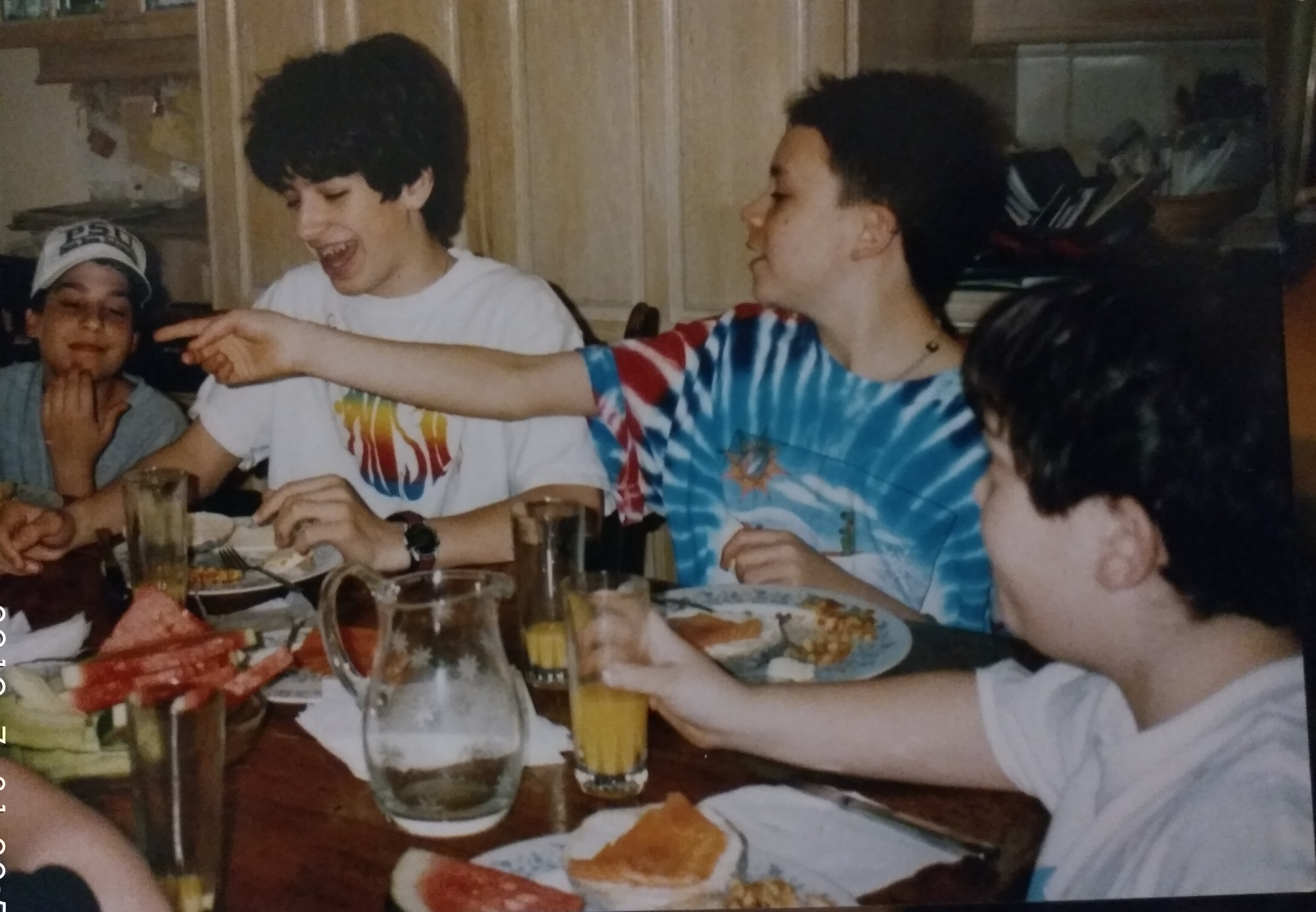
• About the Author
  • Books
  • Vinyl
  • What the critics say about Jeff

Jeff Halperin

Jeff Halperin

Category Archives: Uncategorized

Forcing Music and Novels on People Is My Love Language

27 Monday Jan 2025

Posted by jdhalperin in Uncategorized

≈ Leave a comment

Tags

Art, Grateful Dead, Jeff Halperin, Sun Ra

I have a recurring tendency to force art I love on people who didn’t ask for it and don’t love it…yet. Imagine from my perspective, having an epiphany about something, deriving from it joy and awe, love and genuine wonder. How could you hoard it and keep it to yourself?

The only answer I can find to this question is: I couldn’t, so I don’t.

In a world of soaring prices, the art I love doesn’t cost very much. You can probably access all the music I love on the streaming platform you pay for already. Novels you can get from a library or buy cheaply second-hand. People today commonly recommend way more expensive forms of entertainment without reservations. Even though what I enjoy is more accessible, I face resistance.

Some of the novels I like are large and maybe dense. They take time to read, not money, and time isn’t free. People are burned out from their jobs or raising families or just trying to feel OK in 2025. When they imagine reading the novels I hand them, they imagine the hours it’ll take to read them. My schedule is probably lighter than theirs, so it’s easier for me to conceive of time more broadly and abstract–not as hours it takes to read, but time as in lifetime. I can’t imagine going through life without encountering this or that novel or music.

We’re both right! Nobody’s wrong here. They can’t imagine juggling parenting and their professional lives with the time it takes to listen to avant garde jazz albums by Sun Ra or read a 900-page novel. People have precious little spare time, so why wrestle with art that seems strange or doesn’t suck them in right away?

I get it! When I try to push my longer, more challenging beloveds on my people, my secular proselytizing, I often sense people looking for the politest way to refuse. Sometimes when people say no to a critically-regarded work, they jokingly say something like, “I’m too dumb for it!” No! I don’t think they really mean it, but anybody can consume any art. Creating it is a different story! But consuming? It’s a question of patience and desire, not raw intelligence. Liking highbrow art is not a marker of intelligence, it’s just a question of character and personal temperament.

The way I’d frame the question people should ask themselves is: what responsibility do you have towards yourself to ensure you go through life and find really, really cool art? Are you doing right by yourself? Pushing yourself enough? People need to take this seriously! Don’t shortchange yourself! There are all kinds of BFFs in art you’ll never meet unless you look hard enough.

The algorithm is not your true friend and you shouldn’t outsource art discovery to Big Tech. Fine, if the algorithm serves up good music or whatever, don’t reject it. Enjoy! But it’s only a tool. You owe it to yourself to sample stuff that many serious people love a lot, or dig into some weird dank shit you never imagined yourself ever liking and come out on the other side, changed. Even if you don’t love it, the journey will be a trip. Maybe you will love it later, in time. It’s growth either way. You learn what you don’t like.

“Let people like what they like” is circular because people don’t know until they’ve tried it and really wrestled with it a bit. You might dislike it at first then warm up to it after understanding it better. Hate can become like, like may become love. Dense art is seldom understood right away and yields more and more each time you encounter it.

Reading Great Books is very obviously a good thing to do in life, but it’s also very obviously something people scoff and roll their eyes at. When someone is looking for a good read, what are you gonna do, recommend Proust’s In Search of Lost Time? In a way, no. But in a way, yes!

Art today is often a diversion, something to help people chill and wind down. I don’t say this sneeringly. Art is on different levels and people need to relax. I love chilling. That’s what I’m built for. People struggle to find the mental bandwidth to concentrate.

The trappings of highbrow art are also a barrier—people’s ideas about, say, Kafka are usually very different than what his writing is like. Many Canon novels are funny, including Franz’s! But people brace themselves for “heavy” art and enter a solemn, dusty headspace before opening the first page, misaligning their mood and the works’.

Recommending art that art critics or dirty hippies love draws suspicion because people don’t think of themselves as art critics or dirty hippies, and this conscious self-perception stops them from actually encountering some art.

On a logical level, you’d think everybody would prefer their art to be as “good” as possible, that we’re all on the same page, but that’s seldom how it happens. My view is people should try things in life, they may as well be good things, and having an adventurous spirit about finding it can only be good.

Personally, I can measure my life in terms of the musical phases I’ve been in. This art really means a lot to me! I’d be in my bedroom as a teenager, alone, listening to the Grateful Dead or Django Reinhardt or Robert Johnson or Lenny Breau or Charlie Parker, astonished and ecstatic. Of course I have to tell people about this stuff! I’ve never loved music more than I do now, at 40. Literature, too.

So yes I’ll tell you about what I’m into because I don’t know how not to be like that. I don’t mean to pester, just share my life and my loves. I can’t tell you what art to love, but you owe it to yourself to go into the deep end and don’t come back until you’ve caught something serious, cool and probably unexpected. When you have, you’ll know.

Music is Good or Bad, Not Simple or Hard

20 Monday Jan 2025

Posted by jdhalperin in Uncategorized

≈ Leave a comment

Tags

Britney Spears, David Gilmour, Jerry Garcia, Neil Young, Pink Floyd, Sun Ra Arkestra

I used to be very drawn to guitarists playing music that I, a guitar player, couldn’t imagine myself ever being able to play. Look what Django can do! It was a physical feat, a triumph of dexterity. Of course the physical feat was very much connected to the sound: Watching somebody move their fingers how their solos required but without a guitar in their hands—essentially, air guitar—would have meant nothing to me. I’ve been wrestling lately with the relationship between the physical part of music, what’s required to play it, and how music actually sounds, how they’re connected and how to feel about it.

I think the best way to think about it is to create categories along these lines. Simple-great and hard-great on one hand, simple-sucks and hard-sucks on the other.

In simple-great I’d put Neil Young and David Gilmour of Pink Floyd. Neil gets the most out of GCD songs imaginable. He does use some odd tunings and unusual chords, too, and his voice and songs are just so beautiful and singular. He’s a musical god! I’ve spent years playing his songs on guitar and really love him, but there are much more complicated players out there. Neil has feel. Priceless feel. If you practice, you can sound a bit like Neil. Maybe get 80-90% of the way there. But the voice, the guitar sound…Neil is alone. David Gilmour’s solos are mostly pentatonic stuff, but they’re just so, so perfect. There’s a logic to them and you recognize his sound right away. They’re both very accomplished musicians and I don’t mean to give them a back-handed compliment! But to me, they’re both simple-excellent players. Emphasis on the excellent, more than the simple.

In complex-great I’d put Jerry Garcia, Sun Ra, Charlie Parker, John Coltrane. Musicians like that who use various scales and modes over fast, sophisticated chord changes. You need to know your instrument inside-out to play like them, not just have dexterity or a great ear. Improvisers have a very different relationship to their instruments than people who compose music and play written music at their concerts or in the studio.

Playing like Charlie Parker is like solving a Rubix cube while dancing. He was bouncing in impossibly new, daring, inventive ways within his music’s tight constraints. His feel and technique are both top notch. All these guys have endless technique and feel.

The point isn’t to put one type of player over another; if you’re excellent, it doesn’t matter whether it’s “simple” or “hard.” More a question of what mood you’re in, as a listener. But I’ve asked myself, what happens when a musician has been a virtuoso for decades and for them a “difficult” musical passage is just as easy to play as an easy one? How does their proficiency on the instrument affect what they want to play, and how we hear their music?

To help understand the kind of dynamic I’m talking about, imagine listening to music inputted into a computer, rather than played manually by musicians: would you find the faster, “harder” passages more enjoyable than the slower, “easier” ones? When the physicality of playing music is removed from the equation, does our judgement and appreciation for its sound change?

On some level, we don’t trust an artist’s authority unless they dazzle us by doing something we can’t. In musical terms, this means playing fast, complicated passages. People wouldn’t have taken Picasso’s abstract stuff as seriously if he hadn’t demonstrated he could paint like the Renaissance masters.

Along the same lines, free jazz players squawking on their horns would be dismissed outright by many as charlatans or lunatics if they hadn’t demonstrated that they could play conventional jazz too. Many still are.

For years I was floored by the harmonic knowledge and manual dexterity required to play guitar like Lenny Breau and Joe Pass, guys who simultaneously play chords, basslines and melody as a solo act. Sometimes they play all three at once, or two, or one, alternating between these roles smoothly. It’s incredible to do! You need a commanding knowledge of music theory and probably no amount of practicing will let me play like this.

But who cares? Today I listen to it and think to myself, yes it’s still beautiful and impressive, but get some friends! Find buddies to play instruments so you don’t need to do the bass, chords, and melody all alone! Joe Pass sounded better on For Django where he had accompaniment and could just solo and leave the rhythm to his band. Breau to me sounds better with less on his plate, too. They’re freed up.

Was I listening to just the sounds they were playing, or were their physical accomplishments (and theoretical knowledge the playing rested on) seeping into what I heard, influencing it?

You can have total command of your instrument and know all there is to know about music theory, but that doesn’t make your music great. Some players play a million notes a second and don’t really say anthing.

On the flip side, the Beatles couldn’t read music. Neither could Jimi Hendrix. The Band relied on Garth Hudson for deep music theory stuff, just like P Funk relied on Bernie Worrell. But music is a results-based medium: if it sounds good, it’s good.

Proficiency and knowledge are just tools. Not knowing theory, or lacking notable skill on your instrument, can be major a limitation, but not always! Some musicians take power chords really, really far. Punk can be about raw visceral power and attitude on stage or on record, more than elaborate solos. Just like bad music isn’t made better because the musician playing it knows all the scales and plays proficiently, good music isn’t bad because the musician playing it doesn’t know about the cycle of fifths.

There’s a difference between how sophisticated music is and how good it is. I’ve stopped thinking about it this way and feel better for it. It may sound odd, but sometimes complexity and simplicity are fused together. Sun Ra would ask Arkestra musicians to remember what it felt like when they first picked up their instrument, to play with some of that freshness, simplicity. The point is to transcend musical knowledge for self-expression.

I try to think critically now about music only to widen and deepen my appreciation for as much music as I can, whatever I happen to be listening to. The point isn’t to build up theories that proclaim a musician good or bad based on how hard it is to play or grasp.

Some players who shred have nothing to say. It’s not even clear that “hard” passages are actually harder to play. Playing slowly can be harder than playing quickly, actually. There’s less room to hide mistakes and every little movement of your finger affects the tone. Every bend, every shake and vibrato. The phrasing really stands out more when there’s more space for the sound to breathe.

The binary between simple-hard isn’t really a good criteria for evaluating music. When musicians are spiritually deep and have total command of their instrument and music theory, you’re probably in very good hands! But these are just tools.

Sometimes very good musicians who lack formal training are insecure about their gaps in knowledge. They shouldn’t be! If you can play, you can play. If it sounds good, it’s good. I hope conceiving of music as good/bad not simple/hard frees up musicians and anyone listening to music from the burden of needing to prove themselves or justify their preferences and musical tastes.

I’m not exactly saying “let people like stuff”! I’m describing how I listen and evaluate music for myself. I’m not here to scold or praise anybody for what they like; the point is for each person to widen and deepen their own musical appreciation by spending more time to consider music they may have dismissed at first glance as being too simple or, on the flip side, too weird or hard or out there.

There’s a world of difference between the Sun Ra Arkestra and Britney Spears, musically speaking, but they’re both valid and cool, even if I can tell you which of the two I listen to more.

What I Love in Sun Ra’s Music

14 Tuesday Jan 2025

Posted by jdhalperin in Uncategorized

≈ Leave a comment

Tags

Jeff Halperin, Marhsall Allen, Sun Ra, Sun Ra Arkestra, To Nature's God

Most people don’t love jazz but those who do probably have a similar progression. On the spectrum of “in” and “out,” people start in and gradually get further “out.” At first, you need splashy cymbals and a tight walking bass to give a sense of coherence, pulse, and beat to the sound. Gradually, you need to rely on these things less and less. Put another way, after you get used to what you’re hearing you’re eager for what’s next, how things stretch from there.

Musicians go through this same progression. John Coltrane is a great example. He played big band jazz, then looser but highly constructed, structured stuff with Monk, then played with Miles and his own quartet in ways that would have seemed very loose and free-form compared to his big band era, but restricted compared to later albums like Ascension. Maybe the simplest way to think about it is that after both musicians and listeners hear the same thing for a while, they get bored and need a change. There’s only so many ways to solo within the changes before something else needs to change.

If I’ve talked to you in the last year or two, you know I am currently very, very in love with the Sun Ra Arkestra. Why? What is its appeal? I’d like to describe it in musical terms but spiritual ones too because that group cannot be explained fully via notes.

I’ve said that the Arkestra represents for me the height of discipline and freedom. This sounds like a cliche so let’s look at this to see precisely what I mean. When the Arkestra wants to be tight, nobody is tighter. With the snap of a finger they can reel off Fletcher Henderson’s big band charts so accurate they include the mistakes musicians made during a live performance. The Arkestra was a huge group, a fixed core with a revolving door of musicians stopping in for days, weeks, months at a time to play with the band, but it was tight.

At the same time, their structure required a certain type of looseness and individual freedom to be what it was. When Arkestra mainstay Marshall Allen first played for Sun Ra, Ra asked him to just play, to test his spirit. There was no music in front of him and he wasn’t playing any song. Anyone who has ever heard one of Allen’s remarkable alto solos knows this spirit. You can’t transcibe what he plays. It’s grunts and high-pitched squeeks and squaks that seem impossible to produce from an alto saxophone, even though overblowing a horn was a technique Coltrane used too, which he heard from 50s RnB players. Allen’s playing took me a while to appreciate, and seeing him play makes it make a lot more sense than just hearing it would have. I wasn’t sure it was even “music,” but part of Ra’s freedom is being in the realm of sound, not notes deriving from a scale.

Sun Ra’s music doesn’t just span the entire musical spectrum; it expands it, making me realize just how varied, rich, wonderful music can be. He’s like the Shakespeare of music, encompassing every mood and character with unmatched technique.

When I listen now to the groups who were my favourite a few years ago–70s Miles fusion and Parliament Funkadelic–they seem almost limited, staid, and small. I still love them dearly! It’s not their fault, everyone seems small compared to the Arkestra. They’re a force that goes deeper and started what everyone else is doing.

Miles got rid of the European-tailored suits because his girlfriend, a beautiful model and killer musician (whose music I also love) Betty Davis told him it wasn’t hip. P Funk bought a lot of their stage wardrobe on Toronto’s Yonge Street, but only after Ra spent years talking about space and looking otherworldly on stage with homemade wardrobes that looked absolutely beautiful.

Ra had multiple dancers at his shows, half-hour long percussion solos, an impossible range of horns and percussion instruments and synths and other keyboard instruments. It’s like his engine never stopped or slowed. His music in the 50s is different than the 80s and 90s, but no less inspired. You can listen or even watch his band play and ask yourself, “what is that instrument?”

His freedom is multi-dimensional. There’s the space concept, the wardrobe, and motion on stage, the way his musicians will walk off stage and break the barrier between audience and musician, or even walk off stage at the end of the show, still playing their instruments. His freedom is also embodied by his just off kilter harmonies, the instrumentation, the time signatures and the shifts, the way instruments can shift ahead and behind the beat, sometimes within the same songs. The chanty songs have a type of tight drawl yet also a kind of upbeat or off-beat quality at the same time that I just love. To Nature’s God comes to mind, a beautiful song praising elements of nature.

It sounds sometimes like all the musicians are playing a different song all at once, but that’s just because they’re playing melodically at the same time, rather than a few people doing chords or vamping to support one soloist at a time. If chords are frozen arpeggios and arpeggios are melted chords, then their solos imply a world of chords or tone. They live within the in-between worlds. It’s kind of a game, to playfully mask or hide the structure, or whatever the key is that opens up the song’s hidden core, and delight in finding it, or feeling it. You don’t need to think about all this music, sometimes it just makes you feel instinctively very good! It can really swing and have a strong sense of melody. But other times it can be extremely dark, dissonant, and you wonder just what this cacophony even is. I’m shocking myself lately by liking this latter mode more than I ever thought I would.

Many of the Arkestra’s musicians lived together, a communal existence that let them rehearse and play 24 hours a day. It kept them out of trouble and simplified meals. Despite being leaders in American jazz who got a wonderful reception in European cities, they never made a ton of money. They needed cash. Yet they were incredibly prolific, putting out over 200 albums, some on Ra’s own record label, Saturn Records.

When publishing a new Saturn album, Ra would hand each band member a few copies, and together they’d do crafts around the kitchen table, drawing on the covers in markers and taping photocopied type-written notes about what songs were on each recording. It was incredibly DIY and resourceful! For laminate, they’d use transparent shower curtains. These hand-decorated, one-of-a-kind records were sold at concerts for cheap and are now some of the most prized collectibles in the world of vinyl. A VG copy of Lanquidity goes for $1,500 cdn. Discipline 27-II went for $1,200 at a store near me.

I’d love to own such a collector’s item not for the monetary value (I’d never, never sell it), but to know that exact album passed through the band’s hands. It’s impossible to imagine a group of artists more commited to their vision. These guys lived the life day in and day out for years. The band started in the 1950s and, while Ra left the planet in 1993, the Arkestra still plays today under the leadership of 100-year-old Marshall Allen.

The spirituality and vision underpinning the music comes from Ra’s imagination and his readings into mythology, the occult, history, numerology, and lots else. For all the out-there strange ideas, it’s also filled with humour, playfulness, and it’s extremely sweet. Ra might have insisted he was from the angel race from Saturn and not a human being, but his music is extremely concerned with people, or maybe as he’d put it, Earthlings. It’s Black music, 100%, but it’s for everyone, too. I read somewhere it’s like Count Basie meets Thelonious Monk and this feels true, but maybe inadequate.

I’m totally floored by the Arkestra’s talent, vision, their raw force, their commitment, their range. It’s exquisite art on many dimensions that’s inspiring and very calming. There are initial barriers to accessing some of their music that once overcome will change the way you appreciate music forever and even your life.

I’ve been obsessed with music from a young age but, in a way, feel like I’m hearing music now for the first time. I hope this isn’t my final musical epiphany in my life and don’t see how it won’t be, yet this band has shown me that musical possibilities are as endless and vast as the cosmos themselves. I feel like I could write more words about each particular album of theirs I love, even each song–it’s extremely difficult to write concretely about such an ever-shifting musical behemoth. Suffice it to say, for me, the Sun Ra Arkestra is more like a miracle than just music.

New Technology in Music and AI

13 Monday Jan 2025

Posted by jdhalperin in Uncategorized

≈ Leave a comment

Tags

AI in music, Jerry Garcia, Music, new-music, news, P-Funk, reviews, rock, Sun Ra

The tech world has a way of promoting what business wants in ways they make sound like you want it. For years it’s felt like everyone pushes you to download their app in what I suspect is a move to get your data, which is then leveraged for marketing or other commercial purposes. Everybody kind of knows this, the suspicion is old. Yet the world carries on as if apps exist for the customers’ sake, to improve their experience, not the company’s. Same with AI.

It feels very much now like people deeply invested in AI need mass buy-in to cash out, and a technology with no real usefulness is being promoted by people who know it’s obviously garbage. I know people have found a range of useful applications, like help in coding or planning an itinerary, but the gap between AI’s alleged usefulness and its hype is so enormous, I’m comfortable saying it’s useless.

Nowhere is it more useless than in making music. One comment from an interview doing the rounds on twitter made my stomach sick, and I’m far from alone. Mikey Shulman an executive from suno AI, said this about making music:

“It’s not really enjoyable to make music now… it takes a lot of time, it takes a lot of practice, you have to get really good at an instrument or really good at a piece of production software. I think the majority of people don’t enjoy the majority of time they spend making music.”

What is said here that isn’t true about everything? There isn’t a discipline on Earth that doesn’t take time to get good if you want to do it well.

Anybody who has really wanted to play an instrument can’t take their hands off it. It’s not a slog! It’s anything but! It’s not work! Maybe I’m wrong, but I can feel this CEO and others dying to insert in this conversation the idea that limiting music to musicians, or people playing instruments, is elitist, that anybody should be able to play music.

But the thing is, anyone can play music! A decent guitar costs a small fraction of one month’s rent. At some point, making music involves doing something, and so long as you can do that, you can make it.

I’ve thought a lot about how music incorporates new technology, and how there’s always a pushback from old fogeys who resist modern change. Am I doing that? I don’t think so, but here’s what I mean…

When the piano first came out, people thought it was a form of cheating because the player only has to hit a colour-coded button (white for natural notes, black for sharps/flats) to pluck the string. With piano, the keys activate a hammer which strikes the strings, there’s no contact between the strings and the fingers.

When hip hop started sampling music, people wrongly thought that was just plagiarism. Let’s be clear about something every knows: rock stole blues, or grew out of it, or whatever you want to call it. There’s nothing new about taking older forms of music into your own; sampling just made it more direct. From an artistic standpoint, there’s no difference between copying someone’s guitar riffs and stitching a bar of their music into your song. These only differ on a technical level. The copying is automatic instead of manual. There’s an old joke about jazz I like that goes like this:

“Maaan, that sax player is just stealing Charlie Parker riffs.”

*Sax player walks over, hands him the horn*

“You try it.”

If anything, sampling is more honest because it’s more direct and there’s no cover-up or masking going on. People thought Led Zeppelin or whoever wrote those Robert Johnson songs, but De La Soul never claimed to have invented P-Funk, even if many people didn’t recognize, say, the Knee Deep sample on Me Myself and I.

My favourite musicians eagerly incorporated new technology right away. Jerry Garcia had an ultra-sophisticated custom guitar with crazy built-in mods in the 80s and 90s, Tiger. Sun Ra jumped at the chance to play any new keyboard instrument (rocksichord, wurlitzer, clavinet, minimoog, farfisa, the list goes on…) and like many he used odd ball recording techniques on albums in places.

Music is about making sounds, not labouring on the rudiments and working on an instrument until you advance and pass a test and get sanctioned to play. You don’t need to log 10,000 hours to play punk or even rock. So I can’t help think that this AI music movement is designed to produce lots of place-holder “content” music so companies can use it in videos or ads or whatever without paying for the rights. They’re not promoting AI in music for musical reasons, just self-interested commercial reasons.

I can’t help but notice that the people pushing AI in music aren’t musicians, but executives and investors. Maybe Brian Eno can find a cool way to make music using AI and I’m not really saying AI is totally useless, but even if you ignore all the absurd amounts of energy and water AI consumes, I am an enormous skeptic that AI will make music sound better and bet it will only make life for real musicians even harder, not easier.

“But Why Do You Hate Cars So Much, Jeff?”

22 Sunday Jan 2023

Posted by jdhalperin in Uncategorized

≈ Leave a comment

Tags

Car dependency, induced demand, Toronto car-free, urban planning, Vision Zero Toronto

A buddy who reads some things I tweet asked me to explain my loathing of cars when I saw him this weekend. We were drinking and someone asking me to rant was highly appealing, but I figured I may as well set the basics down soberly in print, too.

It’s not that I hate cars, exactly. I hate our over-dependence on them. That a person who doesn’t own a car is all but isolated from society is barbaric. Car culture has normalized enormous sacrifices for cars that don’t even strike us as sacrifices because we’re all accustomed to them.

When you look at a house or a property, look how much of it is taken up by the driveway or parking. It’s not uncommon for around half a new home’s façade to be a garage, or at least a very large chunk. Almost one quarter of the city of Toronto is taken up by roads! Not parking lots, roads. Basically, any outdoor space that isn’t a commercially or privately owned, or a park, is consumed by cars.

Homeowners spend thousands to accommodate their vehicles and the city devotes its budget to cars, too. The city of Toronto charges much less for housing for cars (ie parking), than housing for human beings. One parking spot is worth tens of thousands of dollars. The city subsidizes street parking but refuses to do the same for people, and Free Market boosters don’t even notice the former, while the latter enrages them. If you asked motorists to spend on street parking what the actual rate should be, they’d be livid. They think they’re getting squeezed now, when really they’re getting subsidized.

Parents are quick to point out that it’s easy for a guy like me, no kids and works from home, to be opposed to cars, but just try schlepping your kids to hockey on a bike or bus! I get that and I’m not here to scold exhausted parents dealing with shit as best they can. I have a car too! I hate that it’s necessary, but we’re living in a world designed for cars and not having one is indeed difficult (so is having one).

Between the environmental, health, financial, and just lifestyle, a sensible, modern city would follow the data and do its utmost to remove private cars from the road, not by banning them, but by making alternatives more appealing. Busses, streetcars and subways should be clean, frequent, and reliable, then people would take them. Instead, under John Tory, the TTC continues its death spiral of critical under-funding (no North American city of comparable size funds its public transit system with fares to the degree Toronto does, not even close).

The cycle moves in both directions: everyone would love to take transit! But transit here is shit. That’s not because transit doesn’t or can’t work, it’s because we defunded transit for decades and pour our money into private car infrastructure. And why do we do that? Because nobody takes transit and everyone drives.

Instead of retrofit outdoor space to encourages safe and active forms of transit that get people around for less money in a way that’s fun and promotes good health, Tory and Ford are making unjustifiable and unconscionable decisions auto executives drool over because they lock-in car usage for years.

Cars are excellent when nobody else around you is driving them because they let you get around quickly. Decades ago, this was the case. But the more people do this, the less useful and more expensive cars become. They’re not a perk anymore, they become the baseline form of getting anywhere, which makes them essential, and therefore a burden. If you need to go to a far-flung location far away, by all means, drive. That’s what they’re best for. For short trips in the city or daily commutes thousands of people do at the same time…it’s stupid.

Because everyone is expected to own a car, developers buy cheap parcels of land in the middle of nowhere. It doesn’t matter that there’s farmland around you instead of a baker or grocer you can walk to, because you can drive to these things. Land in the city that could be used for building high-rises are instead devoted to parking cars. Cars enable our worst decisions.

We should be fixing this by turning car housing into people housing. There’s acres of under-used or unused land in the heart of the city and across the GTA, but instead of focusing on that, Ford is re-writing/undoing the law to let donors develop environmentally protected greenspace they purchased weeks before he changed the law. The OPP is investigating corruption allegations.

Conservatives paint any critic of this obviously corrupt scheme as an opponent of affordable housing, as if Doug Ford is letting Gasperis develop environmentally protected land to house homeless people and immigrant laborers. It’s an absurd joke, but issues surrounding cars is very much related to the price and nature of housing. If you don’t believe me, ask anybody whose community was razed to build an urban highway (guess which communities get selected).

The above is far from the only reason I hate cars! There’s also the spiritual or marketing aspect. It seems incredible to me that anybody, let alone millions of people, identify themselves with their cars. Such and such a person should drive such and such a car. Macho right-wing guys with a penile complex drive monster trucks, even if it’s to get McDonald’s drive thru instead of hauling work-related loads in the rig or building an off-grid cabin. Meanwhile, flaccid-dicked little liberal cucks drive a Prius.

It’s the underlying premise I reject, that a person’s vehicle reflects who they are in some meaningful way. The extent to which marketing has rotted our brains is tragic and, frankly, embarrassing. It’s nonsense! Commute in a way that makes practical sense and stake your identity on higher things that actually matter.

Most of the trips people do in the city are walkable. Not all trips, and not everybody’s trips. But most people don’t need to drive to get groceries, they can just bring a nap sack and some bags and walk. But because we live in a marketing hellscape that promotes the automobile as the symbol of a person’s worth, many people view the idea of walking instead of driving anywhere as a form of giving up, or turning you back on society.

There are urban myths of CEOs who want to drive modest vehicles, but the company wants the BMW in the best reserved spot because otherwise it looks like a freak is running the company! Whether companies coerce executives into buying luxury vehicles or executives coerce themselves into thinking it’s necessary is mostly a distinction without a difference, but that they’re both entirely plausible is messed up.

To be fair, if people have an attachment to their car, perhaps it’s half due to marketing, and half due to the fact that our car-centric planning makes people attached to their car in understandable ways. For many working parents, their commute is a rare and important solo time where they can listen to podcasts or music and think their thoughts. They’re between work demands and family demands, and the idea of losing this private time to be on a crowded bus in bad weather and multiple transfers…it sucks.

The auto industry lobby is why we have such pitiful busses and trains–50% of Canadians live on a straight-shot route from Windsor through Toronto, Ottawa, Montreal, and Quebec City, yet there’s no train service. Over-reliance on private cars ruins public transportation. Uber competes against the TTC, and the TTC is losing big time.

Again, I get that taking the neglected form of transit sucks! The point is, though, we should stop neglecting it!

I had a sad thought recently that’s related to this. It could be that most people’s main form of public interaction with strangers is, if not internet comment sections, driving. Cars let people navigate public spaces privately. We don’t talk with neighbours as much because, in a very literal sense, you can’t bump into someone when you’re driving and have a little chat. Instead of conversing, our interactions are all driving-based. This usually consists of things like, “Can you believe how this fuckin idiot is all over the road and in my lane?” We don’t talk to people; we try not to collide into each other on the way to everywhere.

Cycling and walking have no equivalent term for “road rage.”

This sad form of “interaction” shapes how we think of the people around us. The same thing that makes it convenient to get into your hermetically sealed and portable living room, with its infotainment centre, temperature controls, and whatever other indulgences, and cross a city without encountering another person is also extremely sad and isolating. And that’s sad for the person who has the car.

If you don’t have a car? The TTC is raising fares yet again, even while cutting services and investing in more Fare Enforcers. Tory spends billions to shave seconds off a suburbanite’s work commute, but wants you to spend more for less public transit. It’s known that fare enforcers treat non-white riders differently than white passengers, just like cops use car-related reasons to disproportionately pull over Black drivers, sometimes with violent and even lethal results.

On another basic level, Toronto drivers have never been more dangerous. Anecdotally, I’ve read stories in the last year about drivers crashing into poles, fences, businesses (a car drove through a bike lane, into a bike store, Sweet Pete’s), homes, even second-storey condos. And of course, people. Out on a walk a couple weeks ago, I saw the recent aftermath of a car that had driven through a bike lane, onto the sidewalk, and into a bus shelter. The previous night, blocks east, a driver crashed into a cyclist. A few days afterwards, a few blocks west, a car drove into a laundromat.

The hype over electric cars and self-driving cars is wrongheaded. As they say, if electric cars are the future of cars, car-free cities are the future of cities. Most “safety” feature only make it safer for the people in the vehicle. Cars, SUVs, and trucks are dangerously large now in North America.

The term “world-class city” is so embarrassing and I don’t mean to invoke anything like it. But right now cities worldwide like London and Paris are currently undoing car-centric planning to save money, improve health, and help people get around faster and safer. Instead, Doug Ford is proposing a bougie-ass waterfront spa costing taxpayers probably half a billion to pay for a private company’s underground parking lot. He campaigned on new highways and widening existing ones. In 2021, the private company that bought highway 407 owed taxpayers about $1 billion, and Doug Ford wouldn’t take the free money even while underspending on healthcare during a pandemic.

If something helps the auto industry, austerity governments that don’t have a penny for public services eagerly spare no expense.

Ultimately, cars kill cities in so many ways that it’s hard to even notice or convey. Indeed, there are sensational stories of violence in the TTC system lately, which are tragic. But there are deadly car “accidents” on the streets every day and those don’t put people off driving, and the media frames road violence stories as, essentially, a tragic whoopsie.

The idea that someone spends thousands to buy a car, thousands on insurance annually, then more for parking (from their wallet and city coffers), yet more for maintenance and fuel, all visit stores that could be located closer to them if planners didn’t assume everyone would own a car…it’s stupid! In a sense, the more refined and improved the individual cars get, the stupider the whole thing is. Just walk! Bike!

That the car industry promotes the idea that driving makes luxury car and truck owners somehow rugged individuals, not the cyclists braving the weather and lethal risks drivers present, is absurd and somehow funny and depressing.

The auto industry famously created the term “jay walker” in the 1920s because before then, people assumed public space was entirely for walking or tram, and private vehicles were the outsider. The classic “hey, I’m walkin’ here!” in the thick New York accent doesn’t register anymore today, because people identify with the driver. The car is now thought to be the city’s natural inhabitant, not the person.

In the same sense, shifting the safety burden away from city planners and drivers onto vulnerable roads users is illogical and dangerous. “Share the road” is bullshit! The whole point of physically separated bike lanes is cyclists shouldn’t share the road with drivers! Nobody wants that! Pedestrians are never told “share the road” because we’re used to them having “sidewalks,” a euphemism for the narrow lanes at the margins of public space (ie roads) reserved for people to walk.

It took me a while to grasp that all infrastructure is car infrastructure. Sidewalks aren’t for pedestrians; they only exist so drivers don’t crash into people walking. “Bike lanes” let motorists drive without the risk of killing a cyclist, which will raise their insurance premium and, also noteworthy, end a cyclist’s life. Cyclists and pedestrians would have unlimited freedom if it weren’t for cars! They don’t need paved lanes. Drivers need everyone else to be in reserved sections of public space so they, the motorists, can do their thing freely. Same with traffic lights, police enforcement (everything from cops at construction sites to highway speeding tickets issued from a Cessna flying overhead), R.I.D.E., “pedestrian bridges,” parking enforcement, crossing guards, street signs, and everything else we pour money into. It’s all for cars.

Injured, mained, and dead cyclists, pedestrians, and drivers are collateral damage.

City budgets and residents are being held hostage by the auto industry. Maybe it’s worse, and that they took control of policy decades ago and aren’t giving up control now. Worse still, people want laws written by the auto lobby because they’re convinced they can’t live without private cars. We’re getting bamboozled into pouring money into the blackhole that is auto-dependency because auto-dependency has made the alternatives to driving suck, and we can’t get out of that cycle. Plus, the voice on the commercial during the hockey game saying trucks are bad ass is gravelly.

It’s not too late to undo Toronto’s car-centric planning and design public space that people want to be in, instead of drive through.

(I was on the verge of drunkenly shrieking all this and lots more to my buddy Friday night but stopped myself last second because somehow this long complaint isn’t everybody’s idea of fun. I could have written more, too, because you can’t imagine just how insufferable I can be on this topic.)
Problems with Cars: Space

30 Wednesday Nov 2022

Posted by jdhalperin in Uncategorized

≈ Leave a comment

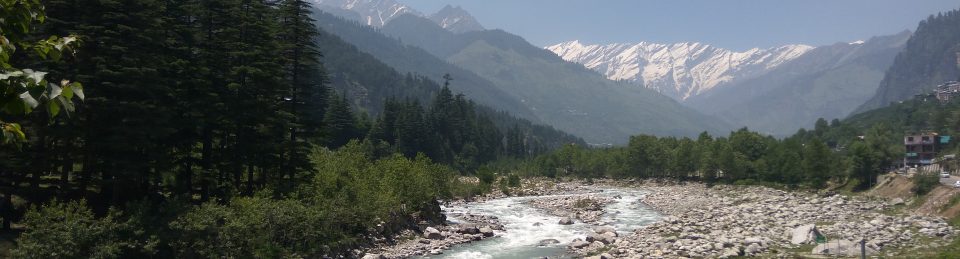
It’s hard to describe just how much space cars take up because we’re so accustomed to them. Mammoth parking lots in a housing crisis don’t make sense, but they’re everywhere. It should strike people as wrong that property is valued by the square foot, but the city hands out countless sports for free parking.

In a very basic sense, let’s just talk about the figures. Toronto is 630 kilometres squared. Stats Can only has stats on how many vehicles are in Ontario, not Toronto. Estimates peg the total at 0.9-1.5 per household—needless to say, there are well over one million cars on Toronto roads. The average car is, say, 15 feet long, 6 feet wide. But you can’t just park cars tip to tip, so they essentially require more space they actually take up.

When driving, cars require an even buffer around them. Take the physical space on either side of a car that needs to be void for the driver to feel comfortable passing through—that’s a car’s real width. In other words, a 6-foot wide car is in effect 8-feet wide, or wider.

Imagine how much accustomed we are to sacrificing space on our lawns (driveways, parking pads), or even building structures specifically to house cars (garages). Cars take up so much room at both ends of their drive. They go from one designated spot to another, which means every every trip requires a special accommodation at each end, which usually results in a huge oversupply or undersupply of parking.

No place can always supply just the right amount of parking! If stadiums have sufficient spots for the game, they have way too much parking 98% of the time. Malls have enough parking for Boxing Day, which happens once a year, if ecommerce hasn’t made parking unnecessary. Downtown only has so many parking spots available because that’s where most of the stuff in the city is, so when there’s a big night on the town, there likely are way too few spots. There should be a parking shortage, in other words.

Stable harmony is hard to come by because cars come in spurts of waves, not constant waves. There’s morning and afternoon rush hour and, say, a Jay’s game bringing thousands of commuters some days but not others.

The physicality of cars themselves are the reason cars clog cities. There’s no way for cars to at once be in the world and yet not take up space in it. There’s no way for over a million cars to be in the city without sacrificing the space over a million cars take up. Remember, a car’s footprint is magnitudes larger than the car’s size!

I just read an article saying the average Canadian spends 3 days in traffic a year. A year is 365 days, so this is approaching 1% of life. Billions get drained in lost productivity because we are scrunched between cars and cannot get away from the other cars on the road to our destination.

Every driver imagines a rout with no cars on it, then they’re shocked, shocked, when the roads are filled with cars. They act like bad traffic is a surprise even though gridlock is expected to the point reporters specifically report on traffic! That there is such thing as a “traffic reporter” is an indictment of car culture we’ve come to accept. It’s proof cars as a mode of transportation are an utter failure.

No amount of tinkering with traffic lights will solve gridlock because the problem is the number of cars, not how they move.

Induced demand is the idea that widening roads encourages more people to drive, which offsets any gains the additional space from the widened road once provided. Therefore, widening the roads is doomed to fail. You can’t widen roads forever not only because it doesn’t work, but because the city is only so big.

Something like 20% of Toronto is roads. A fifth of the city! At some point, a city needs stuff for the roads to lead to. It shouldn’t all be converted to roads. Which neighbourhoods get selected to be the site of new highways? Phrased this way, I suspect the answer is clear. That marginalized people are the first victim of car culture is true across America, Toronto, New Delhi, and beyond.

Low caste people get pushed aside to build a “flyover” in New Delhi just like Black neighbourhoods were razed to build highways post WWII. So it’s not just a question of how much space cars take up, but whose space it is.

If you look at the stark wealth divide on either side of the Allen in Toronto…I mean, it’s hard not to notice roads are pretty much a literal class barrier, or at least a demarcation of class. Even if you try to just talk about the space cars take up, eventually you need to talk about whose space it is, and it’s an unsettling conversation. It’s no coincidence that the first communities displaced for highways are also the least served by public transit.

Today, Toronto celebrates the public backlash that stopped developers from extending the Allen through Cedarvale and the Annex to connect with the lakefront highway, led by Jane Jacobs. This was of course a victory, but the shame is most neighbourhoods can’t similarly defend themselves.

Add up all the space taken up by roads, parking lots, driveways, parking pads, highways…no electric vehicle fixes the problem of how much space cars consume. As it’s said, if the future of cars is electric cars, the future of cities is car-free. We need to stop relying on cars and build infrastructure that assumes people won’t be driving.

Most drivers are in a car alone, while busses and streetcars take dozens of people. Sure, busses are fuller at some time than others, just like roads are full of cars at rush hour but are totally empty at other times.

But we need to move people, not cars. That’s what efficiency means. There’s nothing less efficient than making everyone effectively 4000 pounds, 6 feet wide and 15 feet long.

People are so attached to their car today because our brutally underfunded public transportation system isn’t reliable or pleasant. The cycle moves in both directions at the same time: because public transportation sucks, people all but need their own private vehicle to get around, and because so many people own a car, they’re happy we widen roads and neglect the TTC, even though a vastly improved and properly funded public transit, as well as safe active infrastructure, offers the freedom promised in car ads.

It’s understandable but sad how many people enjoy their alone time in their car, and see it as a calm period to listen to music, podcast or an audio book. I don’t mean to scold people who really like their car and enjoy this time! But they love their car the way a person in a storm loves their safe haven. Highways are the storm, not the haven, and this endless cycle of governments spending billions to make the storm worse, then people personally spending tens of thousands to find shelter from the storm, only perpetuates the problem.

So I get that in this obscenely car-dependent world you like your car, of course you do!

But if we can’t agree that cars with just a driver in them effectively make that single person 15 feet long and 6 feet wide and weigh about 4,000 pounds, and that it’s impossible to expect free-flowing roads when you do this to millions of people in the city simultaneously, we won’t be able to agree on anything.

As the popular adage goes, “cars aren’t in traffic; they are traffic.” Toronto doesn’t have space for this many cars and this many people and we need to choose. The choice should be an automatic slam dunk, but doug ford’s decision to enrich donors by increasing sprawl and paving over the Greenbelt is corrupt (that’s another article!), dangerous, braindead, and proves we’re going down the wrong road.

Long-Term Don’t Care: a Doug Ford Crisis

21 Saturday May 2022

Posted by jdhalperin in Uncategorized

≈ Leave a comment

Tags

doug ford, Ontario Election 2022

Photo Credit: Vlada Karpovich via Pexels

Canada had a relatively low COVID mortality rate compared to other OECD countries, but residents in Long-Term Care (LTC) died in disproportionately high numbers. To be clear, it’s not that COVID killed LTC residents in greater numbers here than it did young people because older people were more susceptible. It’s that LTC residents in Canada died in vastly higher percentages than LTC residents in other OECD countries.

Canada’s long-term care problems extend beyond Ontario, but our country was uniquely dangerous for seniors in LTC compared to other similar nations, and Ontario was and is a particularly dangerous province. In Ontario, seniors in for-profit LTCs were substantially more lethal.

Doug Ford’s ministers didn’t do much for LTCs when the virus hit in 2020. The Ministry of Health and Ministry of Long-Term Care submitted their reports, memos, and briefing notes concerning COVID-19 and long-term care to the CBC, which determined it sat back and was ill-prepared.

By May of 2021, 70% of all COVID deaths in Ontario were in LTC settings. This number has only gone up.

Doug Ford promised an “iron ring” around LTCs on March 30, 2020. He did not create one. A 2021 report by the Canadian Armed Forces led to widespread outcry as a picture emerged of seniors dying preventable deaths in “horrifying” conditions. Think cockroaches, dehydration, patients with ulcers neglected in beds, staff wearing contaminated gear. The backlash was so intense even Doug Ford promised an investigation and accountability. He had said the investigation was already underway, when in reality it had never begun and would never begin.

Instead, Doug Ford rushed to create a law protecting privately-owned LTCs from lawsuits. He claimed the law would protect all businesses from unnecessary lawsuits that could bankrupt them. That explanation seems a little convenient given the conservative connections to privately-owned LTCs.

For example, the former Conservative Party leader Mike Harris has sat on Chartwell’s board since 2004, and has made great piles of cash by reducing regulations and oversight. IE, cuts made prior to COVID resulted in LTCs being so deadly when the pandemic struck.

For-profit LTCs hire lobbyists with conservative ties. Current MPP Melissa Lantsman was a registered lobbyists for Extendicare. The list goes on. The revolving door between the conservative party and for-profit LTCs is such that the LTC’s failures are Ford’s failures, too.

The Liberals also deserve blame for overseeing the privatization of LTC for 15 years. This isn’t all on Doug Ford, but this is a story about governments deliberately sacrificing elderly Canadians’ quality of life for shareholder profits, a pattern that Doug Ford repeats so often, it’s about the only approach he knows.

Abandoning seniors was just the first stroke.

The federal government donated COVID tests to Ontario that somehow people never received unless they were students in private schools, and instead, for months, people paid Shoppers Drug Mart and other pharmacies $30 or $40 for a rapid test countries like the UK, US, and Germany made free or inexpensive (say, $4). (Ontario Pharmacies only began handing out boxes of free rapid tests weeks before the provincial election.)

By approaching the pandemic as a money-making opportunity for government insiders instead of treating it primarily as a public health crisis to solve, the Doug Ford government ended up relaying COVID tests to the very communities least likely to get COVID, and neglected communities that needed support the most.

This is a mutually reinforcing cycle: COVID initially spread in poorer, non-white communities because people there were more likely to work in-person jobs that couldn’t be done remotely. Existing systemic injustices made “frontlines heroes” more susceptible to getting the disease. But because Doug Ford governs primarily for the wealthy, poor people had to fend for themselves, which inevitably resulted in them getting COVID in higher rates while getting no to little government support.

Doug Ford refused to give working people paid-time-off, which experts said was required so workers with COVID symptoms could stay home rather than risk spreading the disease because they couldn’t afford to not work for a day. Ontario workers had more paid-time-off before the pandemic than during it.

Vaccination rates were initially lowest in communities where spread was highest. This pattern repeats itself and has done so throughout the pandemic.

It may sound like a cliché or oversimplification to say Doug Ford repeatedly put profits above people’s lives. I am confident that the more you read about his failings, the truer it will seem. This, despite his platitudes about representing ordinary people.

The idea that “frontlines heroes” were so actively neglected by this government, left to fend for themselves while the premier essentially handed over control to lobbyists and tycoons…it’s heartbreaking and unconscionable.

I half-joke that the media backlash was fiercer when a few young people tweeted “OK, boomer” in 2019 than when seniors died in appalling conditions under Doug Ford, who reacted by changing nothing except to further cement the dangerous conditions. We need to reckon with the underlying lethal economics behind our lethal long-term care centres. Indeed, conservative ministers were buying stocks in for-profit long-term care centres during the pandemic, while Doug Ford handed out millions of tax dollars to upgrade for-profit LTCs and changed laws to let LTCs increase their rates for rooms and charge extra for private ones.

The profiteers are already inside the government; they must be voted out in June.

War, Convoys, and the Point of it All

03 Thursday Mar 2022

Posted by jdhalperin in Uncategorized

≈ Leave a comment

Tags

canadian politics, doug ford, ontario politics, Pandemic

I’m sure everyone thought a lot about life during the pandemic, the point of it all. If we were going to make it to the other side, what would we do once we got there? What is the point of life, society?

Being privileged as fuck, I was situated about as nicely as somebody can possibly be in a pandemic, and it was a fucking misery on all sides. The choice was doom-scroll or feel guilt and powerlessness at being unable to prevent what felt like society’s collapse.

I thought I was a cynical bastard, but it never occurred to me that people would oppose public health measures during a pandemic by invoking “Freedom.” The so-called “truck convoy,” which never represented the majority of Canadian truckers let alone Canadians, was fake-ass right-wing theatre from top to bottom.

Like all elements of cheap partisan political theatre, it needed some very real people to get swept up in it to give the appearance of legitimacy, and there were, but it was organized and coordinated by political extremists and violent crooks, including ex-military and ex-police. You can tell from the support it got from the alt-right shitbag pundit community that this was not a grassroots movement.

If it was actually a working-class protest, conservatives would have opposed it with every fibre of their being. The province’s conservatives have gouged workers and fought to undermine labour rights for the last 24 months of a pandemic, refusing not just what union reps said would be decent compensation but what doctors said was necessary to combat the pandemic–ie, paid sick days. Not even a global pandemic could shake the conscience of doug ford. The conservative support for the convoy was all the proof a person could want that the convoy was in no way working-class. Elon Musk, perhaps the world’s richest person, vocally supported it too.

The alt-right were deliberately conflating the right to protest with the right to park enormous trucks in very tight public places. Just like “50,000 truckers” became maybe hundreds at the pinnacle of that fake-ass protest, the presence of trucks made the size of the protest seem a lot bigger than it was. The physicality of the trucks compensated for the relatively low number of people.

All of this felt foreboding at the time. I saw a picture of a maga militia member (three-percenter) in camo fatigues and patches standing at University and College. The flags with swastikas, confederate flags, and other hate symbols in Ottawa have been well-documented.

But it feels small now that war has broken out in a major European city. Russia’s invasion of Ukraine is horrifying for reasons too obvious to state. Seeing trucker carlson of faux news go from promoting the convoy to defending vladimir putin after the invasion…

Alt-right ratfuckery is all connected. I’ve seen rabid social media support from the same accounts for the so-called truck convoy, putin’s invasion, modi’s hindutva pogroms, the January 6 insurrection on the US capital…they’re all inter-linked.

Condemning the war is inevitable, but what else is there to say?

Despite everything, the crushing hopelessness gives way sometimes to optimism based on my belief that normal people are doing amazing things behind closed doors, in their private lives, things which will never be reported. Little things to cheer up those around them, support people. From community solidarity, people helping strangers and kin.

I’m not saying that these good and great private deeds will be enough to overcome war, the inherent violence of alt-right politics, end the pandemic, or fix the climate crisis. It’s just that people genuinely give me a good feeling. Being cynical about politics is reasonable right now, too utterly reasonably, but that’s not the same thing as misanthropy. I love people and always will.

I’ve had spiritual musical-revelations lately involving Parliament Funkadelic and somehow, not to be flippant, but this to me feels like the kind of thing that can fill in society’s hollowness. I’m not sure what the point of North American society is. It feels wasteful and dangerous in a stupid, vulgar sense.

The things people commonly point to as the crown achievements of civilization feel to me not just bad but anti-civilized. A legal code is an achievement compared to what you find in the jungle, but ours enshrine and protect racism as basically its central premise. Our technology is advanced, but it only exists for advertising, which in turn only exists to sell things probably unsustainably-produced things made by horrifically exploited people, if not outright slaves. Phones make people miserable, they’re expensive, and wasteful. Cars are sophisticated machines that can be beautiful and convenient, but they waste resources to a shocking degree, are the sole source of murder-inducing traffic jams, and they injure or kill people every day. Gas is rising in costs and our corrupt premier does everything possible to lock-in cars for the future in a way that disfigures the natural world, solves 0 problems, causes new many problems and exacerbates old ones, wastes billions of dollars, and benefits nobody except his oligarch donors and pandemic profiteers like galen weston (ford nixed public charging stations and is now putting them at en routes which galen weston owns; ford received COVID tests from the federal government, which mysteriously never got distributed, while galen weston sold COVID tests for $40).

During the pandemic my apartment got broken into while my girlfriend and I were asleep and her car was stolen and totalled, I developed shingles from stress, our place had roaches and neighbours who made my gf uncomfortable, we had to finally move apartments and after a year of not seeing anyone got COVID from the movers pre-vaccination Dec 2020, my GF broke her collar bone in a bike accident…still, I feel fortunate, humbled, grateful to be alive.

I can’t be the only one who has wondered, am I depressed, or is this merely a reasonable reaction to this moment?

We are governed by culturally impoverished aristocrats who don’t give a fuck. John tory, ford, and trudeau are all spoiled sheltered nepotism hires. If a private equity firm could take human form, it would take basically these human forms.

I’m from Forest Hill, I grew up anything but a radical leftist. Indeed, if anything, my upbringing only helps me to recognize a tycoon politician on sight. Toronto is lopsided as hell, and deliberately so. The mayor of a city where housing costs rose 28% in one year claims to be fighting for affordability? Our leaders aren’t failing to do what’s right, they’re successfully doing wrong.

So long as we continue to elect slum landlords as our representatives, who cancel public service under the guise of “savings,” homelessness will only grow and increase in severity and life will get harder and more brutal. I also feel like upper class people are miserable here, too. Depression is everywhere. What is the point of this city?

Either you need to rent a home to people to gouge them (ie, be a landlord) or be gouged yourself. Fuck or be fucked. Housing should be a human right, not a retirement strategy. If this is a wealthy society, what is the point of being wealthy if people need to either live on the street or stress about a mortgage their entire life?

Is it better to be a hammer than a nail? Maybe, but that’s a false choice, and the hammer is stressing over failing to live up to inflated, vulgar, unrealistic class expectations and feeling like shit because at heart it knows to “make it” in this society may involve causing harm to oneself or others or both.

I’m glad organized religion has lost its central position in society, but this is a society that doesn’t value human life or culture properly or at all. A spiritual crisis underlies our political ones. I encourage everyone to be outrageously nice to each other, read novelists like Roberto Bolano or Tolstoy or actual political writers and academics not the disgraceful postmedia blowhard class, and listen to deep funk and spiritual jazz very loudly on the best speakers you can access. Pamper your own soul, because we’re all going to die some day and you owe it to yourself. The point of life has to involve loving other people, friends and family and neighbours, but love for the species means spreading the work of our best artists and contributing to the life of the soul.

People need to come together now, at whatever stage of the pandemic this is, and that means privileged people with power need to condemn the racist violent barbaric tycoon politics being conducted in our name and exchange it for something genuinely peaceful, civilized, and cultured.

The Breakup Suite, by Trevor Abes — Poetry Review

19 Monday Apr 2021

Posted by jdhalperin in Uncategorized

≈ 1 Comment

Tags

TheBreakupSuite, Trevor Abes

The series of poems contained in Abes’ beautiful collection is almost too raw emotionally to be judged fairly in aesthetic terms, yet the language is undeniable. The Breakup Suite is about exactly what it sounds like.

You seldom ever see someone else at their lowest emotional moment, fresh after a breakup of a 5-year relationship, and if somehow you do, you don’t expect it to be written about at all, let alone like this. You expect the person to be a fucking mess, yet the outpouring of a heart here is graceful, measured, balanced, contained.

The poems are as much a triumph of spirit and resolve as of language. The love of writing is as palpable as Abes’ love for “E.”

I felt like, for Abes to move on in life, the sentence and the sentiment had to be pitch perfect. Working out his own feelings and expressing them just so was the same act.

Which writer said, “I write so that I know what I think.” Whereas poets and writers may sometimes select frivolous subjects or go on sentimental trips, the stakes here are high. Abes writes poems where another person may go on a bender, with the same level of sobriety and reflection that the debauchee invests into getting drunk. He’s responding to devastation by trying to master his emotions, not get conquered by them.

The result is poetry that documents the collapsing of a shared rich, complex, loving inner world without any such collapse in the poems. That these poems can face the onslaught of raw emotion like this and endure suggests the poet can, too.

Talking about the actual breakup feels like I’m cheapening out on the language, which is continually impressive. The love felt is inspiring, even if it’s over now. The poems come almost as a secondary accomplishment, like, they’re great, but, holy shit, this poet really knows how to love someone and live life!

Abes says in the intro that maybe these poems could help someone else who is reeling after a breakup, but the world of love he describes is, well, lovely. That it was written during COVID is incidental in a sense. It mattered to the couple in their lives, not to the poems per se.

“The number of hours I’ve spent worrying
About whether or not I’d ever be able to ignore your Facebook and
Instagram to get a taste of the life we had even though it stirred my guts
to tears…
It’s not embarrassing so much as evidence of how I loved you big enough
To not take insurance out on us…”

-Excerpt from When Hope Returns

The language is precise but modern and matter of fact, not overblown ornate Poetry. It’s honest and unassuming. Sensitive, but tough, and even muscular in its sensitivity. If being raw and vulnerable, open and honest at your deepest point, is a tough form of modern masculinity, The Breakup Suite lays a blueprint.

These poems contain a slice of love as charged as you’re likely to find, and, despite Abes’ contention it may only be suitable for people fresh off a breakup (“poetry for the dumped”), these are simply very moving poems. In the way you can listen to the blues even if you woke up this morning and all you had was not gone, anyone can and should read these poems.

Writing them was a courageous act.

If you’d like to read The Breakup Suite, please email transfer $10 to Trevor (trevorstevenabes @ gmail dot com) and he’ll send you the PDF, or you can order a copy of the physical book from Amazon.

Disclosure: Trevor and I briefly worked for the same company in 2019. We’ve met exactly once, at a staff party. I describe the extent of our relationship because a review this positive may sound like sponsored content. It’s not! Only, had we not worked together, I wouldn’t have found his poetry.

Ode to My Grateful Dead T-Shirts

01 Thursday Aug 2019

Posted by jdhalperin in Uncategorized

≈ Leave a comment

Tags

Bootleg Ts, Dead shirts, Grateful Dead T-shirts, Jerry Garcia

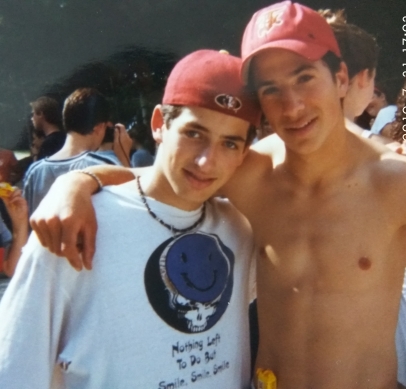
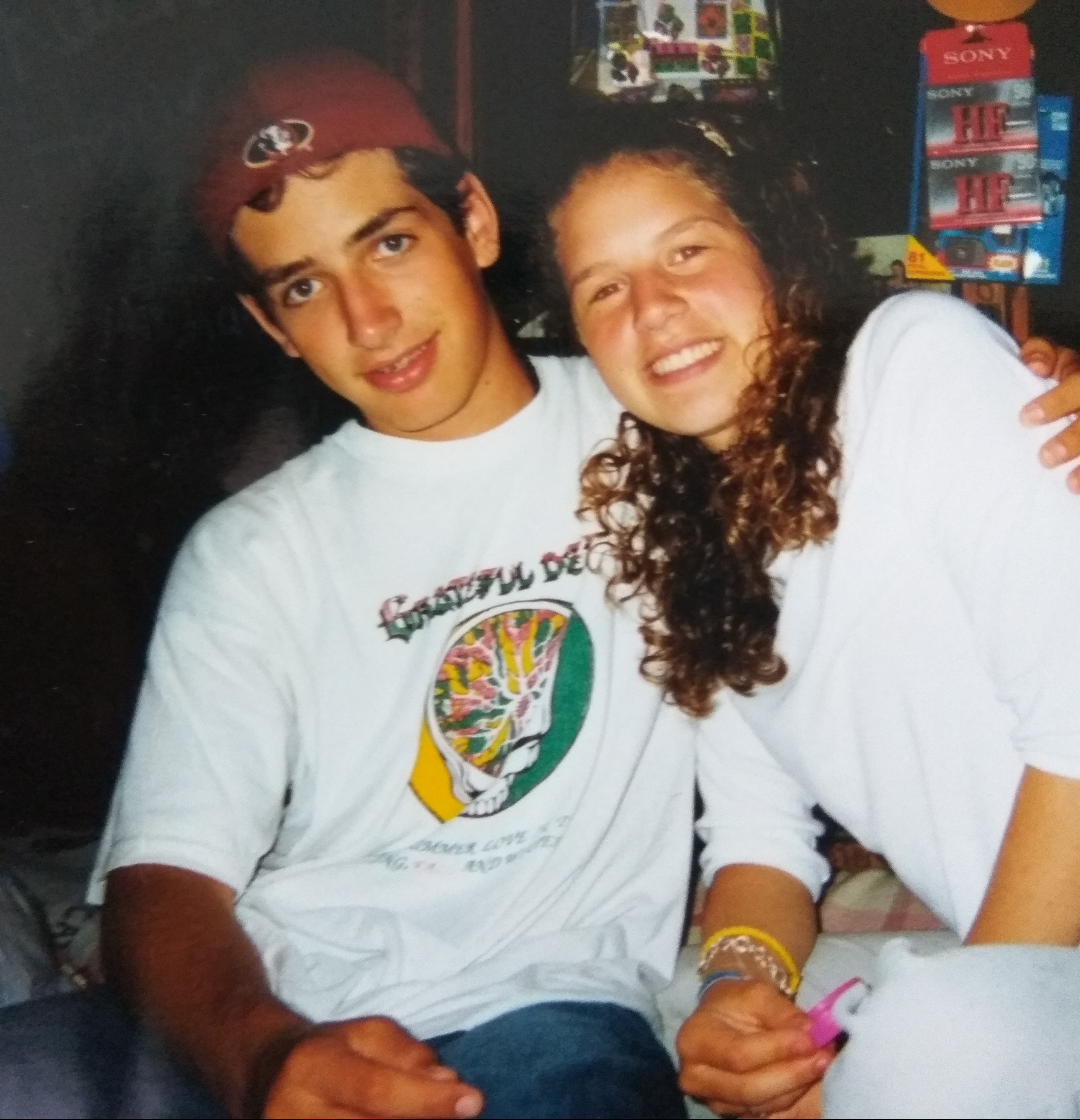
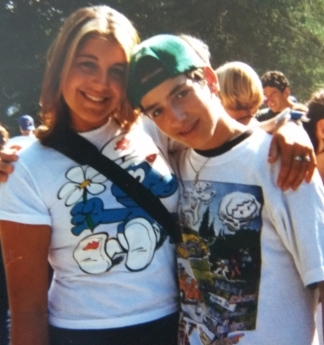
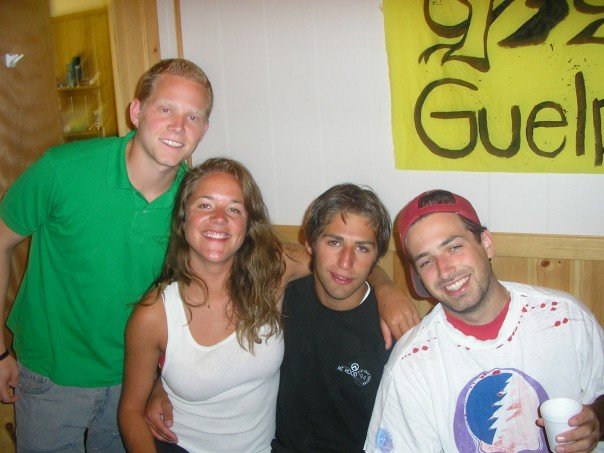
Looking through pictures from overnight summer camp a while ago really made me miss, of all things, my old Dead t-shirts. I wore a dead t-shirt consecutively every day between 1997-2000.

Bootleg Grateful Dead t-shirt culture has been written about at large. In my day I competed against CWP counselors for who had the coolest Jerry shit and the best tapes. I  held my own.

Today is August 1, Jerry’s Bday: happy birthday, big guy! Love you forever! In honour of it I’d like to catalogue My Dead Ts for posterity, with pictures where possible.

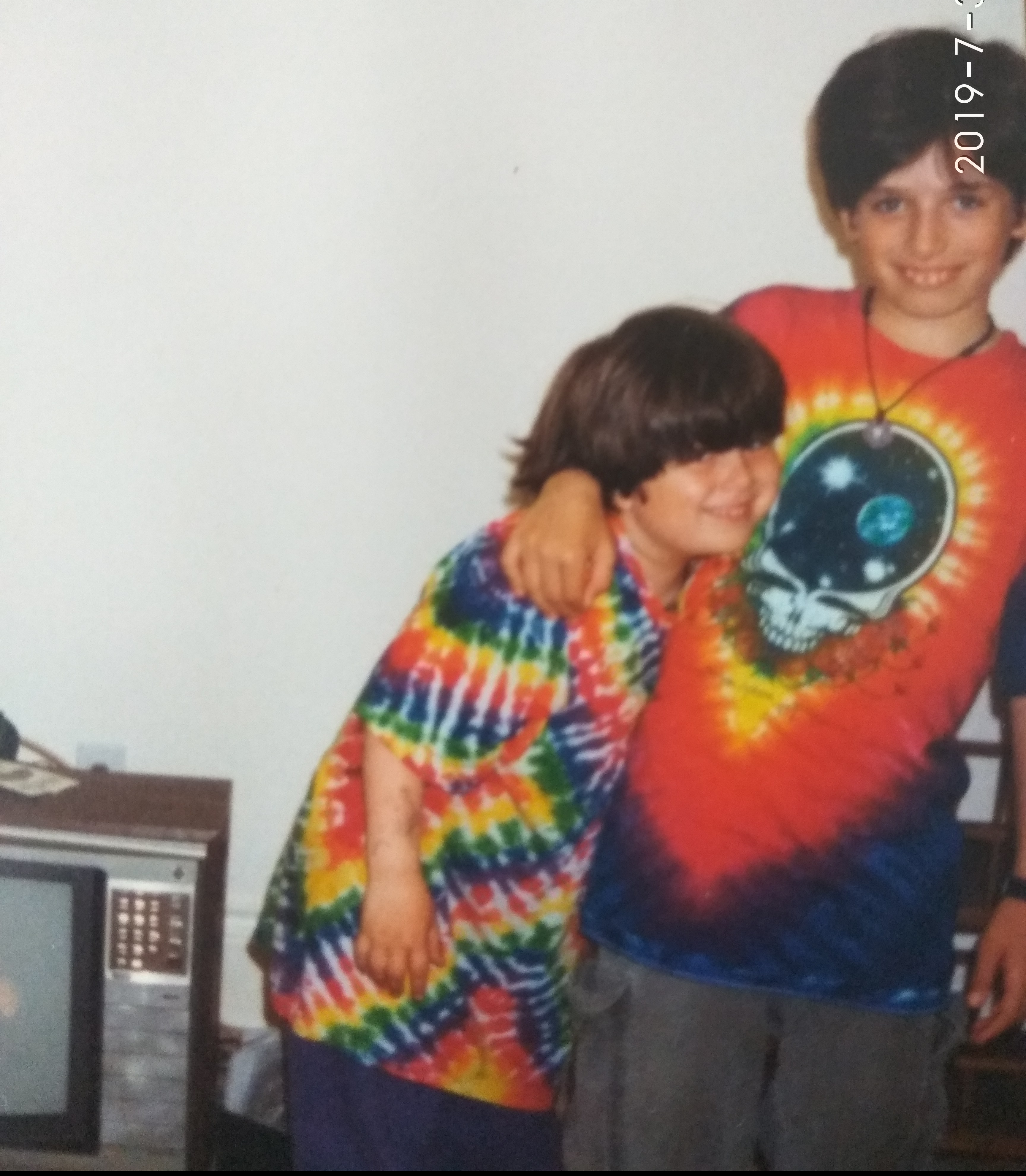
  1. “Space Your Face”—First Dead T, acquired in 1994. Standard Dead Skeleton with cool space shit inside it. This is me and my younger bro. This pic shows how long I’ve been in the game!

IMG_20190731_170350


2. “You know our love will not fade away”—Silhouette of Jerry’s face with lyrics from Not Fade Away on the back. Purchased in Vermont by my parents on a trip in ’95 or ’96.

3. “Nothing left to do but smile, smile smile”—This T was given to me by a family friend, herein called The Source, which he got from the parking lot of a Jerry-era Dead show. I got it in 1996, an early long-sleeved gem. Black and purple on either side of the stealie, with a smiley inside and the lyrics from He’s Gone, “Steal your face right off your head,” underneath.

IMG_20190731_170337

4. Sugar Magnolia T—Stealie with green and yellow on either side of the lightning bolt. Underneath was lyrics from Sugar Mag, “She’s my summer love in the Spring, Fall, and Winter…” Tour dates on the back from Fall 92 Dead tour. Shirts like this get reproduced today, but you can’t find ’em like this anymore.

img_20190731_170238.jpg

5. Blue tie dye, Skeleton with Roses—Blue/white tye dye. Acquired from The Source. I’ve seen this shirt on other people, but it was cool! I had the same image on a window sticker that’s still beautifying my parent’s house.

6. Deal T—Jerry-era parking lot T from The Source featuring a cartoon Jerry playing poker against cartoon skeletons, with the lyrics to Deal in bubble letters. Tour dates from 92 Tour on back. This was the best shirt of them all! In 1999 I happened to be wearing this shirt at a Merl Saunders concert, who played keys with Jerry in the Legion Of Mary. Merl sang Deal that night and I was in the front row, pointing to the lyrics on my shirt he was singing. He smiled. RIP, Merl! I wish I had a picture of this T somewhere!

7. VW Busses—Lot shirt from The Source. Dates from 90s tour on back. Everybody who saw me was envious of this BEAST of a shirt, and I’d kill to have it back and in good condition (I wore it to shreds). It was the best shirt I or anyone else ever owned.

IMG_20190731_170245

7. American Gothic Skeletons—Classic Grant Wood American painting rendered in Grateful Dead styles, a male and female skeleton farmer in tie dyes and overalls, etc. Lot t-shirt given by a good friend’s older brother—Source 2. This shirt was COOL!

8. Yosemite Sam Dead—frosh shirt from early 90s, inherited from Source 2. You can’t see the ‘stache on the skeleton, but it was there alright.

yo sammity sam Dead t

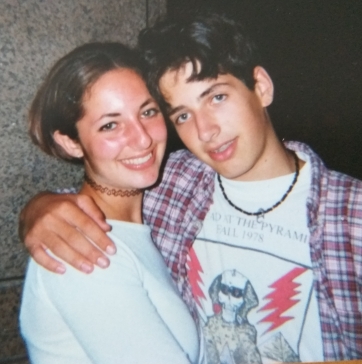
10. Blues for Allah—Dead at the Pyramids Egypt t-shirt, acquired in 1998. “What good is spilling blood, it will not grow a thing.” A friend bought it for me when she visited Israel. I still have this shirt!

IMG_20190731_170232

11. Warrior skeleton—this low key Dead T-shirt had a pic of a skeleton on horseback wearing native regalia, on his shield was an ad supporting the Rex Foundation, named after a Dead roadie who died. Acquired from The Source.

12. The Wheel—Jerry Bear riding a motorcycle, green tye dye. I gave this to a close buddy and devoted Dead Head. I got a lot of shirts in my day, more than I gave away.

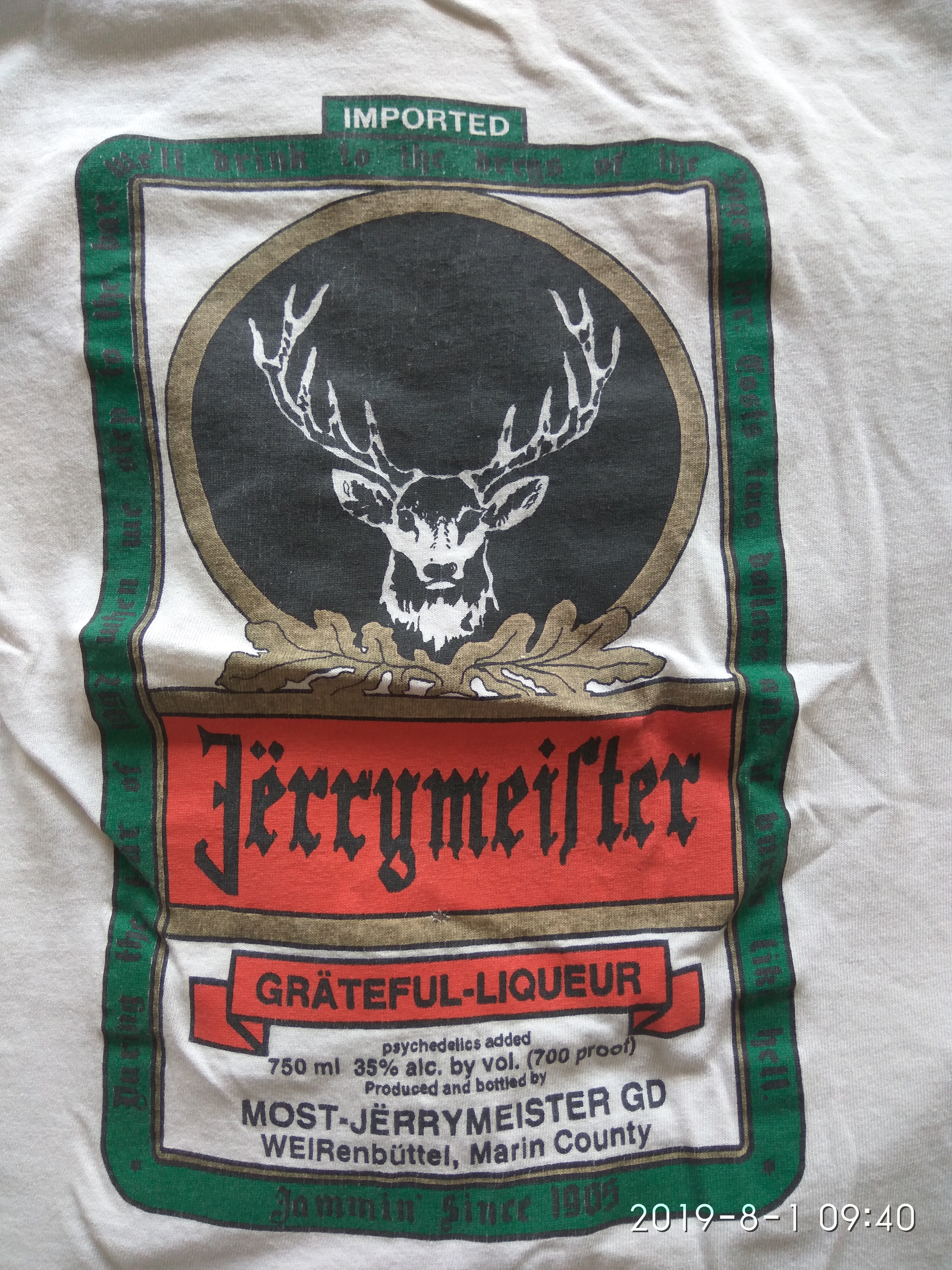
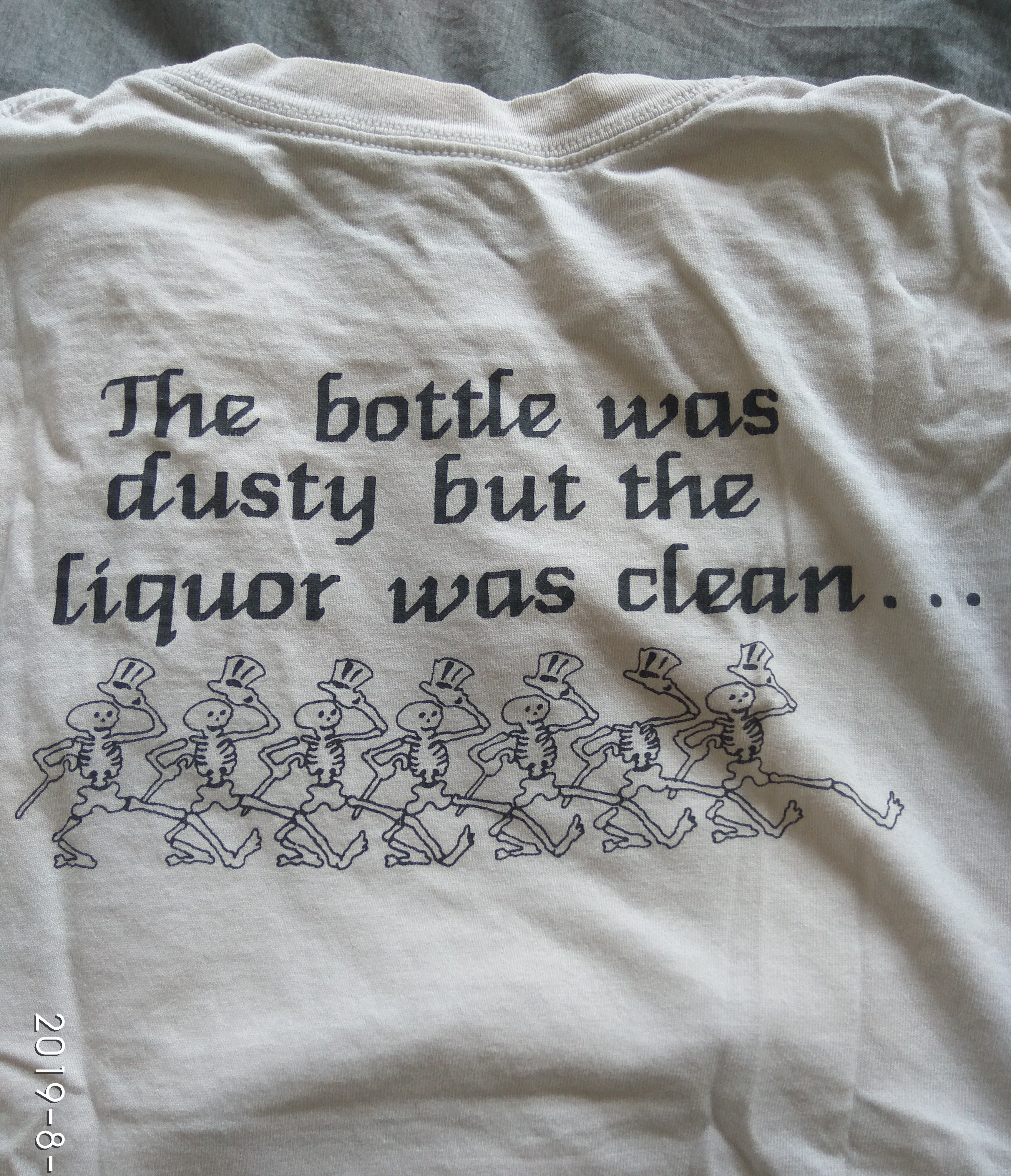
13. Jerrymeister—people think this is a booze shirt, but it’s Jerrymeister. Lyrics from Brown Eyed Women on the back. Purchased at Grateful Fest in Ohio, ’09.

IMG_20190801_094037img_20190801_094058.jpg

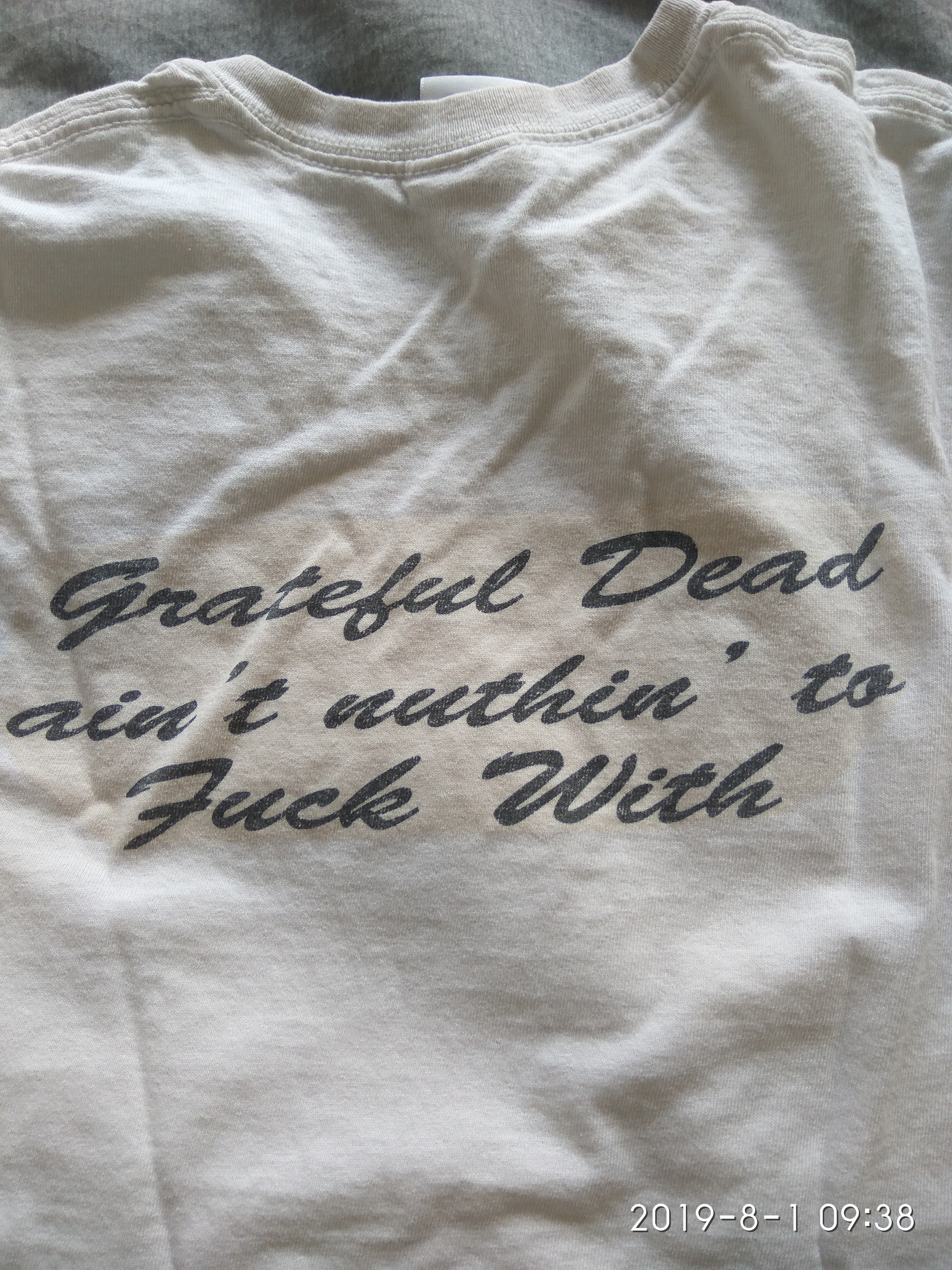
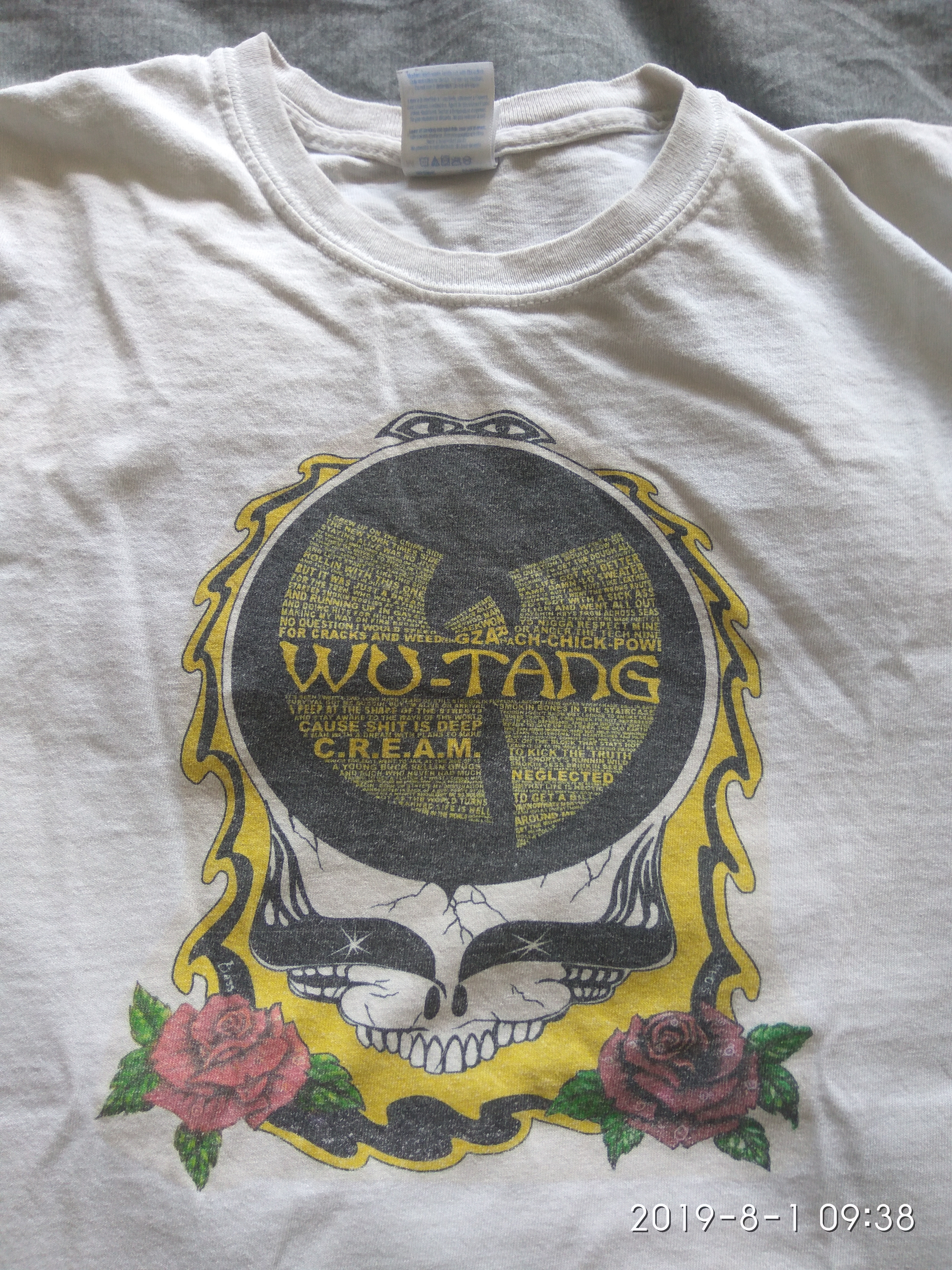
14. “Grateful Dead Ain’t Nothin’ to Fuck With”—Dead and Wu Tang mash-up. Phish show parking lot, SPAC, ’14.

IMG_20190801_093835.jpgIMG_20190801_093814


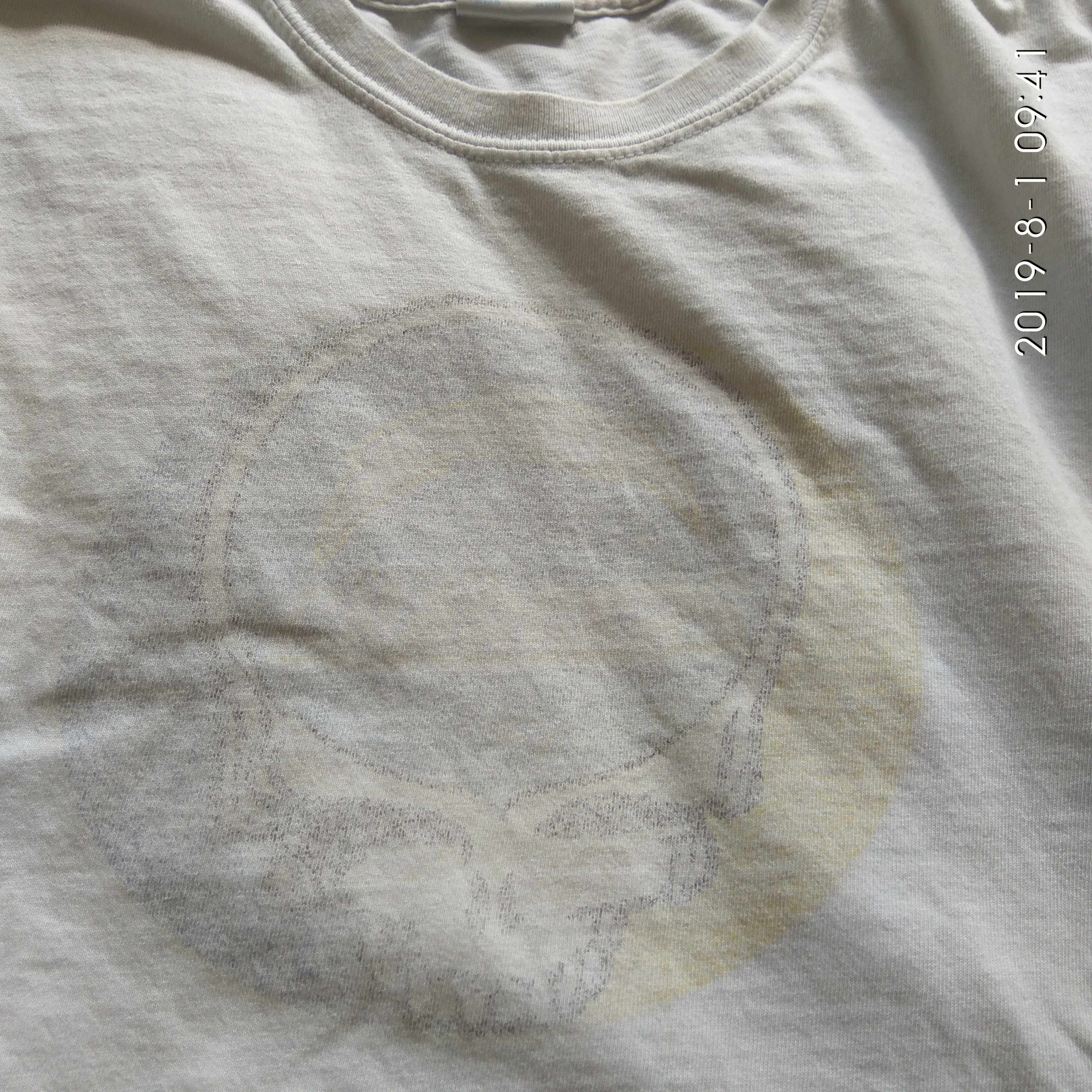
15. San Diego Chargers/ Stealie—Chargers/Dead mashup. Grateful Fest, ’09. Pretty much just a white t-shirt at this point.

img_20190801_094121.jpg

16. Ohio Buckeyes/Stealie—Dead/Buckeyes mashup, Grateful Fest ’09. Gave to a beloved friend.

17. Pink/Salmon Jerry Stealie—from Grateful Fest, ’09. It’s a nice thick cotton piece, of higher quality than other bootleg shirts, which you come to appreciate after a while.

img_20190731_172418.jpg

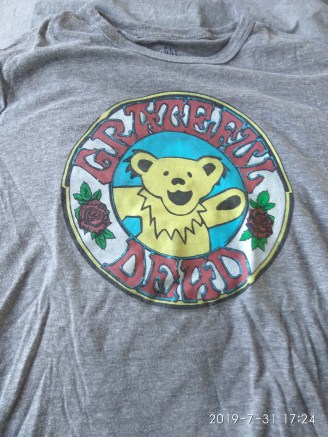
18. Jerry Bear—this one was a gift, a friend saw it at The Gap! Weird, but hey. Dead shirts once supported people in need of money to see more Jerry shows and now it’s sweatshops, but this shirt does

IMG_20190731_172429.jpg

19. Sphinx Jerry Bear tie dye—This had a Jerry Bear as a Sphinx, and there was a pyramid or two. I vaguely remember getting it at Kensington in the 2000s. Looking through pics I saw it. I also had another Space Your Face tie dye, and probably some others I can’t remember to be honest.

random tie dye

20. Cats Under the Stars: I got a JGB T-shirt in San Fran in 2012, with the famous logo from the Cats album.

Honourable Mentions:

You get to spoon with Jerry every night when this is your blankie. Acquired in late 90s from The Source, who I understand got it from Haight/Ashbury.img_20190801_095657.jpg

Technically this is not a Dead shirt. My good buddy, younger brother of Source #2, is seen rocking a serious tie dye skiing/snowboarding Jerry Bear shirt.

save_20190731_230011.jpeg

← Older posts
Newer posts →

Twitter

Follow @JDhalperin
Tweet

Enter your email address to follow this blog and receive notifications of new posts by email.

Join 1,022 other subscribers

Essential sites

  • Grateful Dead Chords/Tabs
  • Neil Young Chords/Tabs

My Writing

  • Huffington Post
  • Maclean's
  • Music Writing
  • The Star
  • the Walrus Laughs
  • Toronto Review of Books
  • Toronto Standard
  • World Is One News

Topics

  • Comedy (18)
  • Literature (13)
  • Politics (27)
  • Sports (16)
  • Statements (36)
  • Uncategorized (44)

Create a free website or blog at WordPress.com.

Privacy & Cookies: This site uses cookies. By continuing to use this website, you agree to their use.
To find out more, including how to control cookies, see here: Cookie Policy
  • Subscribe Subscribed
    • Jeff Halperin
    • Join 52 other subscribers
    • Already have a WordPress.com account? Log in now.
    • Jeff Halperin
    • Subscribe Subscribed
    • Sign up
    • Log in
    • Report this content
    • View site in Reader
    • Manage subscriptions
    • Collapse this bar
 

Loading Comments...