As a white guy in India, I experienced things that’d never happen to me in Canada, things I’d never dream possible. Some small, some big. Some very nice, others…weird and not so nice.
Let’s start with the fun innocent stuff. My local grocer in Lajpat Nagar II added me on WhatsApp and over the next few weeks and months sent me pictures of textiles and pillows made by his daughter, festive messages on Hindu holidays, and poems written in Sanskrit. I asked a dude in Defence Colony for directions once, and he told me to just hop on his scooter and took the time to drive me all the way there himself.
There’s a warmth and simplicity that’s refreshing and genuinely lovely! People in Toronto, like many big Western cities, cannot be counted on to be so effusive and kind. We’re nice here too, but busy and stressed and sometimes appear cold and distrustful.
But when you look closely under the hood at the favourable treatment I got, it’s not always healthy. I have one such example I still think about a lot, and regard it differently now than I did then.
I visited New Delhi’s Red Fort in 2016, a UNESCO World Heritage Site for being the historic seat of power for about two hundred years when India was ruled under the Mughal Empire, before the Brits. That day was amazing. The architecture was thrilling, you could feel and walk through the history, and it had the same architect as the Taj Mahal, though there’s way fewer tourists, so being there is very chill and relaxing. You have more space and time.
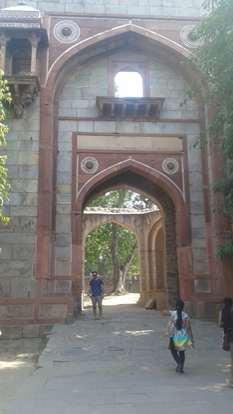
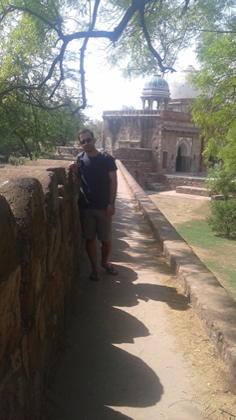
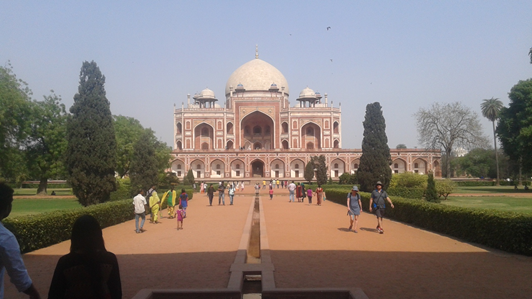
But here’s where it gets weird. While there, for no apparent reason and very much without my asking for it, something incredible happened: a stranger handed to me the most precious thing in his life–his child.
He didn’t speak English, so I’m still not sure what this was all about and I’ll never know.
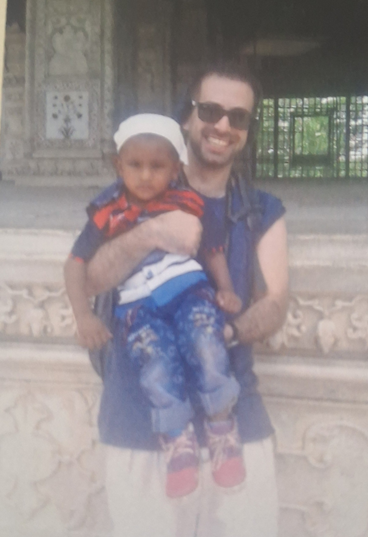
As I type this in Toronto in 2026, I struggle to believe it really happened. It seems so far fetched. This sort of things just doesn’t happen to me here! I don’t think I’d truly believe it without the picture.
Why did this happen? I have some theories.
Maybe I was the first white person the man ever saw, and a novelty. That’s happened to me before. One time, driving in South Delhi, a hijra asked to touch my face because she had never touched white skin before, so I obliged. When she asked if I’d marry her, I had to let her down easy. (I was in the car with my friend who speaks Hindi and translated all this.)
Anyway, the New Delhi metropolitan area has about 33 million people and its fair share of white ones, but they’re not evenly distributed geographically. As the capital of India, there are posh areas where local politicians, foreign diplomats, tourists, and immigrants (excuse me, “expats”) hang out. It’s not surprising to see white people in places like Paharganj, Hauz Khas, Khan Market, Lutyens, or Connaught Place, and Indians there didn’t usually seem visibly excited to see me, which was fine by me.
Maybe tourist sites like Red Fort were different because they attract rural Indians who haven’t seen many, or any, white people. I did get hit up for rupees more in places like Qutb Minar in Delhi or the Taj Mahal in Agra.
Strangely, even the street kids who swarmed my car window for rupees stopped doing so after a few months in Delhi, as if they somehow knew I was no longer the naïve target most white people are upon arriving in India. (Not only will giving them money attract more kids asking for money, which then becomes a scene, but it was explained to me that the kids don’t keep most of the money; it goes to a handler, who in turn gives a cut to politicians…apparently, this thing goes all the way to the top.)
But to return to the point, what does it mean that a stranger gave me his child?
One thought I’ve had a lot since is, “If this man ever came to Toronto, I know that no white person would ever give their young child to him.” Of course, not handing a stranger your child is perfectly understandable! That this is a one-way street says something though. The thought I had was true in 2016, but it’s even truer in 2026, as Canada has seen a sad, despicable surge in anti-Indian racism and anti-immigrant sentiment in general. But that’s another, larger topic.
In my mind, I was just a dude walking around seeing the sites no different than anybody else, but let’s be real: I was a white guy walking around India. Of course I was different. It doesn’t matter what was in my head: race and racism reside externally, they’re in the world. There’s no way I could have conceived of my skin colour that would have changed how everybody else did, or how they responded to me.
The attention, the reactions I’d get in tourist spots and elsewhere in India from total strangers could be so bonkers that pretending whiteness didn’t matter wouldn’t just be wrong, it’d be silly. The very idea is laughable. It’s just so in your face and inescapable.
Maybe you’re wondering, what’s so wrong about showing kindness to a stranger, even if in an extremely mind-boggling way? In a vacuum, nothing. I joke, or half-joke, that to understand what it’s like to be a white guy walking around certain places in Delhi, you need to walk around anywhere in Toronto with a dog. Strangers fete and praise you, speaking to you in that excited high-pitched voice people speak to dogs in. They trust you automatically and assume you’re wonderful. In New Delhi, as a white dude, you don’t need the dog. In a way, I was the dog.
At first I thought my whiteness merely signalled to Indians that I was a foreigner, which activated people’s innate sense of hospitality. Maybe! Indeed, strangers I met were extremely nice, and no doubt they could tell I wasn’t from there. I’m sure many were just lovely, warm people.
So at first I was baffled and amused. But I’ve come to see this child-posing as a kind of darker thing a, negative image and reversal of the cruelty non-white people may receive in India and elsewhere.
Attributing the excessive, effusive warmth I enjoyed to people’s hospitality is a much less weird and more pleasant thing to believe in. Maybe that’s why I instinctively reached for that explanation, though I genuinely didn’t understand how rampant racism was in India, nevermind how caste worked.
I played with it in my obliviousness.
Sometimes just to mess with people for fun, when an Indian (usually a cab or rickshaw driver who spoke some English, much better English than I spoke Hindi) asked me where I was from, I’d reply nonchalantly, “Tamil Nadu.” At the time I just meant to name a different Indian state, as if despite all appearances I was from India, not Canada or The West. In my innocence I didn’t realize the implication, that Tamil Nadu is a Southern state where people generally have darker skin.
What’s confusing about all of this is that of course you get a sense that something’s off, that things are different, but that doesn’t mean you really understand what’s going on. On one hand, you’re a white person new to India—the smells and sights and sounds are all extremely different and impossibly stimulating, and you’re constantly bombarded by, among other things, a palpable sense of privilege because people beg you for money and sometimes even hand you their children. But on the other hand, you also genuinely don’t really get how things work.
As a visitor, you’re instantly wowed and sometimes disturbed by things you see, but it takes months to begin to grasp the dynamics at play. Your heart feels a lot of things before your head gets it. Much of it I still don’t get!
Maybe that guy had a different reason altogether for handing me his child, some plausible sensible reason I haven’t considered. I can’t imagine what it would be.
Over time, I’d file stories for WION about Nigerians being chased and beaten by Hindu mobs in a Greater Noida mall, I believe only kilometres away from our Uttar Pradesh newsroom. White and dark skin may both signal that a person is from out of town, but the treatment couldn’t be more different.
This is only one example, but it’s illustrative. For one thing, millions of Indians pay good money to literally look whiter. In a society characterized by caste, having light skin can practically determine your destiny. No wonder skin whitening cream is not just a product but a multi-billion-dollar industry.
There is no skin darkening cream, for obvious reasons.
The same force, or a similar one, that encouraged a man to briefly hand me his child also encouraged a mob to assault innocent Nigerian men. Thankfully I was never beaten, and while it’s a weird thing to do or have happen, I doubt Indian locals ever give their children to Nigerian tourists for any reason, however briefly.
That so much wonderful warmth and friendship I experienced among people in India is sullied by this dynamic sucks, but of course the racism sucks more. So much easygoing kindness I encoutnered genuinely filled my heart and 10 years later I still feel and cherish it! It’s not always possible to distinguish between nice-niceness and weird-niceness. India has so much to be proud of, it’s an impossibly rich culture, more like a continent than a country. And while racial dynamics can often be less subtle there, we’re anything but free of them here.
Anyway, while I seriously doubt he’ll ever read this, I hope that child I very briefly held is doing well today.



 Jeff Halperin