
Tags
Adam Feibel, Avril Lavigne, In Too Deep, Jeff Halperin, Matt Bobkin, Sum 41, When Canadian Punk Took Over the World
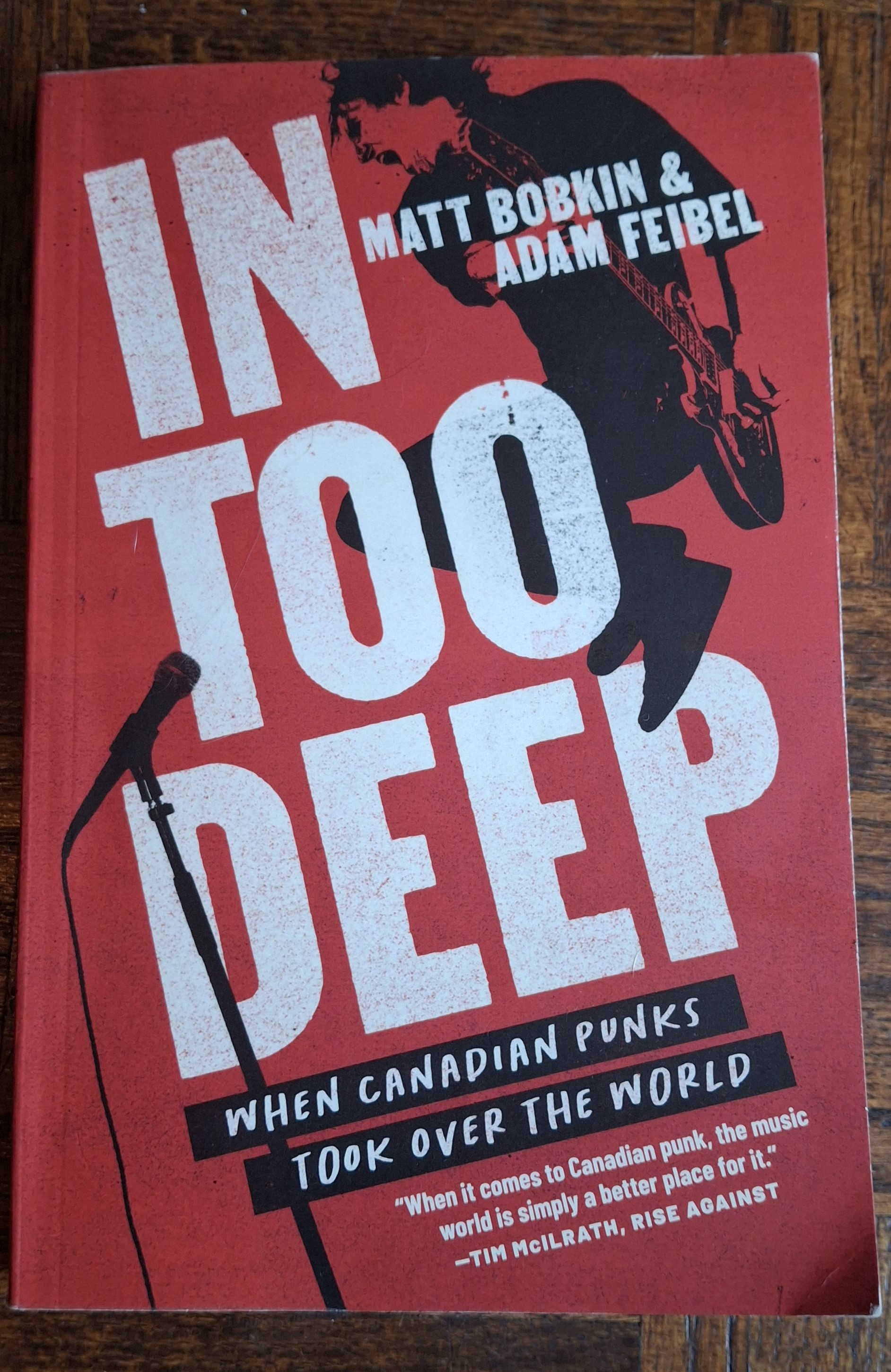
In Too Deep was a pleasure to read and made me rethink music I didn’t care for much when it came out. I was 16 in 2000, listening almost exclusively to the Grateful Dead, then had a years-long hip hop phase. Billy Talent, Sum 41, Avril Lavigne, Alexisonfire…I remember not thinking very much about any of them at the time, but I guess I was glad they were there. At least skaters and punks had something unique and cool they were into and stirred up public culture, even if I wasn’t drawn to this music.
In Too Deep has a very local sense of place involving cities not just outside the US, but outside Toronto. The authors do a wonderful job conveying what GTA cities were like for young, ambitious musicians trying not just to make it big, but just play their music for people. There’s a really sweet purity here. Before they wanted to ascend the charts, they just wanted to perform.
Bobkin and Feibel zoomed out on the scene but zoomed in quite closely on the different cities in question. There’s a real keen sense of how each group managed to find their secret sauce, balancing the sound and musicianship on one hand, and attitude and energy on the other. Creating a band isn’t just about writing original songs. There’s also practical questions of finding money for gear, postering for upcoming concerts, finding somewhere in town to play.
Reading about 9 punk Canadian bands from the 2000s was surprisingly cool because, when you get into their origin stories, their success feels far-fetched, even sitting here now in 2025, knowing that they succeeded. Even record company scouts become recurring story characters, which I didn’t expect. You can feel the authors’ appreciation for the artists and different punk scenes in the writing that struck me as surprisingly earnest. I didn’t know what screamo was.
From a musical standpoint, these bands translated something about their life, an attitude they held at a young age, into a sound. It’s less about taking music theory forward or redefining what has been done before and more about finding the right sounds of a vibe, in a way. I don’t mean to sound patronizing or belittling, I think finding the sounds of an energy is a wonderful achievement! Teenage angst, anti-authoritarianism, or the adolescent urge to just fuck around and cause a little mayhem…what do these sound like? The answer, or one of them, is Sum 41.
Music is never just about music. Fans of commercially successful music tend to get uncomfortable with the idea that something other than music is driving their favourite band’s commercial success. Even musicians themselves think along these lines. Are certain musicians really punk, or are they just contrived industry plants? Are the musicians play-acting punk musicians, or are they the real deal? That sort of thing.
Every genre faces this dilemma of street cred. Musicians get accused of imitating a type of lifestyle on stage or in the studio versus living it day in, day out. Producing sounds or music isn’t enough. Musicians are often expected to be something. Drake faces this in hip hop. Country has it, too, from what I understand.
When the musician in question is an industry plant, when their music genuinely is reverse-engineered by focus groups and executives, the question of authenticity feels essential—it protects the music and the culture. When an artist is sincerely grappling with their own feelings and instincts, and reconciling these with the conventions of the music and the culture they love, having to prove and demonstrate “authenticity” feels unfair and even silly. This books tackles these tensions in a punk context with a deft touch. It’s about the genuine sensitivities of these artists, who they are, and how they fit into a growing and changing punk world dealing for the first time with commercial success and all that comes with it.
Co-authors Bobkin and Feibel address these questions head on without dismissing the very idea of them, which I found refreshing. Questions of authenticity don’t tend to arise unless there’s big money around, and for years, punk wasn’t commercially popular. In Too Deep is also a story about a relatively new type of music coming into its own. If some new popular and successful artists like Avril Lavigne had their punk bonafides questioned unfairly, punk fans of course come from a genuine place. Feibel told me about what these bands meant to him when he was a teenager:
“Several of these were among my earliest favourite bands that got me into playing. I can distinctly remember writing songs at age 13 or 14 that were blatant ripoffs of Sum 41 or Alexisonfire.”
Hearing tales of very young people so determined to do their thing and be themselves, and have this new commercial space open up for them just at the right time…it was a nice story that played out similarly but differently for each artist. The older punks who made it and the younger punks inspired to make noise in their garage feel extremely connected to each other, as do the musicians in the book and the authors, who are also punk musicians. I found this to be very touching and even hopeful. Music is so vital in so many ways! As therapy, to help people understand who they are, whether musician or listener.
Hardcore fans of these bands will enjoy the authors’ in-depth research, expanding on known lore. Feibel told me that was what excited him, too.
“We knew a lot of their stories pretty well, but the level of previously uncovered detail that we were able to dig up from our research and interviews was fun and validating. There was lots of behind-the-scenes stuff that had only previously been summarized in, like, a paragraph on Wikipedia. Telling these stories in full like this had never really been done before, and we were thrilled to do it.”
I see these bands very differently now than I did at the time. The macro perspective you get looking back at things is a trippy concept. I’m 41 now, these people were teenagers when they broke out, but I’m also more or less the same age as the musicians. Avril Lavigne is a few months younger than I am. Am I reading about kids or adults? Both.
The section on Fefe Dobson I found sad and stirring! I didn’t understand how she was held back at the time, typecast, and am glad she’s enjoying a resurgence. I hope that’s consolation for her.
I learned a lot about punk. In Too Deep also made me appreciate how different groups of my youth, all from within like 100 kilometres or so, weren’t isolated acts but formed a musical continuum I didn’t know about despite living through. Who knew that while I was listening to Jerry and De La Soul, Canadian punks took over the world.
 Jeff Halperin