When you spend enough time observing nature, I mean really looking at it, suddenly, you begin to hear it too. The visible is apparent immediately, the audible comes second.
We love watching the sun rise or fall and love hearing the birds sing. Even inanimate aspects of nature keep us in awe, things like mountains, maybe because they’re so immovable and permanent.
I’ve been thinking lately about the secret music found in nature, and while it sounds a little kooky I’ve seen the notion echoed in two very different books. The first is A Subversive History of Music, by Ted Gioia. It’s wonderful and very wide-ranging! The second is a novel called The Wind From the Plain by the great Turkish writer, Yashar Kemal.
To what extent does nature have a secret life that can produce sounds, or music?
We’ve heard of the sounds of wind rustling through the trees, but that’s not only what I mean. The trees themselves vibrate! Let’s look at what two very different books say.
Two wonderful books, which overlap to a surprising degree
From Ted Gioia’s A Subversive History of Music: “From the start, waves of sound came not just from a primal explosion, but from the smallest particles of matter. In the heart of the atom we find vibrations of extraordinary speed—up to one hundred trillion times per second—creating a tone some twenty octaves above the range of our hearing” (page 11).
It’s not that a force like wind produces a sound by blowing through something else; that second thing itself contains its own innate sound. It doesn’t need to interact with, say, wind, water, or fire to produce a sound. Although, the sounds of the breeze through nature is indeed a common music. Many instruments people play rely on wind, too: recorders, saxophones, trumpets, etc.
It may seem less surprising, then, that later in the chapter Gioia describe Australian researcher Lynne Kelly learning to hear the wind through different types of trees, bushes, and even grasses while embedded with the Warlpiri tribe in Australia: “…when she began listening to vegetation, she found that the passing breeze imparted a distinctive aural soundscape to the trees around her. ‘The eucalypt to my left, the acacias in front, and the grasses to the right all made distinctly different sounds. I could not accurately convey these sounds in writing. In subsequent sessions, I’ve been able to distinguish between different species of eucalypt, the experience convinced me that the sound of plants, animals, moving water, rock types when struck and many other aspects of the environment can be taught through song in a way that is impossible in writing.’”
Cool! This makes me want to watch a documentar film I’ve been meaning to see but haven’t yet, The Secret Life of Plants, for which Stevie Wonder did the instrumental, atmospheric soundtrack. That documentary looks at plant consciousness, ecology, environmentalism. Leave it to a blind man to hear into this secret life. Maybe when what’s visible doesn’t jump out at you, your ear gets to work sooner.
But before getting sidetracked by my love Stevie Wonder, let’s get back to Yashar Kemal’s novel, The Wind from the Plain.
It’s about a remote mountain tribe’s arduous trek from the hills to the Anatolian plain, to pick cotton to make enough money to survive the harsh highland winter. Every year, Old Halil tells the village when the cotton is ripe for picking by using his keen senses to hear the wind. I was struck by some beautiful descriptions of nature that echoed this secret musical life of plants and even inanimate parts of the environment.
Here’s a great early passage that’s explicitly about how nature is a secret conduit for sound:
“Rustling sounds come from the steppes. Old Halil puts his ear down to the ground and listens to the murmur rising from deep deep down. The soil of the steppe is a good conductor. One can hear the creeping of ants in their heaps, the scurrying of birds in their holes. There is a bird of pure lustrous blue that makes its nest be delving deep into the cliff walls. One can hear it digging away in its tunnel. One can know when the roots of the whirling thistles are on the point of breaking by the special creaking noise they make. ‘There’s nothing like the earth of the steppe,’ says Old Halil. ‘Why, it’s better than the telegraph. Put your ear to it and you will hear all kinds of wonderful sounds. You will hear a shepherd piping at the other end of the world, you will hear a song that has never been sung before, laden with all the beauty of strange flowers. Yes, put your ear to the ground and hear the beat of horses’ hoofs a day’s journey off. But it’s not everyone who can hear the voice of the earth. It needs a good ear, a discerning ear like mine, you ignoramuses!’” (Page 18-19).
In Gioia’s book, researchers hear the music of the wind through the trees, bushes, and grass. In this Kemal passage, the vibrations travel through the earth itself and Halil hears the wind from the distant shepherd piping his song. The wind travels a longer distance. More than that, the songs are “laden with the beauty of strange flowers” in it, as if the wild flowers physically rooted between this shepherd and Old Halil are somehow converted into sound and become a part of the wind’s song. Something to hear, not just see–the flowers have a sound to them that fuses with the wind’s tune.
There’s a really cool kind of synesthesia going on! If you listen correctly, you can hear nature’s physical, inanimate parts, things normally only visible. Who knew!? This reminds me of the first Gioia excerpt, where the smallest particles of matter, in the heart of the atom, vibrate at speeds so extraordinary, the tone they create is twenty octaves beyond our range of our hearing.
There’s a mystical, spirutual quality to this music, to these sounds. We know about third-eye psychedelic, spiritual truths. I’m not sure if this secret aural world of nature sounds is a type of third-ear music, or merely what you can hear by listening carefully with your regular ol’ two ears.
There are many other extremely beautiful passages in Kemal that anthropomorphize nature. Mountains are awake and alive, the rocks themselves, not just the animals and plants on the mountains and in them. The soughing of the trees makes music. For all the beautiful lyrical nature passages, there’s also a lot of wonderful cursing and shit talking! It’s quite down to earth. In Old Halil’s case, literally.
Neither of these books are about nature, but nature and music come up together in both, almost accidentally, even if in distinctly different ways.
The “music” here is vibrations ringing through the natural world, but then again, that’s all music ever is. If you placed a chromatic guitar tuner on the soil to detect the rumbling of the shepherd’s piping song, or placed the tuner touching rustling grass, it would measure the frequency of the sound waves and on its screen would read a note, or a pitch: C#, Bb, or whatever. We tend to associate notes with the physical properties of musical instruments, like strings, frets, or keys on a keyboard. But that’s all music is: sounds, vibrations, notes…they’re all the same thing.
This all brings to mind the lyrics in one of my favourite Sun Ra songs, To Nature’s God. “Sometimes we do appreciate the work of nature’s god…lightening, sunshine, wind…the leaves on the trees.” Truly, everything comes back to Sun Ra eventually.
Ra, who titles his poetry collection “My Words Are Music,” and whose poems provide the lyrics to many of his songs. He also believed his clothing was music. Synesthesia is everywhere! Everything is music! Clothing, flowers, wind. You just need to know how to hear.
I get how this sounds a little kooky. I want to believe in it and train my ear to hear nature better. Tune up my hearing and be like Old Halil and listen with a good ear. “It’s not everyone can hear the voice of the earth. It needs a discerning ear like mine, you ignoramuses!”
Before Black History month ends, I’d like to celebrate it by describing some of the Black musicians whose music has meant a lot to me. The idea to write this came weeks ago, then the holiday came up so I thought, why not get it done before February is over.
If I look back on my life and divide it into chapters, the headings would be musicians. Many Black. This music means a lot to me.
Some of my beloveds. Note the signatures on the De La Soul album cover. Dave signed the inside, too. RIP!
I’m not an expert on Black music but I know what I love. Here it is, in rough order of when I listened to it:
Childhood
I used to fall asleep to an MC Hammer tape, a little cassette deck beside my bed. Obviously Can’t Touch This was a jam, but I loved ballads like “Have You Seen Her?” too. He was on the original Ninja Turtles soundtrack, so I felt very close to MC Hammer.
Kriss Kross was big! I had no idea who Jermaine Dupri was then, but “Jump” is still a killer beat. It really is, play it now, I dare you. For Music Day at school in 1993, kids wore their clothes backwards. “I Missed The Bus” was another great track whose chorus is still with me.
One day, I found a Maestro Fresh Wes CD in the snow, dried it off and lo and behold, I was listening to a Toronto legend.
I heard Baby Got Back on a school bus, but didn’t know what the song was called or who it was by (Sir Mix a Lot). I loved it! I wanted to get the tape, but you couldn’t use Google to find out who sang it. At HMV I described the tune to the employee, who tried their best to guess what song meant, but got it wrong, instead recommending K7, an album which turned out to be very great—Swing Batta Swing! My mom and I listened to that a lot in the car, I’m not sure what she thought of it.
A lot of dance music is by Black artists and I had Dance Mix 92, 93, and 94. You can pop any of those albums on and they still hit hard. I actually got into PM Dawn a few months ago out of nowhere, Set Adrift on Memory Bliss.
Adolescence
My Grateful Dead phase was largely white, but not entirely! Some of my favourite Jerry is Legion of Mary and Reconstruction, which both featured Merl Saunders, a Black organist who also played with Betty Davis. Paul Humphrey played drums with LoM, Gaylord Birch with Reconstruction.
These were Jerry’s jazzier side bands. In 2000, Merl played the Comfort Zone. I was front row wearing a t-shirt with a cartoon Jerry playing cards with some cartoon skeletons, with the lyrics to Deal on it…Merl saw, pointed to me and started playing Deal. I was in heaven.
I had a tape of Miles at the Fillmore, which I understood then to be music fans of improvisation should hear and know. I didn’t get it. Then, but more on that to come!
The Jerry Garcia Band’s backup singers, the “Jerryettes,” were Black women who added such a beautiful element, often a gospel touch…I read somewhere that Jerry wanted to kind of stop playing with the Grateful Dead in the 90s and focus on JGB, but too many people’s jobs depended on it. If there was any band I loved more than the Dead, it was JGB.
Teenage Years
My guitar teacher rightly said I needed to know real blues musicians. I enjoyed BB King and Muddy Waters, but Robert Johnson floored me. I had no idea how he played like that and sang. I too was alone on an acoustic, and the idea we held the same instrument in our hands but he produced that…years later, I got a book of his tabs, learned to tune my guitar in open tunings, and I sat in my room until I could do a few of his songs passably well. Probably the most rewarding playing music has ever felt. I had the Eric Clapton Unplugged album on tab too, and learned a lot from the way he played covers.
I read books about Robert Johnson, watched that Crossroads movie with Ralph Machio, got the Clapton cover album of Johnson tunes. He really is the roots of rock and roll. I listened to a lot of Son House, Mississippi John Hurt, and Big Bill Broonzy too.
When Grateful Dead stopped being the entire basis of my existence, I got into hip hop. De La Soul was my absolute favourite. Saturday floored me, 3 Feet High was so much fun, so clever, and the beats just hooked me. Their first four albums were sacred. AOI has grown on me a lot. I met De La Soul briefly after a concert they signed my 3 Feet High and Rising album, and later that night I met the man who became my brother in law. I love that I met De La and Brad on the same night, both family. I’ve seen De La 5 times.
Tribe is inseparable from De La, for me and really for everybody. Midnight Marauders is very fused mentally to cherished summers. Beats Rhymes and Life to house parties. I could go on forever about Tribe. I saw Phife (RIP) at the Comfort Zone too in 2000, that energy was impossible to describe and I’m so glad I got to see him, somehow in such a small basement club.
Hip hop meant a lot to me. Roots, Talib, Mos Def, Fugees, Digable Planets, Pharcyde, Common, Gang Starr (RIP Guru), Wu Tang, Biggie, Snoop, Jungle Brothers, Outkast, Arrested Development, Souls of Mischief, KRS One, Nas. Nothing obscure, but all wonderful stuff.
20s
Jimi Hendrix I also went nuts on. I loved him from the first note, from the Forest Gump and Wayne’s World soundtracks. I played Purple Haze at my guitar recital in grade 7. When I got older I dove into all his albums, every song I could find. The videos of him playing Hound Dog and Hear My Train a Comin’ on acoustic inspired me so, so much. The Mt Rushmore of rock and roll guitarists is Jimi’s face four times. It kills me that he died before he could make an album with Miles. RIP, Jimi!
Jazz took over my life the day I heard Charlie Parker. It was a relatively corny record I still love, Charlie Parker with Strings, the track Just Friends. His solo killed me and I can play the whole thing in my head to this day.
I was taking a guitar course with a jazz player who gave me a hard drive loaded with 30+ Charlie Parker albums, 40+ Miles Davis albums, 40+ John Coltrane, all the Mingus and Art Blakey too. I was floored! Whatever musical epiphanies I’ve had since, I doubt any bowled me over like Charlie Parker. Dizzy Gillespie was his twin giant. I read his memoir and he really had a hold of me. Dizzy’s playing and coolness are so timeless.
Coltrane too, holy. Sometimes I think my favourite musician of all time is Elvin Jones. His polyrhythms…it was like I had never heard a drummer before. I listened to a lot of Eric Dolphy. I went deep and nuts and to this day that music will always be religious to me. Not in a figurative, abstract or joking way either. If I put on Love Supreme or Live at the Village Vanguard, it’ll be alone, or in company but in appreciative silence, and if we do talk, it’s about the music. Anything else feels sacrosanct.
I love Grant Green’s playing, a guitar player who plays like a saxophonist. No bends, alto scoops on the strings. I read that he didn’t cut his guitar strings because he thought it improved his tone, he just let them dangle, so for years I did that too. Not sure it worked for my tone!
I loved early Miles, with Cannonball and Coltrane and Monk, and of course Parker, with Bud Powell, Duke Jordan, and Tommy Potter. 40s and 50s Miles. I needed to digest Miles from the start, and when I was ready for new sounds, Miles had the new direction ready. Mellow Cool jazz. Pretty lyrical ballads. The second quintet with Tony Williams was pure fire. Williams too was maybe my favourite musician and I couldn’t believe he joined as a 17 year old. I was maybe 22 when I got into him and felt old. He and some other kid in the band, Herbie Hancock. Miles Smiles is still an all time favourite album.
I also listened to a lot of Oscar Peterson, a Canadian legend in jazz, in music, and just in general. The Stratford concert from 1956 was my favourite. He played with Joe Pass, who I love deeply too. When Peterson died, I attended a free tribute at Roy Thomson Hall. Stevie Wonder couldn’t make it in person but sent a lovely video tribute. Herbie Hancock performed and I was so touched he came to honour Oscar, nevermind delighted to see a musician I also loved.
Amanda and I went to 2025 Montreal Jazz Fest and saw a performance honouring Peterson in what would have been his 100th birthday. Beautiful playing and just delightful. His daughter MCed and his dear friend and bandmate, Oliver Jones, performed wonderfully. Still got at it 91.
30s
I knew about Erykah Badu and D’Angelo for years, but wasn’t hungry for them earlier. When I lived in India, for whatever reason Badu really hit there. Suddenly I got what she was about and was hooked. Aside from the hippie soul aura and cool feminine energy, the musicianship was just so killer. The beats and the playing. I didn’t know about the “Soulquarians” even if I knew most of the musicians in them. I didn’t know who Thundercat was and didn’t know Badu also had Roy Hargrove and Roy Ayers on some tracks, but that made sense. Such raw emotions, no artifice, pure art. Her concert in TO months ago was simply astounding.
D’Angelo…I played him at house parties in New Delhi and…they didn’t really take to it. They preferred Bollywood or rock. But I needed him there. I’m not surprised he distanced himself from “neo-soul” and preferred simply “Black music” to describe his music. In India, where the musical soundscape is very different, Black music felt like home to me. Tablas are very cool instruments and there’s a million traditional types of Indian music I couldn’t begin to tell you about, but I yearned for D’Angelo and Badu often. Neil Young and The Band too, but those two a lot.
I also got into earlier soul music in my mid-30s. I have a few volumes of that Atlantic 7-disc box set. I loved the Dead Presidents soundtrack as a kid, but listened to more Isaac Hayes and, of course, James Brown. Staple Singers too. I reconnected with Lucy Pearl in a big way too. I liked them in high school but hearing them again was like seeing a good looking person you haven’t seen in decades, and somehow they look even younger and hotter. Ali Shadeed Muhammed, Raphael Saadiq, Dawn Robinson. I just read that D’Angelo was supposed to be in it, but he was too busy recording Voodoo. Fair enough!
Curtis Mayfield floored me too. The music had more songwriting than jazz, but the chops were, if not as loose and exploratory, tighter. I love both approaches but needed the tightness and arrangements. Today I have I think every Curtis Mayfield album but Superfly, many Impressions albums too. I got into early Curtis first, actually. I read Traveling Soul, written by Mayfield’s son. I was friends in high school with a pair of twins, rad dudes named Curtis and Miles. Their dad is a drummer and I get why he named them that.
Tim Maia became huge for me, a giant in Brazil’s music. Not obscure here exactly, but not a household name. He lived in Detroit before getting kicked out of the US for weed, and brought US soul sensibilities to Brazilian music. This is my understanding, anyway. He also fell into a cult for years called Racional–he only wore white clothing and strained his neck constantly looking up for aliens–in which he recorded his best music. Maia tried to get John Lennon into the cult by sending him a letter about it, and Lennon wrote back, simply, “I don’t understand Portuguese!”
I did a proper dive into Stevie Wonder’s golden era. I love those albums of course. Hotter Than July is outside that era but I love it too. On a cellular level that man’s body is made up of music notes. No matter how great you think he is, he’s better.
It occurred to me Ray Charles had a cool disco era. For years I looked for the 1980 album Brother Ray Is At It Again!, where he covers The Band’s classic song, Ophelia. Which is nice, because my dear Richard Manuel loved singing Ray’s songs and did them wonderfully. I had to order it from Florida. The record was $3 but shipping was $20. Amazing stuff. When the movie Ray came out I really fell in love with his music, too. Impossible to describe his greatness.
Herbie Hancock…I knew Headhunters as a teen and from his playing with Miles, but Thrust and Fat Albert Rotunda are very, very dear to me. Sly Stone I also listened to at different points when I was younger, both as a kid and teenager, but my deep dive was richer than I could have imagined. Reading his bio last year was beautiful and bittersweet, poignant.
Finally, I was ready for Miles’ 70s fusion and funk eras. In a Silent Way, Bitches Brew, On the Corner, but also Agharta and Pangaea. Live at Fillmore, east and west. Big Fun. Live Evil. I was ready for the music to revolve around groove, instead of soloists taking turns overtop of a rhythm section, even playing melody and rhythm together interchangeably. It wasn’t chaotic to me, it was even, in a way, more democratic or ethical—there was no hierarchy, with soloist on top, rhythm players below and subservient to the musician in the spotlight. Sometimes I wonder if changes to my politics mirrored changes in music. Probably!
In India I found Alice Coltrane, fitting because of her Eastern leanings. I love her! I joke that I used to think John Coltrane was the best musician in music history, now, I’m not sure he was the best musician in his marriage. Journey in Satchidananda and Ptah the El Daoud have some of the nicest sounds I’ve ever heard. I heard Turiya and Ramakrishna in Delhi and it’s just wave after wave of pure ethereal beauty.
Pharoah Saunders I also came to really love. Several abums. Thembi, but especially Karma. You can feel the philosophy and love in his playing. This kind of music, to me, transcends the physical instrument. It’s really special!
LA legend, DāM FunK, a producer, ambassador and a true curator of funk…he means the world to me. I got into him in Delhi, and he had a way of introducing me to decades-old music that felt very familiar and homey. In the way that a best friend laughing at something automatically makes it funnier, his approval of a tune is authoritative. He knows the coolest tracks, song I feel like I know, but have never heard before. I introduced a buddy to DāM FunK’s music and changed his life–we saw him together in Toronto years ago, a sacred day.
Nightmares On Wax, some of his DJ sets and albums like DJ Kicks have given me priceless moments. Actually, I learned about him in 2001 from the buddy I showed DāM FunK to.
I also fell in love with a contemporary singer-songwriter, Michael Kiwanuka. I have all his albums and saw him live twice. Getting to see him months before lockdown…many times I told myself, say what you will about all the fuckery of 2020, at least that didn’t get cancelled.
Kiwanuka really does have a foot in a lot of worlds. Beautiful acoustic guitar songs, crunchier rock tunes, hip hop production at times, strings. All with sensitive, emotional, raw lyrics sung tenderly, sweetly, and often with pain. When Amanda and I got married, our first song was Rest by Kiwanuka.
In my late 30s I had two major musical epiphanies:
Parliament Funkadelic
Like everyone, I had always known about Parliament Funkadelic. Their hits were enormous. Atomic Dog. Flashlight plays at Leaf games. They were in the movies PCU and even Good Burger. They were everywhere.
Sometimes you assume a band’s most famous songs are their best. Then you listen to a couple albums and think, OK those must be their best. For years I had their first self-titled album and One Nation Under a Groove. I loved them.
But one night in 2021 I put on a P Funk concert on YouTube, thinking I’d pass out to some tunes…I was up for 2 hours, jaw on the floor. It was the Houston Halloween 1978 concert and it blew my mind. I’m still not over it.
I went nuts for every single P Funk album. I listened to them one by one, certain whatever I had just listened to couldn’t be eclipsed. Their 10 year run in the 70s is unmatched. P Funk embodied the freedom of hippie psychedelia, rock and roll energy, the tightness of funk, and Black freedom in a political sense. They were serious but with a goofy exterior. Not militant, they were having a lot of fun. But they were so tight and disciplined amid the raunchy whacky collective.
Speaking of weddings, my wife and I walked back up the aisle to P Funk, Motor Booty Affair. I bonded with our wedding DJ over P Funk–we were supposed to talk for an hour or so pre-wedding about the music he’d play and not play for the party, but we mostly talked about P Funk. As an extremely nice gift, he gave me a beautiful OG pressing of Hardcore Jollies. I coudn’t believe it. Thanks, General Eclectic! Great album, especially the B side.
Suddenly I understood Bernie Worrell’s role with Talking Heads in Stop Making Sense, along with P Funk singers Lynn Mabry and Edna Holt. I also got into Brides of Funkenstein albums, with Dawn Silva. I realized a funny thing: every P Funk solo project also has more or less the entire band playing on it, so they’re all basically P Funk albums.
Biological Speculation is the kind of song you’d never guess they could write from their hits, but it’s top tier Funkadelic. I love My Girl, too, and that they were recorded in Toronto.
Me and an online buddy (who writes wonderfully about delicious, high-quality but affordable food in Toronto…read it for free) tried to get Toronto to rename a laneway off Parliament Street “Funkadelic Lane,” so we’d have a Parliament-Funkadelic intersection, but the city rejected it. Even though P Funk recorded here, and Cordell Mosson, George, Bootsy and Bernie lived here, and bought much of their iconic stage wardrobe on Yonge Street stores, P-Funk’s TO epicentre was adjudged too far away from the laneway on Parliament Street to warrant the name change. Mikey even got in touch with Prakash John, the P Funk bass player on America Eats Its Young and a TO music legend, to send a note to city hall to help it along and still, no. Dorks.
In the darkest hours of early pandemic, P Funk was for me pure sunlight. It changed my life and others. One day I called my old high school friend who I used to spend hours listening to Dead tapes with. He returned my call days later, wondering what made me phone him after years of not really speaking.
“I need to know, what do you think of Parliament Funkadelic?”
“Is that why you’re calling?” he asked, cracking up. It was! I assured him I didn’t care about anything going on in his personal or professional life, just this music. I told him P Funk was kind of like Black Grateful Dead, in that they’re both psychedelic bands, but rhythm plays the role in P Funk’s music that Jerry’s wandering guitar melodies do in GD. It’s an oversimplification, but anyway he came over a lot, it totally rekindled our friendship. He came to our wedding, where he met a really good friend of mine, and now they’ve been dating for over a year, so we can all hang and listen to music together. I love P Funk so much and P Funk is love.
Funkentelechy Versus the Placebo Syndrome is, for me, their best. George Clinton agrees. It’s maybe anybody’s best. I also love Clones of Dr Funkenstein. I have 20+ P Funk records. You won’t really appreciate their range unless you listen widely. They’re nasty rock and roll, doo wop, gospel (Glen Goinns, RIP), funk of course.
Their deep cuts will reward you. They tie up so much Black music that came before them, and launched what was to come. I doubt any band is sampled more in hip hop
Sun Ra
While my life has been a succession of musical phases, Sun Ra might really be the final one. Music’s final boss: The Arkestra. In the way part of me believed maybe Robert Johnson did make a deal with the devil, maybe Sun Ra truly is from Saturn.
P Funk salutes Sun Ra for getting to space before they did, calling him an “apostle.” I sense Ra’s having a moment now. Either that, or I see him everywhere because I’m newly attuned to his influence.
I heard of Ra from Grasshopper and listened to Jazz in Silhouette after finding a cheap repress. On Twitter one day in 2023 I heard the Arkestra was doing a free workshop in Regent Park. It was a mini concert. They explained the music of Ra and jazz history between songs. Their music, what they stood for and what they were…I’ll never forget it. Afterwards, the band was chilling in the lobby, talking with people over free samosas and other food. Next night they played a proper concert around the corner from me and I’ve never been the same since.
Nobody encompasses more moods, styles, and sounds than the Arkestra. Not just music genres, but sounds. Ra plays within and outside every type of music, experimenting with harmonies, rhythms, instrumentation, instruments, recording techniques.
He wrote charts for his hero Fletcher Henderson, so he knows classic jazz inside out. Sometimes his music is very accessible, sometimes not at all. Sometimes it’s too much for me! He has 200+ albums and the “out” playing isn’t always what I need, but sometimes the weather is bad, and that doesn’t make me love nature any less.
When Ra is lush and calm, it’s so serene and warm. He can be challenging and make me uncomfortable but still hold me in awe. There’s a lot of humour, love, deep wisdom. Daring, over decades he never played a note he didn’t feel, no matter how shockingly unconventional. The stage incorporated so many dimensions of not just music but art, with wild costumes, dance, crazy lighting and sometimes even pyrotechnics and controlled explosions, always in a DIY way they budgeted on a shoestring out of love. These dimensions could appeal to people outside the music, but they were never gimmicky, always one with the core of the band.
In a world where fake mimemetic hacks with no imagination or integrity are a dime a dozen, Ra embodies the ultimate antithesis of that. A real one. Coltrane and Miles will be listened to in hundreds of years from now. There will be Ra fans in the year 3,000. He’s already played Disco from that century in 1978!
Reading his song lyrics in poetry form reinforced for me how Ra’s words, philosophies, and music are one and the same
I read all the Ra books I can and have his collected poetry in a nice facisimile reprint I found. I’ve watched every doc I available and live performance on YouTube, spellbound. If you’re trying to listen to Ra and think it’s a bit much, and it can be adventurous and unnerving, one trick I’ve found helpful is to home in on one instrument. Some performances have a key which you mentally turn and suddenly they unlock and open up, and what sounded like cacophony or disordered noise has a secret structure that turns out to be extremely beautiful and ordered, or based on feel and spirit, rather than what can easily be transcribed on paper.
10,000 words on Ra wouldn’t be enough and this is getting long, so I’ll end here. Except to say I’m excited to see the new PBS documentary on Sun Ra. Also, here are some Ra recommendations for what can be a dizzying, intimidating band to check out:
I love the early “in” albums: Jazz In Silhouette, Supersonic Jazz, Jazz. The disco-ey funk classics that are most people’s entrypoint to Ra are truly outstanding, Lanquidity, Sleeping Beauty. These two are all-time favourites of mine. Haunting, shimmering, ethereal, and just so cool and gorgeous.
Also On Jupiter, Cosmos, Night of the Purple Moon, Planets of Life or Death Amiens ’73 (side A) are outstanding. Fate In a Pleasant Mood, Futuristic Sounds of Sun Ra, Mayan Temples, Blue Delight. Nuits de la Fondation vol 2 (side A), Of Mythic Worlds. Of course, Space is the Place, not just the famous title track but the B Side.
Nothing Is has some of my favourite moments of hard bop. John Gilmore is such a legend. The song To Nature’s God from the album Nidhamu, recorded in Egypt, is priceless to me. Marshall Allen’s work leading the Arkestra today, decades later, and releasing his first ever solo album, which is very beautiful, at the age of 101 is simply inspiring. Music isn’t just a thing to hear with this band, but a thing to do and be. Allen was in the US army band in WWII stationed in Europe, and he released that album in 2025.
Discipline 27-ii is perhaps my #1 ultimate Ra album. I love many of his albums…this one’s essential. Pan Afro is for me the perfect sweet spot of “in” and “out.” June Tyson is in amazing form. The B side is something everybody should experience in their life. I’ve listened to it over 100 times.
To wrap up this article, peace and love to all my cherished musicians and all of their fans, whatever skin colour. And also to all the many beautiful musicians I didn’t write about here. RIP to those who’ve passed, let’s celebrate the living legends now. My feeling is any time you’re engaging with a culture outside your own, you should show the respect, courtesy and appreciation you would when being welcomed inside another people’s temple, because that is in fact what’s going on. Happy Black History month! May this music live forever, I’m certain it will.
When I was young my father explained the “error of parallax” to me and today, though my memory is total garbage, that stuck with me for some reason. The error of parallax occurs when you observe something from a skewed angle and misread it accordingly. The simplest example is to imagine yourself in the passenger seat of a car, unable to gauge the speedometer accurately because you’re looking at it from an angle, not from the driver’s seat.
So that’s how parallax works in terms of physical space. I’ve been intrigued lately about how this same bias works in terms of time. When are you really looking at a moment, square and dead on? During it, or some time after?
Adults know how weird it is returning to places you spent time as a kid which seem much smaller than they used to. Physically, you were smaller too. These places were bigger, relative to your size then. I think as a person grows physically, maybe the world around them shrinks.
But also things take on mythical proportions when you’re young, and the passage of time evens this out. That’s why pro athletes seem not just like adults when you’re a kid, but giants. Men. When I was 13, nobody could have been older or more of an adult than Mats Sundin. He was 26. Now, I’m 41.
This is one way I think parallax works in terms of time. But there are other similar distortions too on different scales.
It’s common for every generation to think they had it hard, they were hardcore, and today’s contemporary whippersnappers are soft. We used to walk five kilometres to school in snow this high. There’s always some reason why adults had it rough and kids today are soft. Today’s soft kids will have had it hard as youth, but only once they grow up and see a new crop of young indulged kids.
There’s always some problem society gets fixated on solving, and people are soft because back in my day nobody cared about it. Today we have mental health diagnoses for problems nobody knew existed. This language gives us a framework for understanding behaviour previous generations lacked. Frankly, sometimes I think pseudo-psychology gets tossed around casually, and people sling therapy language around willy nilly, but by and large we understand that conditions people have can sometimes account for behaviour that would otherwise be difficult to us to understand.
This affects how people see a past time and their own. Everybody in their 40s today lived through the 80s, but not as adults. Their perception about what the 80s or 90s were like is no doubt shaped by their age. Is their sense of time skewed by their age? What exactly is the right age to perceive an era?
Today’s adults don’t know what it’s like to live in 2026 as a child. That’s how parallax works in terms of time. It’s unavoidable.
That’s why all those fiery op-eds about what Millennials or Gen-Z or Gen-X are like seem silly to me. People are always the same. Technology changes, economic conditions change, and people adjust to this matrix of things accordingly.
Baby Boomers shat on social media when it came out, believing you had to be a vapid idiot to use it. Now it’s a cliché that they’re the first to believe the most outlandishly fake crap posted on Facebook. They were never above using social media, it just wasn’t aimed at adults initially. (Originally, you needed to have a university email to use Facebook). People didn’t use a social media platform invented in 2004 back in the 1960s and 70s for obvious reasons.
With physical space, it’s easy to understand what a straight-ahead perspective is and look at something dead on. With time, this is much less clear.
Sometimes, you don’t understand just what you’re looking at until you get a broader context than is immediately apparent. Maybe you need time to process what’s going on. That’s what the phrase “hindsight is 20-20” means. It suggests the moment itself isn’t the best time to accurately grasp what’s going on.
That’s why parallax is different for time. Novelists love thinking about this kind of stuff. This is Proust’s subject, and he called his famous novel, In Search of Lost Time. As Nabokov elegantly describes it, “it’s a treasure hunt where the treasure is time and the hiding place is the past.”
In a way, the idea of involuntary memory, where one sudden whiff of a tea biscuit can summon core memories long thought buried, contradicts the idea of hindsight being 20-20. It’s not hindsight that makes the memories come alive, but olfactory stimulation. ie, a smell. Then again, eye witnesses for crimes often remember things they witnessed very recently very incorrectly. Memory and time and perception are funny things!
People talk about the relativity of time, how it can move quickly or slowly depending on what’s going on. One new theory I semi-believe is that everybody is every age at once. Seniors carry with them many things from childhood, and have carried their childhood with them constantly, every day of their life. On the flipside, the way you treat a child today is something that can stick with them for decades, so in a way, you’re interacting with that future self too.
It’s not that they’re literally every age at once, it’s that time is only alive in memory. Sometimes people make up a memory, or misremember something that they genuinely think is real.
One funny thing people post online about macro time, epochs, is that we currently live closer to Cleopatra’s age than Cleopatra was to the Pharaoh Cheops, of Cairo’s Great Pyramid fame, Cheops. That’s how long the Egyptian dynasty was.
On the flip side of this grander scale, in music, I’ve become a much keener appreciation of rhythm. Time can be measured in millennia or measures, bars. Everything is on the one. Some jazz and hip hop beats have a lazy behind-the-beat feel I just love, a type of drawl. A hiccup. The P Funk album Funkentelechy Versus the Placebo Syndrome takes part of its name from the Greek word, entelechy, which is concerned with a being achieving its fullest potential. The way I understand it, P Funk is trying to ask the listener what the state of their funk is now, in the moment that just elapsed, and the next one, and the one after that. Are you realizing your full funk, now, and in the constant now-ness? That’s where the Funk is. It’s on the one, and it’s now. That’s one micro perspective on music I think is cool.
Some musical ideas I’ve had consider time on a small and larger scale at the same time. There are Sun Ra records where the A and B sides are from completely different sessions, perhaps years apart. Maybe this was done unintentionally, as they pressed their own albums and recorded their own music constantly and could have simply lost track of what session was what. Their discography is notoriously challenging. I prefer to think of it as Ra playing with time in a micro and macro sense. Side A is from 1962, side B from the 70s. Greatest Hits albums arguably do the same thing.
What does it mean to have an “old soul”? Usually it’s when a young precocious person likes older, more cultivated art, or seems philosophical beyond their years. But even the way we understand art is influenced by time in a major way. For one thing, older books, movies, or songs have had years of scrutiny, and if people still love them after decades, that’s a test new art can’t possibly get to take, let alone pass. It might pass that test later, but not today.
It’s not just that grandparents aren’t impressed by the music their grandchildren listen to. Louis Armstrong had nothing great to say about bebop, and today, jazz standards written by Charlie Parker and Dizzy Gillespie are a bedrock part of the jazz Canon.
It’s possible to get swept up by music because it’s current, because it responds to current events or the current moment, but this currentness can also obscure perceptions. Sometimes, topical art speaks to a moment, but isn’t remembered much after that current moment passes. Even that word, current, is great because it invokes water moving in this or that direction, just like the passage of time.
I saw a post on twitter recently, where someone was lamenting how today’s youth are nostalgic for the 90s, which have passed. Give it up, they’re gone! That was the message. In response, a gentleman I follow posted pictures of 90s albums harkening back to music from the 70s. The Miseducation of Lauryn Hill took her cover from Bob Marley’s Burnin’. Marvin Gaye’s 1976 album I Want You was the basis for Camp Lo’s Uptown Saturday Night.
Being nostalgic for a time period you didn’t live in is timeless behaviour, if you will. Musicians have always mined the past for sounds and feels, because what else can a musician know but music they’ve heard before? Norm Macdonald made the joke, that “this is a picture of me when I was younger” should be followed by “every picture of you is a picture of you when you were younger.”
Musicians can’t be influenced by music that hasn’t happened yet, so the past is the only place to look. Novelists, same thing. It’s a question of how far back you go, and in which directions. Any new art has something of the old in it too, and this is how time moves in two directions at once.
Parallax for space rightly assumes that there is one central point from which a perspective is centred, the correct one to look and measure from. This doesn’t exist for time, or if it does, it’s not straightforward. In a sense, we live in every time that has ever occurred, even if the past is buried somewhere and yet to rise, awaiting for whatever will excavate or summon it.
How do you know that there aren’t artists out there who you’d love more than the artists you currently love the most? This is a very important question people need to take seriously!
People have a sacred responsibility to blow their own minds. Who else will? Why go through life without encountering the best, coolest, most challenging stuff out there? Not what some insufferable dork at a party describes this way, but what you think. What epiphanies and revelations are you leaving on the table?
This question should frighten you into action!
One thing I keep coming back to is: how do I know when my obligations to myself are over? How does a person know when to say, “That’s enough, nothing still out there is worth seeking out!”? I get FOMO from this.
Life is largely mental; we all live inside our own heads 24/7. Literature and music are centuries old. Film is newer but what a vast rich fun world. There’s a lot out there! It feels like looking out at an endless ocean vista, only to remember the real ocean is under the water’s surface.
Obviously personal relationships are the fundamentals of life, not just this art stuff, and travel is another surefire way to blow your mind. But personal relationships are unique and complex, while travel costs time and money. In the streaming era, many great works of art have never been more accessible.
If you don’t make a genuine attempt to explore and wrestle with the deeper ends of this stuff, as far as you’re concerned, it may as well not exist. That’s sad to think of, in a way. But it’s also amazing to think that there’s such a wealth of beautiful priceless culture surrounding you, you could spend your whole life exploring it and not get to everything.
But imagine what life would be like if you had never encountered your favourite artist. Emptier. It’s like being without a best friend. Maybe you can’t really imagine never having heard of Bob Dylan because he’s just so famous, but there are artists out there just as talented and visionary whose name you don’t know. Me too! It’s true for everybody.
In my experience, blowing your mind with art comes in cycles and waves because you keep thinking, this is the best, surely it’s over now, this is as good as it’ll get, but then there’s more! It’s always in flux.
But let’s be practical here too though. Life is busy and expensive and who has time for all this? On the other hand, why even be alive only to miss so much joyful and inspiring human activity, especially when it’s potentially only a click away?
If you’re grinding and tired and saddled with major responsibilities like a demanding job and/or kids, it can be difficult to hear from somebody with spare hours to prattle on about their precious art! I get it.
The subtext of this conversation may sound like, “listen to how much free time I have!” or “look how much deep shit I know, and how cultured I am!” It may seem like the person preaching about this stuff is trying to make an exhibition of their brain or their lofty soul, rather than being driven by pure high-minded motives like love of beauty and a desire to spread it.
I urge people not to think of it this way! It’s better to endure several pompous weenies than risk not paying attention to the one person who gets it, whose tip or insight could change your life. It’s about you not them.
Of course, I have my own personal agenda here too, and I’ve yelled at friends, acquaintances, and strangers on the street to familiarize themselves with different artists I love. Personally, I really do love these writers and musicians, they mean so much to me!
I just want more people to be on that level, where they’re happy and excited and surprised by what’s out there. I can only advocate for the artists who’ve made me feel that way. (Music: Sun Ra Arkestra, Parliament Funkadelic, Miles; Literature: Bolano, Gogol). But really what I’m pushing here is not these specific artists, it’s the idea of people pushing themselves to get the most from culture.
I get why sometimes you just want to turn your brain off after a long day, rather than wrestle with Deep Shit, but to bring it back to the beginning, the obligation is to yourself. Enthusiasts like me might push this or that on you, sometimes obnoxiously and with a crazed glint in our eyes, and god knows algorithms will push their agenda on your under the guise of neutrality or serving you personally, but ultimately this is entirely in your own hands.
When you’re on your deathbed one day hopefully many years from now, talking to yourself in your final moments about the meaning of life and all that, you’ll need to be at peace with your relationships, what you’ve accomplished and left behind, but also what it was all for. You may not mentally rifle through all the highbrow art stuff you investigated in life and say to yourself, “thank god I listened to the Heliocentric Worlds of Sun Ra, Volume 2!” But the artists we love are life companions that help us find meaning and joy, bliss and purpose and inspiration. If you look around now at how depressed, angry, anxious and sad people are, surely we could use more of that. I don’t trust algorithms. You must take it into your own hands and take it seriously, you have a responsibility to yourself.
To some people “secular spirituality” is an oxymoron. To them, spirituality involves the divine by definition. How can anything be said to be “spiritual” if God has no part in it?
But then to secular people like myself, none of the gods posed by various religions exist. There’s no “guy in the sky,” and any spiritual urge anybody has or ever had is by definition secular, even if it’s explicitly about God or gods.
It’s hard to talk about this important subject because it feels like just describing my spiritual views insults other people’s core religious beliefs. Maybe it seems sacrilegious. To be fair, I can see how this is so. In India, “hurting religious sentiments” is a crime enshrined in the penal code, so the phrase carries more weight than just “hurting people’s feelings,” even if it means the exact same thing. What I’m saying may sound provocative or inflammatory, but I really don’t mean it to!
I don’t know how else to describe my views aside from calmly and peacefully laying forth what I think. Not everybody is calm and measured when it comes to the topic of god or religion.
The New Atheists—writers like Christopher Hitchens and Richard Dawkins—loved to attack religion and pull the rug out from under the feet of believers. I don’t. Not exactly. Part of me thinks the New Atheists were understandably combative because they got tired of the custom of sitting back and laying off beliefs they thought were pure junk, buncombe that evil charlatans use to exploit vulnerable people and gain control in and over society.
I’m a little torn in how to write about this topic gently, bearing in mind that, in practice, religion is both a violent international horror and the source of people’s fundamental views that give them precious comfort and strength in daily life.
I’ve started writing on a defensive note in a way people speaking about their religious views would never do for atheists. Even if they were a considerate person, would a religious person ever suppose that describing their belief in God would offend the sensibilities of atheists? In a religious world like ours, atheists defer to believers, never the reverse.
Yet I do think it’s worth stating my intentions and reasoning explicitly about my lack of belief, even if it means making an overture that would never be reciprocated. It’s a very strange, sad, and helpless feeling to look at the world and know that many of the forces separating people are fictions only existing entirely in their own heads. On a smaller more local level, it’s also upsetting to know that even in a so-called secular society, religious people are often assumed to be on a higher spiritual plane and even morally superior too.
An atheist’s lack of belief in God is taken as a negative or a void; people assume that because we don’t believe in organized religion or the gods they’re founded on that we have no spiritual beliefs of any kind or even any system of morals!
To understand how a secular person feels culturally in a world that is only technically or legally secular but in practice isn’t, just imagine an atheist claiming they’re entitled to a paid-day off work to celebrate something spiritual. It’d seem like a student not just flagrantly skipping school, but asking their teacher for money to see a movie while they play hooky.
Of course, to an atheist, all religious belief is rooted in secularism, the world without god or gods is the one we all live in. From where I’m sitting, everybody’s religious beliefs are essentially secular since there very much is no god, God, or Gods for you, me, or anyone else. It’s all just us here! Religious and secular people all live equally under this reality, except secular people aren’t in denial about it.
Spirituality and Music
There’s a phrase which some people use lightly or half-jokingly that to me really resonates lately. “Music is my religion.” I’ve always loved music, both listening and playing it. But I’ve got to thinking lately about the role of my religion, music, in other conventional religions.
Frankly, I’m not sure any religion would have survived without music. Music is the essential component that popularized religion and made people really believe in God.
If you want to convince people to believe in God, you can’t just speak to them. You need to preach, and that takes rhythm, singing. Prayers are sung. Even better, get a choir to sing harmonies in a giant room designed to have unbelievable acoustics. Get Bach to compose organ music. What they’re hearing then, that is God. Even if Bach would often write at the end of his compositions, Soli Deo Gloria–to the glory of God alone.
Religious people couldn’t just state that they didn’t like the blues; it was the devil’s music. The drum has always had a prominent role in religious ceremonies in too many places to name. “Music is my religion” may sound like something written on a graphic t-shirt the wearer doesn’t believe in too seriously, but it’s no accident that music played an enormous role in the origins of many religions. Maybe music isn’t just my religion, but yours, too.
I just finished reading a novel by William Gaddis called The Recognitions, an extended meditation on art and religion, creative originality and imitation, and [spoiler alert] at the very end, Stanley finally gets to play the music he’s been composing, but it includes the “devil’s interval,” and when he pulls out all the organ’s stops, the bass is so overwhelming that it collapses the dilapidated church he’s inside and he dies.
God speaks the world into existence. It’s sound that creates. In Ancient Greece and Rome, the bards play and the muses sing the epic mythologies. Scientists describe the universe’s origins as a “big bang.” Sound is essential at the very start of things. That’s why it’s still so fundamental today.
It’s no accident that today music is still the main driver of many rituals that make people feel a heightened sense of togetherness. Concerts, raves, and religious ceremonies all encourage elation, euphoria. When people hear music in a room together, they feel so elevated that they’re all but compelled to move their bodies in accordance with the sounds, otherwise known as “dancing.” The trembling in your soul is from notes, soundwaves displacing the otherwise still air, not a literal god. But to me it all amounts to the same thing. Music is god.
I’ve been listening intensely to Sun Ra lately and wonder if he’d hate this essay and pity me! When asked about his early influences in music, whereas most musicians might say “Jimi Hendrix” or maybe “Duke Ellington,” Sun Ra responded, “the planets, the creator, mythical gods, real ones, people, flowers. Everything in nature…musicians get their inspiration from environmental things, and all musicians are inspiration to me, no matter what style they play in.”
This is a very beautiful answer! I never know how literally to take Sun Ra. He was an extremely mysterious, profound man. But I can’t help feel like his eccentric spirituality and my seemingly cold secular one overlap considerably, even if on the surface they’re at odds. I’m sure every Sun Ra fan who feels his music also feels like they have a shared philosophy. Who knows.
In any case, as religious fundamentalism is on the rise in North America, people talk about godlessness as if secular people are missing some vital part. I can’t speak for other secular people in general, but as far as I’m concerned, everybody has an instinct and urge for something higher.
Religious people may imagine the godless spiritual world to be empty and nonsensical. Really, again, our secular spiritual world is the exact same as theirs—everything religious people believe in religiously is believed in a godless world, the only world there is and ever will be.
The romantic poet and early atheist Percy Bysshe Shelley writes very well about the sublime, the overwhelming response people feel when they behold something in nature too grand to process or even see at once, like a mountain chain, specifically Mont Blanc. There’s God in that nature, that shiver that is felt but can’t be communicated.
There’s nothing new here exactly about the attitudes I’m describing, but I wish non-believers weren’t so badly misunderstood and even despised, or at least distrusted.
It’s a hard conversation to have because it touches on a very live wire. I don’t mean to attack what people think of as their sacred beliefs! I resent that attitude some atheists have where they seem to derive joy or meaning from mocking religious belief. The beloved comedian and noted Tolstoy reader Norm Macdonald despised this attitude too, and even if I get why atheists are tired of being disrespected, that isn’t the right approach either.
The world can be a bleak and hard place, and belief helps people get by. Atheists aren’t necessarily more rational or intelligent people, even if we tell ourselves that we are. Lots of religious people are way smarter than I am! But my beliefs about spirituality and music are my own, I think they’re correct and I believe in them, and they make me happy to think about.
I have a recurring tendency to force art I love on people who didn’t ask for it and don’t love it…yet. Imagine from my perspective, having an epiphany about something, deriving from it joy and awe, love and genuine wonder. How could you hoard it and keep it to yourself?
The only answer I can find to this question is: I couldn’t, so I don’t.
In a world of soaring prices, the art I love doesn’t cost very much. You can probably access all the music I love on the streaming platform you pay for already. Novels you can get from a library or buy cheaply second-hand. People today commonly recommend way more expensive forms of entertainment without reservations. Even though what I enjoy is more accessible, I face resistance.
Some of the novels I like are large and maybe dense. They take time to read, not money, and time isn’t free. People are burned out from their jobs or raising families or just trying to feel OK in 2025. When they imagine reading the novels I hand them, they imagine the hours it’ll take to read them. My schedule is probably lighter than theirs, so it’s easier for me to conceive of time more broadly and abstract–not as hours it takes to read, but time as in lifetime. I can’t imagine going through life without encountering this or that novel or music.
We’re both right! Nobody’s wrong here. They can’t imagine juggling parenting and their professional lives with the time it takes to listen to avant garde jazz albums by Sun Ra or read a 900-page novel. People have precious little spare time, so why wrestle with art that seems strange or doesn’t suck them in right away?
I get it! When I try to push my longer, more challenging beloveds on my people, my secular proselytizing, I often sense people looking for the politest way to refuse. Sometimes when people say no to a critically-regarded work, they jokingly say something like, “I’m too dumb for it!” No! I don’t think they really mean it, but anybody can consume any art. Creating it is a different story! But consuming? It’s a question of patience and desire, not raw intelligence. Liking highbrow art is not a marker of intelligence, it’s just a question of character and personal temperament.
The way I’d frame the question people should ask themselves is: what responsibility do you have towards yourself to ensure you go through life and find really, really cool art? Are you doing right by yourself? Pushing yourself enough? People need to take this seriously! Don’t shortchange yourself! There are all kinds of BFFs in art you’ll never meet unless you look hard enough.
The algorithm is not your true friend and you shouldn’t outsource art discovery to Big Tech. Fine, if the algorithm serves up good music or whatever, don’t reject it. Enjoy! But it’s only a tool. You owe it to yourself to sample stuff that many serious people love a lot, or dig into some weird dank shit you never imagined yourself ever liking and come out on the other side, changed. Even if you don’t love it, the journey will be a trip. Maybe you will love it later, in time. It’s growth either way. You learn what you don’t like.
“Let people like what they like” is circular because people don’t know until they’ve tried it and really wrestled with it a bit. You might dislike it at first then warm up to it after understanding it better. Hate can become like, like may become love. Dense art is seldom understood right away and yields more and more each time you encounter it.
Reading Great Books is very obviously a good thing to do in life, but it’s also very obviously something people scoff and roll their eyes at. When someone is looking for a good read, what are you gonna do, recommend Proust’s In Search of Lost Time? In a way, no. But in a way, yes!
Art today is often a diversion, something to help people chill and wind down. I don’t say this sneeringly. Art is on different levels and people need to relax. I love chilling. That’s what I’m built for. People struggle to find the mental bandwidth to concentrate.
The trappings of highbrow art are also a barrier—people’s ideas about, say, Kafka are usually very different than what his writing is like. Many Canon novels are funny, including Franz’s! But people brace themselves for “heavy” art and enter a solemn, dusty headspace before opening the first page, misaligning their mood and the works’.
Recommending art that art critics or dirty hippies love draws suspicion because people don’t think of themselves as art critics or dirty hippies, and this conscious self-perception stops them from actually encountering some art.
On a logical level, you’d think everybody would prefer their art to be as “good” as possible, that we’re all on the same page, but that’s seldom how it happens. My view is people should try things in life, they may as well be good things, and having an adventurous spirit about finding it can only be good.
Personally, I can measure my life in terms of the musical phases I’ve been in. This art really means a lot to me! I’d be in my bedroom as a teenager, alone, listening to the Grateful Dead or Django Reinhardt or Robert Johnson or Lenny Breau or Charlie Parker, astonished and ecstatic. Of course I have to tell people about this stuff! I’ve never loved music more than I do now, at 40. Literature, too.
So yes I’ll tell you about what I’m into because I don’t know how not to be like that. I don’t mean to pester, just share my life and my loves. I can’t tell you what art to love, but you owe it to yourself to go into the deep end and don’t come back until you’ve caught something serious, cool and probably unexpected. When you have, you’ll know.
Most people don’t love jazz but those who do probably have a similar progression. On the spectrum of “in” and “out,” people start in and gradually get further “out.” At first, you need splashy cymbals and a tight walking bass to give a sense of coherence, pulse, and beat to the sound. Gradually, you need to rely on these things less and less. Put another way, after you get used to what you’re hearing you’re eager for what’s next, how things stretch from there.
Musicians go through this same progression. John Coltrane is a great example. He played big band jazz, then looser but highly constructed, structured stuff with Monk, then played with Miles and his own quartet in ways that would have seemed very loose and free-form compared to his big band era, but restricted compared to later albums like Ascension. Maybe the simplest way to think about it is that after both musicians and listeners hear the same thing for a while, they get bored and need a change. There’s only so many ways to solo within the changes before something else needs to change.
If I’ve talked to you in the last year or two, you know I am currently very, very in love with the Sun Ra Arkestra. Why? What is its appeal? I’d like to describe it in musical terms but spiritual ones too because that group cannot be explained fully via notes.
I’ve said that the Arkestra represents for me the height of discipline and freedom. This sounds like a cliche so let’s look at this to see precisely what I mean. When the Arkestra wants to be tight, nobody is tighter. With the snap of a finger they can reel off Fletcher Henderson’s big band charts so accurate they include the mistakes musicians made during a live performance. The Arkestra was a huge group, a fixed core with a revolving door of musicians stopping in for days, weeks, months at a time to play with the band, but it was tight.
At the same time, their structure required a certain type of looseness and individual freedom to be what it was. When Arkestra mainstay Marshall Allen first played for Sun Ra, Ra asked him to just play, to test his spirit. There was no music in front of him and he wasn’t playing any song. Anyone who has ever heard one of Allen’s remarkable alto solos knows this spirit. You can’t transcibe what he plays. It’s grunts and high-pitched squeeks and squaks that seem impossible to produce from an alto saxophone, even though overblowing a horn was a technique Coltrane used too, which he heard from 50s RnB players. Allen’s playing took me a while to appreciate, and seeing him play makes it make a lot more sense than just hearing it would have. I wasn’t sure it was even “music,” but part of Ra’s freedom is being in the realm of sound, not notes deriving from a scale.
Sun Ra’s music doesn’t just span the entire musical spectrum; it expands it, making me realize just how varied, rich, wonderful music can be. He’s like the Shakespeare of music, encompassing every mood and character with unmatched technique.
When I listen now to the groups who were my favourite a few years ago–70s Miles fusion and Parliament Funkadelic–they seem almost limited, staid, and small. I still love them dearly! It’s not their fault, everyone seems small compared to the Arkestra. They’re a force that goes deeper and started what everyone else is doing.
Miles got rid of the European-tailored suits because his girlfriend, a beautiful model and killer musician (whose music I also love) Betty Davis told him it wasn’t hip. P Funk bought a lot of their stage wardrobe on Toronto’s Yonge Street, but only after Ra spent years talking about space and looking otherworldly on stage with homemade wardrobes that looked absolutely beautiful.
Ra had multiple dancers at his shows, half-hour long percussion solos, an impossible range of horns and percussion instruments and synths and other keyboard instruments. It’s like his engine never stopped or slowed. His music in the 50s is different than the 80s and 90s, but no less inspired. You can listen or even watch his band play and ask yourself, “what is that instrument?”
His freedom is multi-dimensional. There’s the space concept, the wardrobe, and motion on stage, the way his musicians will walk off stage and break the barrier between audience and musician, or even walk off stage at the end of the show, still playing their instruments. His freedom is also embodied by his just off kilter harmonies, the instrumentation, the time signatures and the shifts, the way instruments can shift ahead and behind the beat, sometimes within the same songs. The chanty songs have a type of tight drawl yet also a kind of upbeat or off-beat quality at the same time that I just love. To Nature’s God comes to mind, a beautiful song praising elements of nature.
It sounds sometimes like all the musicians are playing a different song all at once, but that’s just because they’re playing melodically at the same time, rather than a few people doing chords or vamping to support one soloist at a time. If chords are frozen arpeggios and arpeggios are melted chords, then their solos imply a world of chords or tone. They live within the in-between worlds. It’s kind of a game, to playfully mask or hide the structure, or whatever the key is that opens up the song’s hidden core, and delight in finding it, or feeling it. You don’t need to think about all this music, sometimes it just makes you feel instinctively very good! It can really swing and have a strong sense of melody. But other times it can be extremely dark, dissonant, and you wonder just what this cacophony even is. I’m shocking myself lately by liking this latter mode more than I ever thought I would.
Many of the Arkestra’s musicians lived together, a communal existence that let them rehearse and play 24 hours a day. It kept them out of trouble and simplified meals. Despite being leaders in American jazz who got a wonderful reception in European cities, they never made a ton of money. They needed cash. Yet they were incredibly prolific, putting out over 200 albums, some on Ra’s own record label, Saturn Records.
When publishing a new Saturn album, Ra would hand each band member a few copies, and together they’d do crafts around the kitchen table, drawing on the covers in markers and taping photocopied type-written notes about what songs were on each recording. It was incredibly DIY and resourceful! For laminate, they’d use transparent shower curtains. These hand-decorated, one-of-a-kind records were sold at concerts for cheap and are now some of the most prized collectibles in the world of vinyl. A VG copy of Lanquidity goes for $1,500 cdn. Discipline 27-II went for $1,200 at a store near me.
I’d love to own such a collector’s item not for the monetary value (I’d never, never sell it), but to know that exact album passed through the band’s hands. It’s impossible to imagine a group of artists more commited to their vision. These guys lived the life day in and day out for years. The band started in the 1950s and, while Ra left the planet in 1993, the Arkestra still plays today under the leadership of 100-year-old Marshall Allen.
The spirituality and vision underpinning the music comes from Ra’s imagination and his readings into mythology, the occult, history, numerology, and lots else. For all the out-there strange ideas, it’s also filled with humour, playfulness, and it’s extremely sweet. Ra might have insisted he was from the angel race from Saturn and not a human being, but his music is extremely concerned with people, or maybe as he’d put it, Earthlings. It’s Black music, 100%, but it’s for everyone, too. I read somewhere it’s like Count Basie meets Thelonious Monk and this feels true, but maybe inadequate.
I’m totally floored by the Arkestra’s talent, vision, their raw force, their commitment, their range. It’s exquisite art on many dimensions that’s inspiring and very calming. There are initial barriers to accessing some of their music that once overcome will change the way you appreciate music forever and even your life.
I’ve been obsessed with music from a young age but, in a way, feel like I’m hearing music now for the first time. I hope this isn’t my final musical epiphany in my life and don’t see how it won’t be, yet this band has shown me that musical possibilities are as endless and vast as the cosmos themselves. I feel like I could write more words about each particular album of theirs I love, even each song–it’s extremely difficult to write concretely about such an ever-shifting musical behemoth. Suffice it to say, for me, the Sun Ra Arkestra is more like a miracle than just music.
The tech world has a way of promoting what business wants in ways they make sound like you want it. For years it’s felt like everyone pushes you to download their app in what I suspect is a move to get your data, which is then leveraged for marketing or other commercial purposes. Everybody kind of knows this, the suspicion is old. Yet the world carries on as if apps exist for the customers’ sake, to improve their experience, not the company’s. Same with AI.
It feels very much now like people deeply invested in AI need mass buy-in to cash out, and a technology with no real usefulness is being promoted by people who know it’s obviously garbage. I know people have found a range of useful applications, like help in coding or planning an itinerary, but the gap between AI’s alleged usefulness and its hype is so enormous, I’m comfortable saying it’s useless.
Nowhere is it more useless than in making music. One comment from an interview doing the rounds on twitter made my stomach sick, and I’m far from alone. Mikey Shulman an executive from suno AI, said this about making music:
“It’s not really enjoyable to make music now… it takes a lot of time, it takes a lot of practice, you have to get really good at an instrument or really good at a piece of production software. I think the majority of people don’t enjoy the majority of time they spend making music.”
What is said here that isn’t true about everything? There isn’t a discipline on Earth that doesn’t take time to get good if you want to do it well.
Anybody who has really wanted to play an instrument can’t take their hands off it. It’s not a slog! It’s anything but! It’s not work! Maybe I’m wrong, but I can feel this CEO and others dying to insert in this conversation the idea that limiting music to musicians, or people playing instruments, is elitist, that anybody should be able to play music.
But the thing is, anyone can play music! A decent guitar costs a small fraction of one month’s rent. At some point, making music involves doing something, and so long as you can do that, you can make it.
I’ve thought a lot about how music incorporates new technology, and how there’s always a pushback from old fogeys who resist modern change. Am I doing that? I don’t think so, but here’s what I mean…
When the piano first came out, people thought it was a form of cheating because the player only has to hit a colour-coded button (white for natural notes, black for sharps/flats) to pluck the string. With piano, the keys activate a hammer which strikes the strings, there’s no contact between the strings and the fingers.
When hip hop started sampling music, people wrongly thought that was just plagiarism. Let’s be clear about something every knows: rock stole blues, or grew out of it, or whatever you want to call it. There’s nothing new about taking older forms of music into your own; sampling just made it more direct. From an artistic standpoint, there’s no difference between copying someone’s guitar riffs and stitching a bar of their music into your song. These only differ on a technical level. The copying is automatic instead of manual. There’s an old joke about jazz I like that goes like this:
“Maaan, that sax player is just stealing Charlie Parker riffs.”
*Sax player walks over, hands him the horn*
“You try it.”
If anything, sampling is more honest because it’s more direct and there’s no cover-up or masking going on. People thought Led Zeppelin or whoever wrote those Robert Johnson songs, but De La Soul never claimed to have invented P-Funk, even if many people didn’t recognize, say, the Knee Deep sample on Me Myself and I.
My favourite musicians eagerly incorporated new technology right away. Jerry Garcia had an ultra-sophisticated custom guitar with crazy built-in mods in the 80s and 90s, Tiger. Sun Ra jumped at the chance to play any new keyboard instrument (rocksichord, wurlitzer, clavinet, minimoog, farfisa, the list goes on…) and like many he used odd ball recording techniques on albums in places.
Music is about making sounds, not labouring on the rudiments and working on an instrument until you advance and pass a test and get sanctioned to play. You don’t need to log 10,000 hours to play punk or even rock. So I can’t help think that this AI music movement is designed to produce lots of place-holder “content” music so companies can use it in videos or ads or whatever without paying for the rights. They’re not promoting AI in music for musical reasons, just self-interested commercial reasons.
I can’t help but notice that the people pushing AI in music aren’t musicians, but executives and investors. Maybe Brian Eno can find a cool way to make music using AI and I’m not really saying AI is totally useless, but even if you ignore all the absurd amounts of energy and water AI consumes, I am an enormous skeptic that AI will make music sound better and bet it will only make life for real musicians even harder, not easier.
It’s very hard to write about such a vast, deep musician because where exactly do you begin? Sun Ra insisted he was from the planet Saturn, and all musical evidence suggests this is true. I’ll start with my own personal introduction to his music, since for years I was intimidated by it.
I had heard Sun Ra was some of the wildest music out there and that his catalogue was immense. What to listen to first? For years I didn’t know, so I didn’t listen to any of it. I stumbled on a used record in 2022, a reissue of Jazz in Silhouette for $15, and knew I had to buy it because few records are that cheap, let alone a Sun Ra. It was a surprisingly “in” album, but gorgeous, melodies and big band swing galore. I didn’t go beyond it.
On June 27, 2023, while minding my own business one day I came upon a tweet saying the Sun Ra Arkestra was doing a free workshop in Regent Park. Holy! To be honest, I had been feeling quite down and depressed and leaving the apartment was hard, but I live on Dundas and the show was on Dundas, just a streetcar ride away. If such a killer free show was happening down the street and I didn’t bother to see it, what exactly was I doing?
I didn’t know what a “free workshop” constituted exactly, but it turned out that the band basically played a free concert. There were some kids and adult musicians, a community band, on stage too, albeit not really plugged in or mic’d up. The Arkestra’s music was unbelievable. I went with a buddy and we still laugh about what I told him before the show started. I did say I was no expert on the band, but I knew that they were considered absolutely top tier musicians, comparable to Coltrane, Ellington, all the legendary household names, and the group formed in 1958. “Which one is Sun Ra?” Cian asked. “Hmmm, that one?” I said, pointing to the oldest-looking gentleman. Well, Sun Ra died in 1993. That’s how uninitiated I was then. (Cian plays bass for a band called Swiims, and they’re really cool too, though quite different than the Arkestra!)
The “workshop” consisted of the band, only half of them wearing their elaborate stage costumes, playing some of their well-known tunes (new to me then), talking to the audience between songs about the history of the band and jazz itself, very interwoven things, and encouraging the audience to listen and play music. My mouth hung open. It still hasn’t closed. I couldn’t believe this was happening in my city and to me. I really still can’t! The band was still playing when they walked off the stage over an hour later, mid-song.
Then, in the atrium we all feasted together. Band members and audience were welcome to eat samosas and some other delicious food together, all free. What world was I living in? Toronto is outrageously expensive and so are concerts, so I was truly astonished by the whole thing.
I spoke briefly to Dave Hotep, the band’s guitarist, who said he heard there was a municipal election and that the right person won. Suddenly I was living in a world where Olivia Chow was mayor, the Sun Ra Arkestra plays free shows in my city, and you could just casually eat free samosas and talk to jazz legends.
It did a lot for my mood. It’s hard to be depressed when your mind is blown and your soul is soaring.
The next night I lined up early for their concert at Great Hall because I didn’t have a ticket but absolutely had to see them. This was no ticketmaster/live nation scam, with prices in the hundreds or thousands of dollars. This was $50, cash. The lack of any online reselling scams was so refreshing, in keeping with everything the band does. No gimmicks, no bullshit. Just music.
Outside in the line, the legendary Arkestra member Knoel Scott asked me if I knew where to get a bottle and we (I made some friends in line; Ra is higher conscious music and the whole audience felt palpably friendly, happy and cool) told him where the nearest LCBO was. I was dead sober, excited as hell, and the two-plus hours of music that night changed my life. I was astonished and buzzing and still can’t believe how good it was. I really can’t. I’ve seen Phil and Bobby, Phish, Santana, Dr John…countless killer musicians. I doubt I’ll ever hear or see better music than I heard that night unless I see the Arkestra again.
After the show I went on Twitter to find other fans and pictures from the night and ended up going back and forth a bit with Ra trombonist Dave Davis for a while. My buddy Grasshopper was at the show and ended up hanging with one of the band members until 5am at his place, looking at Sun Ra records.
It’s been months, but I pretty much just listen to Sun Ra now. I just counted and have 13 of their albums on vinyl. The band has probably 250, I don’t think anybody’s sure exactly. Pressings from the 70s or older on Sun Ra’s own Saturn label are among the rarest albums you can find, costing over $1,000 Cdn usually. Some have original one-of-a-kind art work band members devised to help sell the albums because it was their own record label and I don’t think they made official covers, never mind having a corporate behemoth helping with marketing. They painted the covers themselves, sometimes. I’ve seen an original copy of Horizons and Lanquidity, the latter being probably my favourite.
I have two box sets of music from 1978 and 1984 reissued, respectively, in 2011 and 2014, splurges I absolutely love. One I bought from Grasshopper Records, with my now father-in-law the weekend before my wedding. Grasshopper recommended his friend to DJ my wedding, and they gave me a friend discount, and I was more than happy to use some of that to buy a serious Ra record. When I heard they were playing a free workshop, I told Grasshopper, but sadly he got caught in traffic and showed up just for samosas.
I have a few original Ra records that were surprisingly inexpensive, I guess because they’re the least rare albums, not from the Saturn label. $30-40 range. Nothing crazy. Some of the band’s music is too out there for me still, but I consider this something I probably need to work through or advance towards. If anything, the shortcoming is mine, not theirs! The Arkestra can swing with the absolute best of them. They play every type of jazz and blues, fit any mood. It feels like it’s in their bones. The history of the band aligns with the ear test–you hear them and know they go way, way back. They’re not playing jazz, they are jazz. Sun Ra wrote charts for Fletcher Henderson, a big band jazz legend who died in 1952. Marshall Allen, the band’s current musical director, is 100 years old. He wasn’t there in Toronto, but still plays on special occasions in Brooklyn, his home, including I understand his 100th birthday party.
When generations of elite musicians devote their entire lives to music, not just their careers but their spiritual lives too, the result is the Sun Ra Arkestra. My understanding is all or most of the band lived in the same house, a row house in their Philadelphia period, and would play daily for upwards of 10-15 hours. Imagine…you play a 3-hour concert, but that’s only 20% of the music you played that day. Now imagine that dedication and hours logged over decades. That’s how good the Sun Ra Arkestra is. To me they embody the polarities between ultimate freedom and ultimate discipline. They know all the jazz there is on Earth, and lots of Saturn music, too.
Next time I write about them, I’ll focus on an album because it’s crazy to write this much and barely talk about their actual music, one of my favourite things in life, currently.
One final note. In 1999, I saw a show by a group called the Cosmic Krewe at the Comfort Zone because I heard their band leader, a trumpet player named Michael Ray, jam live with Phish on a tape from ’94. I knew then that Ray also played with Kool and the Gang, but had no idea until 2023 he was also a member of the Sun Ra Arkestra since 1979. I listened to the bootleg Comfort Zone Krewe show I went to a lot. There were melodies I’ve been humming for over 20 years, not knowing how to find these songs. How do you google a melody, exactly? So I was shocked yet somehow unsurprised when it turned out these Cosmic Krewe songs were in fact Sun Ra Arkestra songs. Enlightenment I had heard on Jazz in Silhouette, but Live in Nickelsdorf has another tune I knew since 1999. It blew my mind.
I’m only half-joking when I say that despite playing guitar for 30 years, I really didn’t know anything about music until June 27, 2023, the first time I heard and saw the Sun Ra Arkestra. (Half-joking because that’s also what I said in 2021, when I got deep into Parliament Funkadelic, but that’s another post.) I’m still buzzing from those concerts and I doubt I’ll ever stop. Music really is a life-long journey, and I’ve been very grateful, humbled, and appreciative to find musicians so out there and this deep.
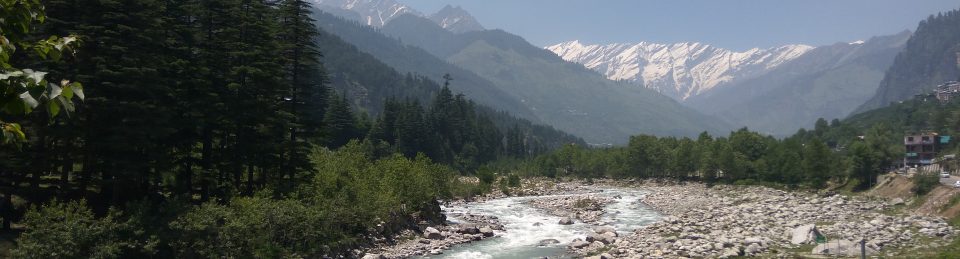
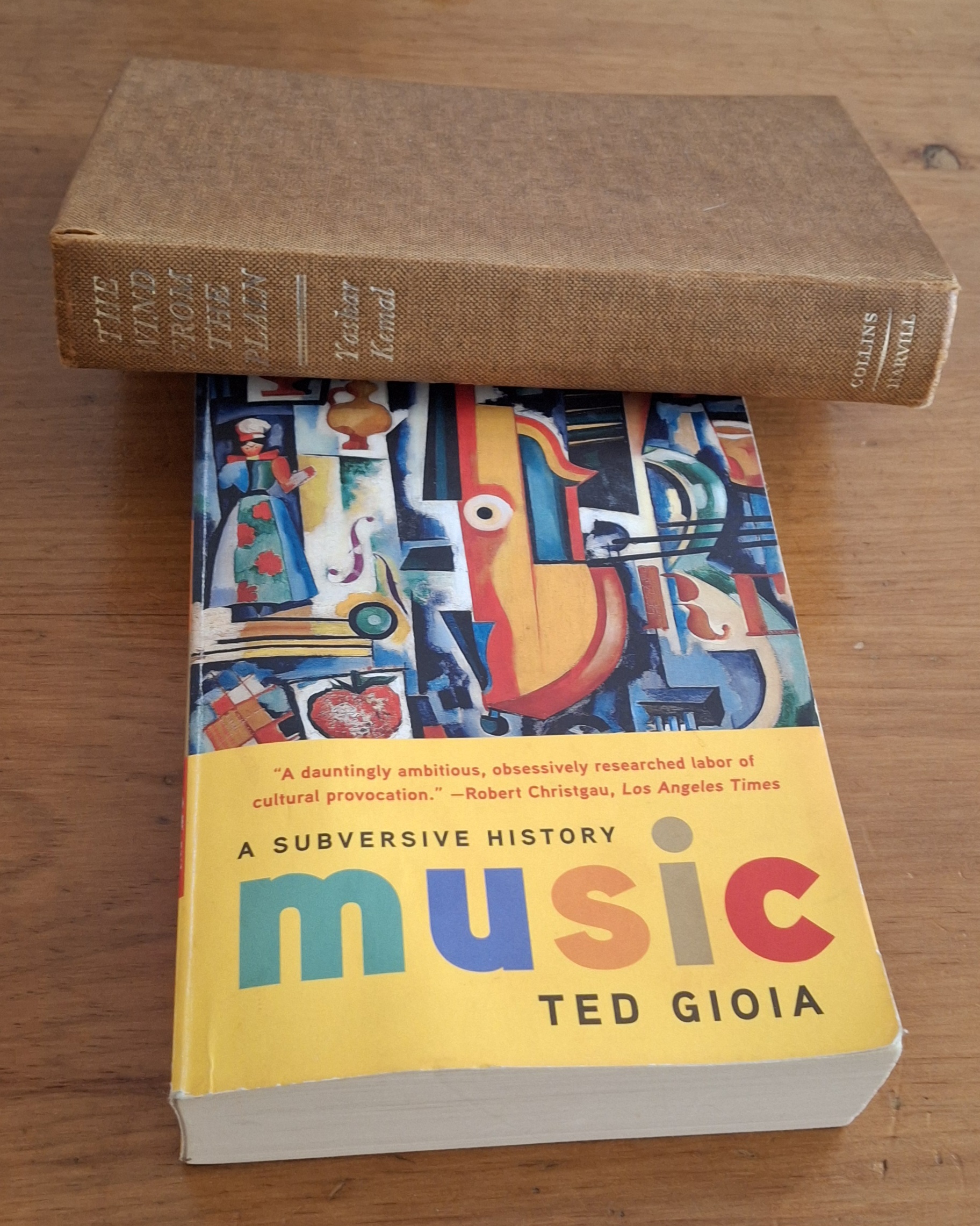
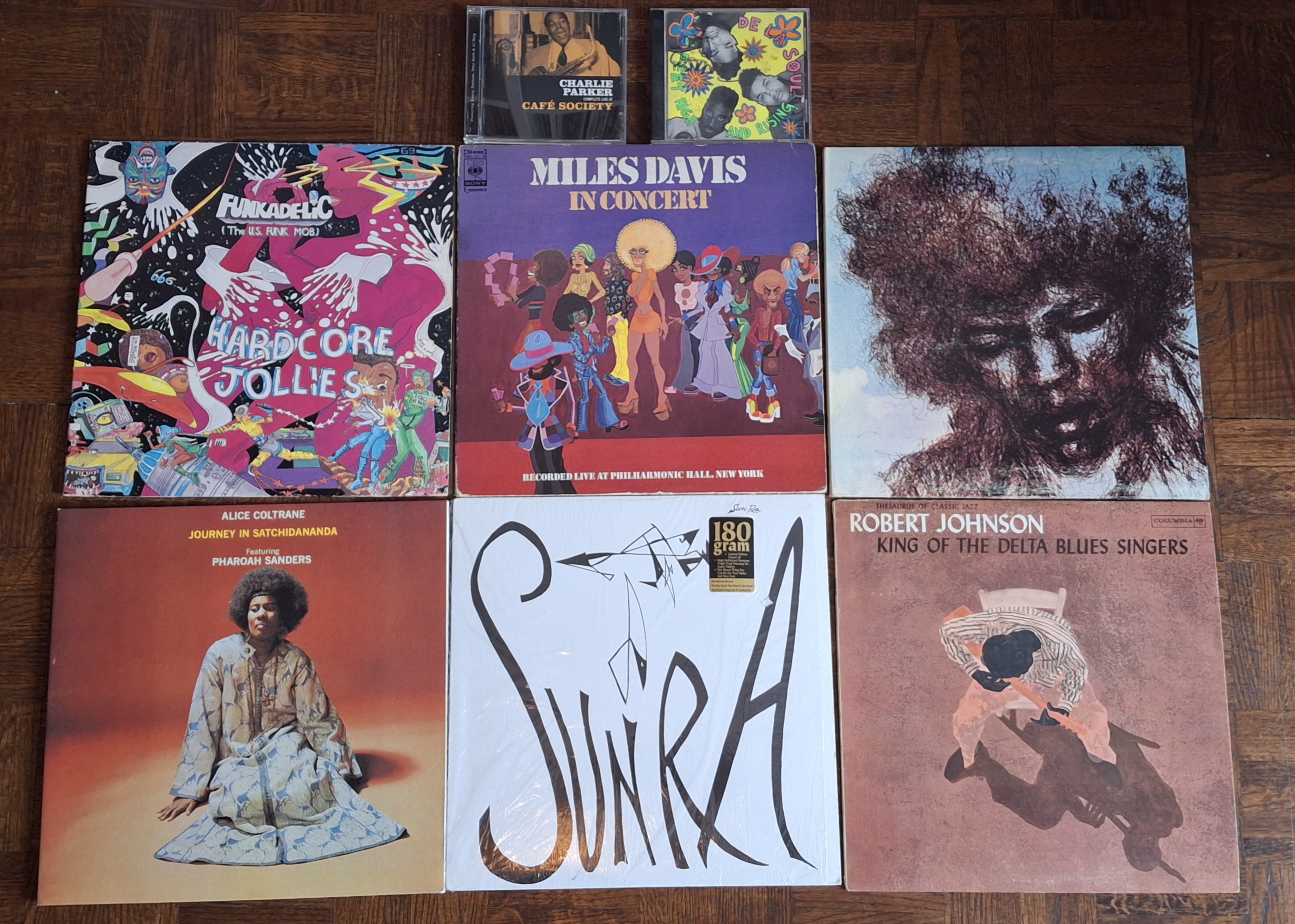
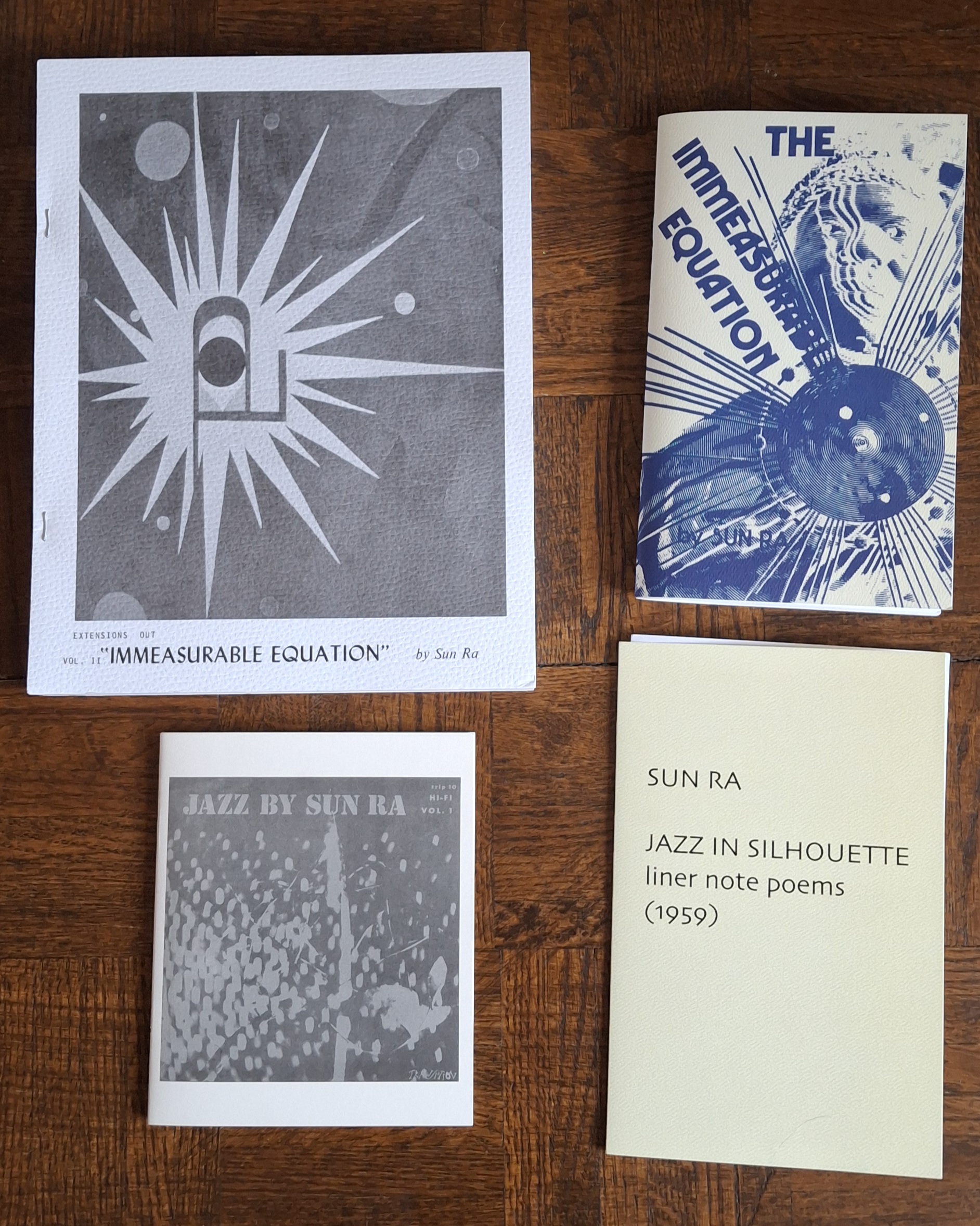


 Jeff Halperin