• About the Author
  • Books
  • Vinyl
  • What the critics say about Jeff

Jeff Halperin

Jeff Halperin

Tag Archives: To Nature’s God

Does Nature Sing? Let’s Look to Science and Literature

18 Wednesday Mar 2026

Posted by jdhalperin in Music

≈ Leave a comment

Tags

A Subversive history of music, Nature's God, Sun Ra, Ted Gioia, The Wind From the Plain, To Nature's God, Yashar kemal

When you spend enough time observing nature, I mean really looking at it, suddenly, you begin to hear it too. The visible is apparent immediately, the audible comes second.

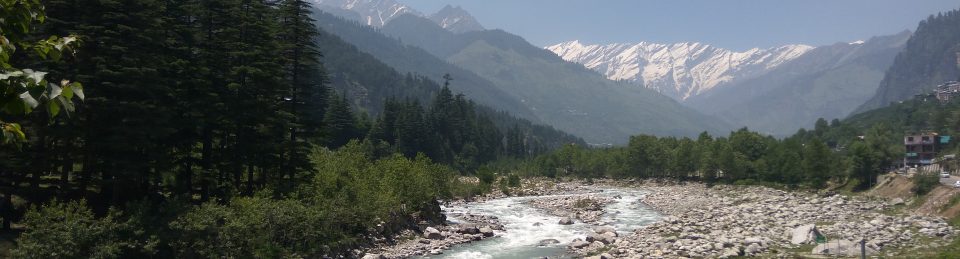
We love watching the sun rise or fall and love hearing the birds sing. Even inanimate aspects of nature keep us in awe, things like mountains, maybe because they’re so immovable and permanent.

I’ve been thinking lately about the secret music found in nature, and while it sounds a little kooky I’ve seen the notion echoed in two very different books. The first is A Subversive History of Music, by Ted Gioia. It’s wonderful and very wide-ranging! The second is a novel called The Wind From the Plain by the great Turkish writer, Yashar Kemal.

To what extent does nature have a secret life that can produce sounds, or music?

We’ve heard of the sounds of wind rustling through the trees, but that’s not only what I mean. The trees themselves vibrate! Let’s look at what two very different books say.
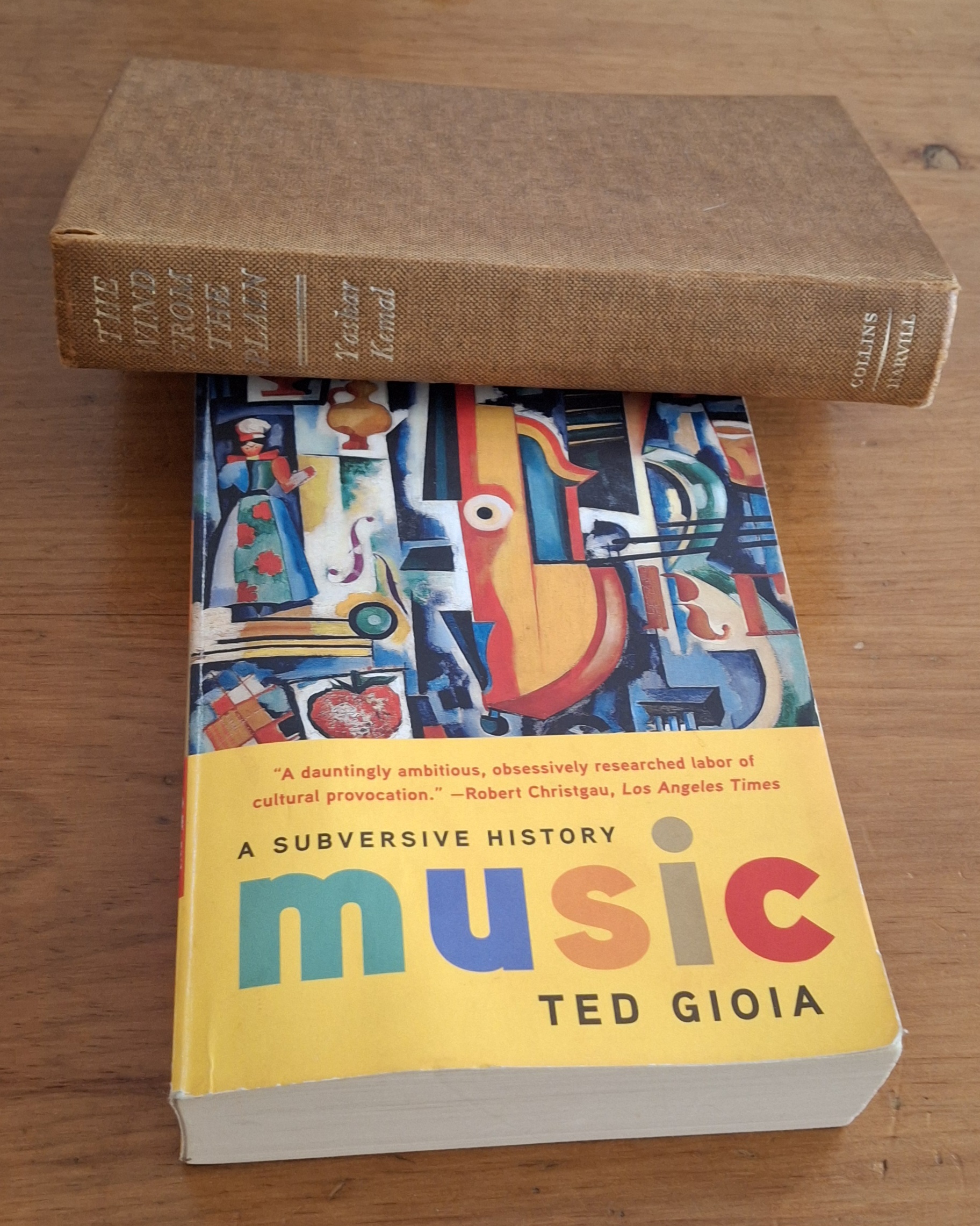
Two wonderful books, which overlap to a surprising degree

From Ted Gioia’s A Subversive History of Music: “From the start, waves of sound came not just from a primal explosion, but from the smallest particles of matter. In the heart of the atom we find vibrations of extraordinary speed—up to one hundred trillion times per second—creating a tone some twenty octaves above the range of our hearing” (page 11).

It’s not that a force like wind produces a sound by blowing through something else; that second thing itself contains its own innate sound. It doesn’t need to interact with, say, wind, water, or fire to produce a sound. Although, the sounds of the breeze through nature is indeed a common music. Many instruments people play rely on wind, too: recorders, saxophones, trumpets, etc.

It may seem less surprising, then, that later in the chapter Gioia describe Australian researcher Lynne Kelly learning to hear the wind through different types of trees, bushes, and even grasses while embedded with the Warlpiri tribe in Australia: “…when she began listening to vegetation, she found that the passing breeze imparted a distinctive aural soundscape to the trees around her. ‘The eucalypt to my left, the acacias in front, and the grasses to the right all made distinctly different sounds. I could not accurately convey these sounds in writing. In subsequent sessions, I’ve been able to distinguish between different species of eucalypt, the experience convinced me that the sound of plants, animals, moving water, rock types when struck and many other aspects of the environment can be taught through song in a way that is impossible in writing.’”

Cool! This makes me want to watch a documentar film I’ve been meaning to see but haven’t yet, The Secret Life of Plants, for which Stevie Wonder did the instrumental, atmospheric soundtrack. That documentary looks at plant consciousness, ecology, environmentalism. Leave it to a blind man to hear into this secret life. Maybe when what’s visible doesn’t jump out at you, your ear gets to work sooner.

But before getting sidetracked by my love Stevie Wonder, let’s get back to Yashar Kemal’s novel, The Wind from the Plain.

It’s about a remote mountain tribe’s arduous trek from the hills to the Anatolian plain, to pick cotton to make enough money to survive the harsh highland winter. Every year, Old Halil tells the village when the cotton is ripe for picking by using his keen senses to hear the wind. I was struck by some beautiful descriptions of nature that echoed this secret musical life of plants and even inanimate parts of the environment.

Here’s a great early passage that’s explicitly about how nature is a secret conduit for sound:

“Rustling sounds come from the steppes. Old Halil puts his ear down to the ground and listens to the murmur rising from deep deep down. The soil of the steppe is a good conductor. One can hear the creeping of ants in their heaps, the scurrying of birds in their holes. There is a bird of pure lustrous blue that makes its nest be delving deep into the cliff walls. One can hear it digging away in its tunnel. One can know when the roots of the whirling thistles are on the point of breaking by the special creaking noise they make. ‘There’s nothing like the earth of the steppe,’ says Old Halil. ‘Why, it’s better than the telegraph. Put your ear to it and you will hear all kinds of wonderful sounds. You will hear a shepherd piping at the other end of the world, you will hear a song that has never been sung before, laden with all the beauty of strange flowers. Yes, put your ear to the ground and hear the beat of horses’ hoofs a day’s journey off. But it’s not everyone who can hear the voice of the earth. It needs a good ear, a discerning ear like mine, you ignoramuses!’” (Page 18-19).

In Gioia’s book, researchers hear the music of the wind through the trees, bushes, and grass. In this Kemal passage, the vibrations travel through the earth itself and Halil hears the wind from the distant shepherd piping his song. The wind travels a longer distance. More than that, the songs are “laden with the beauty of strange flowers” in it, as if the wild flowers physically rooted between this shepherd and Old Halil are somehow converted into sound and become a part of the wind’s song. Something to hear, not just see–the flowers have a sound to them that fuses with the wind’s tune.

There’s a really cool kind of synesthesia going on! If you listen correctly, you can hear nature’s physical, inanimate parts, things normally only visible. Who knew!? This reminds me of the first Gioia excerpt, where the smallest particles of matter, in the heart of the atom, vibrate at speeds so extraordinary, the tone they create is twenty octaves beyond our range of our hearing.

There’s a mystical, spirutual quality to this music, to these sounds. We know about third-eye psychedelic, spiritual truths. I’m not sure if this secret aural world of nature sounds is a type of third-ear music, or merely what you can hear by listening carefully with your regular ol’ two ears.

There are many other extremely beautiful passages in Kemal that anthropomorphize nature. Mountains are awake and alive, the rocks themselves, not just the animals and plants on the mountains and in them. The soughing of the trees makes music. For all the beautiful lyrical nature passages, there’s also a lot of wonderful cursing and shit talking! It’s quite down to earth. In Old Halil’s case, literally.

Neither of these books are about nature, but nature and music come up together in both, almost accidentally, even if in distinctly different ways.

The “music” here is vibrations ringing through the natural world, but then again, that’s all music ever is. If you placed a chromatic guitar tuner on the soil to detect the rumbling of the shepherd’s piping song, or placed the tuner touching rustling grass, it would measure the frequency of the sound waves and on its screen would read a note, or a pitch: C#, Bb, or whatever. We tend to associate notes with the physical properties of musical instruments, like strings, frets, or keys on a keyboard. But that’s all music is: sounds, vibrations, notes…they’re all the same thing.

This all brings to mind the lyrics in one of my favourite Sun Ra songs, To Nature’s God. “Sometimes we do appreciate the work of nature’s god…lightening, sunshine, wind…the leaves on the trees.” Truly, everything comes back to Sun Ra eventually.

Ra, who titles his poetry collection “My Words Are Music,” and whose poems provide the lyrics to many of his songs. He also believed his clothing was music. Synesthesia is everywhere! Everything is music! Clothing, flowers, wind. You just need to know how to hear.

I get how this sounds a little kooky. I want to believe in it and train my ear to hear nature better. Tune up my hearing and be like Old Halil and listen with a good ear. “It’s not everyone can hear the voice of the earth. It needs a discerning ear like mine, you ignoramuses!”

What I Love in Sun Ra’s Music

14 Tuesday Jan 2025

Posted by jdhalperin in Uncategorized

≈ Leave a comment

Tags

Jeff Halperin, Marhsall Allen, Sun Ra, Sun Ra Arkestra, To Nature's God

Most people don’t love jazz but those who do probably have a similar progression. On the spectrum of “in” and “out,” people start in and gradually get further “out.” At first, you need splashy cymbals and a tight walking bass to give a sense of coherence, pulse, and beat to the sound. Gradually, you need to rely on these things less and less. Put another way, after you get used to what you’re hearing you’re eager for what’s next, how things stretch from there.

Musicians go through this same progression. John Coltrane is a great example. He played big band jazz, then looser but highly constructed, structured stuff with Monk, then played with Miles and his own quartet in ways that would have seemed very loose and free-form compared to his big band era, but restricted compared to later albums like Ascension. Maybe the simplest way to think about it is that after both musicians and listeners hear the same thing for a while, they get bored and need a change. There’s only so many ways to solo within the changes before something else needs to change.

If I’ve talked to you in the last year or two, you know I am currently very, very in love with the Sun Ra Arkestra. Why? What is its appeal? I’d like to describe it in musical terms but spiritual ones too because that group cannot be explained fully via notes.

I’ve said that the Arkestra represents for me the height of discipline and freedom. This sounds like a cliche so let’s look at this to see precisely what I mean. When the Arkestra wants to be tight, nobody is tighter. With the snap of a finger they can reel off Fletcher Henderson’s big band charts so accurate they include the mistakes musicians made during a live performance. The Arkestra was a huge group, a fixed core with a revolving door of musicians stopping in for days, weeks, months at a time to play with the band, but it was tight.

At the same time, their structure required a certain type of looseness and individual freedom to be what it was. When Arkestra mainstay Marshall Allen first played for Sun Ra, Ra asked him to just play, to test his spirit. There was no music in front of him and he wasn’t playing any song. Anyone who has ever heard one of Allen’s remarkable alto solos knows this spirit. You can’t transcibe what he plays. It’s grunts and high-pitched squeeks and squaks that seem impossible to produce from an alto saxophone, even though overblowing a horn was a technique Coltrane used too, which he heard from 50s RnB players. Allen’s playing took me a while to appreciate, and seeing him play makes it make a lot more sense than just hearing it would have. I wasn’t sure it was even “music,” but part of Ra’s freedom is being in the realm of sound, not notes deriving from a scale.

Sun Ra’s music doesn’t just span the entire musical spectrum; it expands it, making me realize just how varied, rich, wonderful music can be. He’s like the Shakespeare of music, encompassing every mood and character with unmatched technique.

When I listen now to the groups who were my favourite a few years ago–70s Miles fusion and Parliament Funkadelic–they seem almost limited, staid, and small. I still love them dearly! It’s not their fault, everyone seems small compared to the Arkestra. They’re a force that goes deeper and started what everyone else is doing.

Miles got rid of the European-tailored suits because his girlfriend, a beautiful model and killer musician (whose music I also love) Betty Davis told him it wasn’t hip. P Funk bought a lot of their stage wardrobe on Toronto’s Yonge Street, but only after Ra spent years talking about space and looking otherworldly on stage with homemade wardrobes that looked absolutely beautiful.

Ra had multiple dancers at his shows, half-hour long percussion solos, an impossible range of horns and percussion instruments and synths and other keyboard instruments. It’s like his engine never stopped or slowed. His music in the 50s is different than the 80s and 90s, but no less inspired. You can listen or even watch his band play and ask yourself, “what is that instrument?”

His freedom is multi-dimensional. There’s the space concept, the wardrobe, and motion on stage, the way his musicians will walk off stage and break the barrier between audience and musician, or even walk off stage at the end of the show, still playing their instruments. His freedom is also embodied by his just off kilter harmonies, the instrumentation, the time signatures and the shifts, the way instruments can shift ahead and behind the beat, sometimes within the same songs. The chanty songs have a type of tight drawl yet also a kind of upbeat or off-beat quality at the same time that I just love. To Nature’s God comes to mind, a beautiful song praising elements of nature.

It sounds sometimes like all the musicians are playing a different song all at once, but that’s just because they’re playing melodically at the same time, rather than a few people doing chords or vamping to support one soloist at a time. If chords are frozen arpeggios and arpeggios are melted chords, then their solos imply a world of chords or tone. They live within the in-between worlds. It’s kind of a game, to playfully mask or hide the structure, or whatever the key is that opens up the song’s hidden core, and delight in finding it, or feeling it. You don’t need to think about all this music, sometimes it just makes you feel instinctively very good! It can really swing and have a strong sense of melody. But other times it can be extremely dark, dissonant, and you wonder just what this cacophony even is. I’m shocking myself lately by liking this latter mode more than I ever thought I would.

Many of the Arkestra’s musicians lived together, a communal existence that let them rehearse and play 24 hours a day. It kept them out of trouble and simplified meals. Despite being leaders in American jazz who got a wonderful reception in European cities, they never made a ton of money. They needed cash. Yet they were incredibly prolific, putting out over 200 albums, some on Ra’s own record label, Saturn Records.

When publishing a new Saturn album, Ra would hand each band member a few copies, and together they’d do crafts around the kitchen table, drawing on the covers in markers and taping photocopied type-written notes about what songs were on each recording. It was incredibly DIY and resourceful! For laminate, they’d use transparent shower curtains. These hand-decorated, one-of-a-kind records were sold at concerts for cheap and are now some of the most prized collectibles in the world of vinyl. A VG copy of Lanquidity goes for $1,500 cdn. Discipline 27-II went for $1,200 at a store near me.

I’d love to own such a collector’s item not for the monetary value (I’d never, never sell it), but to know that exact album passed through the band’s hands. It’s impossible to imagine a group of artists more commited to their vision. These guys lived the life day in and day out for years. The band started in the 1950s and, while Ra left the planet in 1993, the Arkestra still plays today under the leadership of 100-year-old Marshall Allen.

The spirituality and vision underpinning the music comes from Ra’s imagination and his readings into mythology, the occult, history, numerology, and lots else. For all the out-there strange ideas, it’s also filled with humour, playfulness, and it’s extremely sweet. Ra might have insisted he was from the angel race from Saturn and not a human being, but his music is extremely concerned with people, or maybe as he’d put it, Earthlings. It’s Black music, 100%, but it’s for everyone, too. I read somewhere it’s like Count Basie meets Thelonious Monk and this feels true, but maybe inadequate.

I’m totally floored by the Arkestra’s talent, vision, their raw force, their commitment, their range. It’s exquisite art on many dimensions that’s inspiring and very calming. There are initial barriers to accessing some of their music that once overcome will change the way you appreciate music forever and even your life.

I’ve been obsessed with music from a young age but, in a way, feel like I’m hearing music now for the first time. I hope this isn’t my final musical epiphany in my life and don’t see how it won’t be, yet this band has shown me that musical possibilities are as endless and vast as the cosmos themselves. I feel like I could write more words about each particular album of theirs I love, even each song–it’s extremely difficult to write concretely about such an ever-shifting musical behemoth. Suffice it to say, for me, the Sun Ra Arkestra is more like a miracle than just music.

Twitter

Follow @JDhalperin
Tweet

Enter your email address to follow this blog and receive notifications of new posts by email.

Join 1,022 other subscribers

Essential sites

  • Grateful Dead Chords/Tabs
  • Neil Young Chords/Tabs

My Writing

  • Huffington Post
  • Maclean's
  • Music Writing
  • The Star
  • the Walrus Laughs
  • Toronto Review of Books
  • Toronto Standard
  • World Is One News

Topics

  • Comedy (18)
  • Literature (13)
  • Music (1)
  • Politics (28)
  • Sports (16)
  • Statements (36)
  • Uncategorized (44)

Create a free website or blog at WordPress.com.

Privacy & Cookies: This site uses cookies. By continuing to use this website, you agree to their use.
To find out more, including how to control cookies, see here: Cookie Policy
  • Subscribe Subscribed
    • Jeff Halperin
    • Join 52 other subscribers
    • Already have a WordPress.com account? Log in now.
    • Jeff Halperin
    • Subscribe Subscribed
    • Sign up
    • Log in
    • Report this content
    • View site in Reader
    • Manage subscriptions
    • Collapse this bar
 

Loading Comments...