
• About the Author
  • Books
  • Vinyl
  • What the critics say about Jeff

Jeff Halperin

Jeff Halperin

Author Archives: jdhalperin

On what I currently listen for in music

16 Tuesday Oct 2018

Posted by jdhalperin in Uncategorized

≈ Leave a comment

Tags

Jeff Halperin, Miles Davs, Music, The Band

My musical ear has changed. I always listened to excellent music—my first loves were MC Hammer, Aerosmith, Dance Mix 92-95, Phish and of course Grateful Dead. I don’t regret one note I listened to, but I wasn’t listening to the whole of every song, and gravitated too heavily to the guitar.

It’s begging the question: Did I focus too much on guitar because I was a guitar player, or is that why I became a guitar player in the first place? In either case, I didn’t properly value rhythm sections. I should have listened to everything. This might seem like not really a big deal but actually I think of it now as a sonic sin, akin to watching only 80% of the every screen while watching a movie. Musically, I was crooked.

Rhythm sections were something I responded to, I felt them, but didn’t hear. To be fair, I listened to a lot of bootleg Dead tapes with varying degrees of audio quality. But to listen to the drums without really hearing the bass is to hear the drums without their context. Drums and bass live together, there’s a dialogue between them in the music, and to only hear one is to really miss both.

I have known this for a while now, maybe months, but felt this quite intensely the other day messing around on a bass while my buddy drummed. The bass drum and the bass guitar are a tandem. It’s very possible to like a band because of their rhythm section without quite knowing that’s why you like them. That’s why Dave Byrne of Talking Heads wore that big suit, to make his head look small and his body look big as a reminder that music is fundamentally physical, not intellectual.

Early, the jazz bass player’s role was to support a soloist improvising over the tune’s harmony. They soloed, too, but it was mostly a supportive role. In 1970 Miles gives us Bitches Brew, which isn’t just a killer album title, it provides musical hints about the new direction: the instruments simmer together in a cauldron. Gone is the formula for 50’s jazz and even the freer 60’s stuff, where all instruments play the head of the tune, principle soloist solos first followed by second and third horn, drum solo then close with the song’s opening melody. Rather, there’s one groove that everyone participates in at the same time.

I had one saxophone lesson in 2007, wherein my teacher made an astute observation that astonished me: Coltrane was a hog! He kept soloing forever and forever, with the best rhythm players backing him. There was no melodic exchange. Now, I love Coltrane deeply, but this is more or less what he did.

A nasty alto player who used to run the Dal sax department told me something similarly astonishing: He said Cannonball Adderley was content with his bad ass swing, while tortured Coltrane changed his sound every week because he was just unsatisfied. I had thought Coltrane’s quest to find music’s highest height was a service to humanity. I will never say a bad word about John Coltrane, whose sublime music has genuinely given to me more than what religious people get from religion. Once in a while I’ll play him and have a kind of sacred experience, but generally I need music structured differently.

Miles said he learned from Sly and the Family Stone how to dismantle that old standard jazz formula, and melt his horn into the other instruments, rather than playing one after another in their turn.

The Band is the perfect sound for me now because of its balance. On the surface they don’t appear to have anything in common with Miles, but not only did they play on bills together in the early 70’s, their music is both a cauldron even if the brew is nothing alike.

The Band was a bar band for 10 years before they recorded their first album. This is key to understanding them. They had played loud high-octane Rock in every bar in the American South and Ontario. In the studio, in Big Pink, they wanted to turn the instruments down, hear each other, play songs on which their instruments intertwined. No virtuoso guitar or drum or bass solos. Their music is on a foundation of interdependence.

Most bands only have one or two super talented members whereas everyone in The Band is an all star. So maybe other groups can’t be as balanced as they are because their talent is dispersed lopsidedly—it’s a question of talent, not vision.

Glenn Gould said it’s “anti-democratic” for a pianist to have one dominant hand. Sure, but commitment to democracy isn’t enough, it’s very difficult to have a left hand that plays as deftly as the right. Gould would call The Band democratic. They are perfectly, utterly balanced.

There’s something so tacky to me now, even vulgar, about million-notes-a-minute guitar solos. So guitar-centric. “Play rhythm for me while I shred” is like asking friends for a favour rather than hanging out together on equal terms. This kind of solo is a physical achievement of dexterity, not necessarily a musical one. I can marvel at Steve Vai and G3, even feel envy at their shocking chops, but I don’t really want to listen to it.

Picasso had to prove he could paint in a renaissance style before his more abstract stuff was taken seriously. Why? For many people art can’t be serious unless it passes a certain threshold of technical achievement. This is understandable to an extent—you don’t want to celebrate an artist that produces something an untrained infant can.

Yet complexity does not equal quality. Would his abstract work be any less incredible if Picasso couldn’t also paint in a renaissance style? Does Neil Young need jazz chops to be taken seriously? Of course not, it’s ridiculous. Every artist is their own genre.

Most art presupposes the possession of certain amount of artistic skill, but not all. Judging art purely by the skill required to pull it off, rather than by the vision or soul behind it, is nearly as vulgar as judging paintings by how much money the Art World says it is worth. A solo isn’t good because it’s hard to play, but because it’s musical. Of course it’s OK to be impressed with a tough passage, but only if it’s musical.

Art is a mood, a vibe, a sound, a feel. Art is not ranked along any one ultimate hierarchy. But in music, I think it’s important to give the same weight to all the instruments. Actually I think Western Classical generally privileges melody and harmony over rhythm, the first conditioning of the Western ear. This dynamic trickles down.

The ironic thing is African music was often called “primitive” specifically because the rhythms were literally too sophisticated for Westerners to process. There’s a moment in the Ginger Baker documentary when he’s hanging privately with one of his hero drummers as a teenager, who plays records of some African drumming. Baker is asked to name the time signature, identify where the beat starts. He cannot.

Balance for me in music is along this axis to, between harmony, melody and rhythm. Rhythm should be a feature, not in service to the other two. I listen to a lot of Atlantic Soul records now, where the punch is the groove, not some dazzling soloist.

Music is infinite permutations of tension and release. I want to caution against confusing sophistication in music or art for quality: Like I said, I still love that old Dance Mix stuff, and a lot of old E-A-B blues is basic on paper but sounds like shit unless you play and sing with feel. If you can dance to a tune or you like hearing a song, that song has done its job.

But the music hitting me hardest now has togetherness, it’s communal. The Band sounds like they’re all having a great time hanging out together (and when they stopped enjoying hanging out, their music immediately suffered). It’s not an accident that they all play each other’s instruments, live and on albums. They’ve transcended their particular instrument and are playing music.

A wise friend told me once there are four stages to music. The first is “unconscious-unknowing.” Think of a child who plays air guitar because they feel the music in their bones but have no idea how to play actual music. Second is “conscious-unknowing,” the beginner who labours to follow the basic instructions, but is now playing music. Third is “conscious-knowing,” the accomplished musician who knows what and how to play but still must think about it. The final stage, that almost nobody reaches, is “unconscious-knowing,” where music is simply felt and transferred to the instrument immediately, without thought required.

This fourth category is filled with musicians who have transcended their instrument, or maybe two or more instruments. Their music isn’t a physical phenomenon anymore. It’s not even a cerebral one, because while it takes brains to play, it’s about feeling as much as thoughts. Not just the degree of thoughts and feelings—not how much intelligence and feeling is there–but the nature of these things.

The only pertinent question to musicians in the fourth category is: what are their musical thoughts like? How good are these thoughts/feelings? Charlie Parker’s music is nearly impossible to play, but that isn’t his real achievement. It’s his ideas that are impossible to conceive of. Lots of people mimic Parker today, and they are incredible musicians! It’s very, very hard to do! But they are reproducing his licks, not the mental originality that gave rise to them in the first place.

Musical ideas need not be complex to be good. It’s instructive that when musicians get tired of playing bebop, they mellow out and play grooves. Miles’ Birth of the Cool or even Kind of Blue. Thought of this way, the idea of ranking musicians or bands in sequential order is ridiculous.

I worry that a lot of people hear music on YouTube and it sounds like shit. MP4s, or iTunes, sounds like shit. Non-flac digital files compress music so that a device can store a million songs. Really, the sound waves have a narrower range. It’s a real distortion. Apple, Spotify and YouTube offer immediate access to every song on earth, and in exchange, they don’t sound as good. This may differ from recording to recording, or on your speakers or something, but I suspect there is a generation hearing subpar music. As TVs have improved their picture, our audio quality has gotten worse.

I say this not merely as grumpy man, but from having taught guitar to kids for years and seeing how they listen now, on devices or computers. I suspect the worsening audio quality impacts the way contemporary producers and DJs create and play music. Medium Is The Message kinda thing. But that’s a longer story for another day.

An old proverb I heard is “chess is an ocean in which a gnat may drink and an elephant may bathe.” Same goes for music. Take from it as much or as little as you want. If you like having it on in the background, cool! But listening actively is a life-long activity that evolves, and pleasure really deepens. However far you want to go in listening to music, there are many who have already gone further. That this is true is just such, such a blessing.

Am I in the echo chamber, or are you?

06 Saturday Oct 2018

Posted by jdhalperin in Statements

≈ Leave a comment

Tags

doug ford, echo chamber, trump

This will sound sarcastic, but honestly I never got accused of being influenced by an “echo chamber” until after I moved to India to work as a journalist, and after making a deliberate effort to read non-white and non-male writers.

To review, an “echo chamber” is the phenomenon where a person only exposes themselves to views they already have, and the more online they are the more they deeply entrench their own beliefs/biases.

Whatever people think of my views, objectively speaking, I’m not a product of an echo chamber. The accusation is laughable.

I read Conservative media. I used to be conservative. For years I kept tabs on the heart of Conservative Canada by reading the FB updates of my cousin’s husband, a former speech writer for Harper who is currently strategic director of communications for Doug Ford.

This guy has defended Trump, Breitbart, rejoiced when NFL planned to shut out Colin Kaepernick, Betsy Devos, and more. He once accused me of being in a social media echo chamber, and has since defriended me from FB. I cannot help listen to Ford without being deeply aware that he hired a man with these views to communicate for him.

I read the National Post for years–I know the work of Rex Murphy, Blatchford, the Kays, Conrad Black, Robyn Urback, Lorne Gunter, and the rest. I used to see the Sun’s Sue Ann Levy at city hall when I wrote about that circus, and ran into Tarek Fatah in an elevator in Film City. I read (hate-read) Wente at the Globe.

I can’t read Ezra Levant on Twitter because he blocked me, but I’ve seen this former National Post editor’s Rebel segments and read enough of his writing, from his early days at Maclean’s. I read Barbara Amiel, Conrad Black’s wife and the former wife of George Jonas, a small-C conservative voice I read fondly in the National Post for years.

I worked for Zee Media, basically India’s Fox News. Sudhir Chaudhary was my editor in chief (I was on Web and he was TV, and mostly does Hindi news, but still, I sat in story meetings and am acquainted with his thought). I have read/watched enough Jordan Petersen and have talked with him before.

I had to read US Conservative media in the summer of 2016 when researching for a TV show I was writing about Trump. I don’t read it all the time now because it’s exhausting and time-consuming, but I know the work of Ben Shapiro, conspiracy theorist Alex Jones, Bari Weiss at the NYT, Sam Harris. I used to read Krauthammer, and still read former Bush speech writer David Frum.

I was in the belly of the beast of India’s Conservative news machine. When demonetization was announced, we got an order not to write anything critical about it.

The BJP announced Demonetization on literally on the night of the US election, and like everyone I was consumed by Trump news. While I had reservations about demonetization right away I thought my fellow Indians on the desk were better suited to pronounce on it than me. Maybe this is me rationalizing a moment where I should have quit on principle, out of disgust for the flagrant conflict of interest–the owner of my station is an independent member from Haryana of the BJP, the ruling national party.

But the point is, I’ve seen first-hand how money influences/determines coverage of economic policies. Even without telling this story, my station ran a disgraceful commercial that promoted not WION, but the government policy! Imagine CBC running a commercial promoting Trudeau–that’s what my station did.

When people claim that Postmedia is affiliated with the conservative party here in Canada, it means they informally do what in India is done formally. It’s not an accident that Tarek Fatah writes for the Sun here and appears on Zee TV.

What become undeniably clear to me during my time in journalism is the extent to which economic reports are deliberately and shockingly cooked, both by ostensibly neutral economic institutions like the IMF and by journalists covering the industry.

I had a good talk with John Perkins, the author of Confessions of an Economic Hitman, who for 10 years negotiated in backrooms with the leaders of Central American countries, unofficially but decidedly on behalf of American business interests. Perkins was recruited by the NSA, and his book outlines the basic process:

  1. Corruption: Offer leaders money and perks if they give major contracts to American businesses
  2. Propaganda: Tell the leaders, we will cook the books/stats so that your citizens believe (wrongly) you will benefit the country.
  3. Threaten: Cooperate, otherwise, see examples where national leaders were removed by coup, to be replaced by cooperative leaders.
  4. Threaten more: Cooperate, because if you don’t play ball and a coup doesn’t work, the US will simply assassinate you or take power by force

People in Toronto seem to have no awareness that Free Market ideology is an ideology. It’s assumed that the current stage of consumerism/capitalism arises here naturally, like lakes do, that the Free Market’s global success is do to its innately superior properties, and not to external pressure applied by wealthy people.

They think the Market is a non-human entity, an omniscient force that somehow distributes the right money and jobs to the right people based on a complex but merit-based algorithm. That it somehow weighs people’s personality, skills, responsibilities, and other criteria and allots to them the salary they deserve.

I believed something like this. But it’s total horseshit. Of course the control of money has human fingerprints all over it. It’s incredibly naive to believe that ultra rich people simply entrust their fortunes to fate.

Really, they acquire and guard it ferociously–there are entire industries that exist so that people with immense wealth can use either legal, quasi-legal or illegal means to shelter their fortunes from tax authorities in offshore accounts. Money buys politicians or media influence. People know this–every pseudo-sophisticated political observation is based on the wonderful quip “An honest politician is one who when he’s bought, stays bought.” But I suspect most people downplay how much this of a role this plays in politics.

I had a fascinating conversation with a longtime Canadian journalist who mentored me, who said that the Globe and Mail is basically a money-losing entity that only exists so the owners can frame the national discussion. Obviously they’d rather make money than lose it, but even if it bleeds money, it’s a very worthwhile investment, and anyway it’s only a small part of the owner’s portfolio. The Globe’s target audience, according to internal documents from the Globe, is people who make over $100,000 annually.

The Sun and National Post–2 of 4 of Canada’s major daily newspapers–are the Conservative Party’s low brow and high brow blogs, respectively. But even the Globe is not there to expose white collar crime or anything that seriously undermines how the Free Market.

These newspapers work on the assumption that the grotesque and ever-growing income inequality is by definition justified because the market dictates it, and to interfere with the market is akin to sticking a wrench in Nature.

While social conservatism is often berated in public and in media, when it comes to money journalism in Canada and really everywhere has a right wing bias. Look at a newspaper: there are entire sections devoted to Cars/Driving, Travel, Movies, Sports, and now Cannabis–these papers will neglect some life-and-death issues (jailing, housing crises, police brutality) while reporting on subjects that might be interesting but are only only important because money is concentrated there.

These are complicated topics, oversimplified here for my purposes. It’s impossible to talk fully about the Market and how money works without talking about race and gender, and that’s also beyond the scope of this little article.

I have an acute sense that my FB friends despise my political posts (I do too! I swear, politics is miserable and depressing). But my views are in the minority in the broader community, too: Toronto elected Tory and Ontario elected Doug Fucking Ford.

So, if my views are unpopular, doesn’t that suggest my views were arrived at despite the echo chamber?

Isn’t it possible that the people and media institutions with long histories of promoting the status quo are the creators of the echo chamber?

There’s a concept called “Vertical Integration” coined by an old sociology professor of mine. The idea is this: If a theory is incompatible with other types of accepted explanations of the world, it is likely bogus–it’s not enough that the Bible says that the Bible is true, because it’s contradicted by so many interdependent branches of science. This is begging the question 101. The more a theory tallies with different kinds of thought, the more buttressed it is and the more likely it is to be true.

The Bible is a self-contained echo chamber. I put it that conservative politics is drifting further and further into the same kind of realm.

Trump calls any credible media report that doesn’t flatter him “Fake News”, and a hostile country flooded social media with fake accounts (“bots”) that pathologically promote Trump, who has created an entirely alternate reality for his followers to believe in because his views are so incompatible with the actual world: Isn’t it possible that *this* is the echo chamber?

The left is frequently entreated to watch 4 hours of Jordan Petersen videos to see that his latest misogynist quote was deliberately misquoted to smear him. I’d like to ask those on the right to do a type of mental back flip, a very hard thing to do and no small ask, but really, ask yourself: “am I the one in the echo chamber?”

PS: I am happy to discuss any of these broad topics with more nuanced with anybody, privately or in the comments or whatever. I do think it’s important to be approachable: Sometimes my writing comes off snarky because the truth is I can be a little shit, but I do get bored talking to basic liberals and find these and other conversations very fascinating.

To my conservative friends…

29 Wednesday Aug 2018

Posted by jdhalperin in Politics

≈ Leave a comment

Tags

conservatives, doug ford, Jeff Halperin, Racist, Rob Ford, White supremacy

Many conservative voters object to overt, extreme forms of racism, then have a hard time reconciling how leftists can accuse them of being racist. They don’t feel racist. They get defensive and accuse the liberal in turn of being over-sensitive, or using “racist” as a smear to dismiss without cause anyone they disagree with. Everyone and everything is racist, these days.

I posted an article to Facebook shortly before the 2018 Ontario election about a white supremacist podcaster hoping Doug Ford would win. There was nothing contentious or up for dispute in the article: the white supremacist was a self-declared white supremacist, cheering on Doug Ford because, in his opinion, Ford was the only candidate who would implement white supremacy.

“Ronny Cameron, a white nationalist blogger who has recently published several pro-Ford posts, suggested that when Ford declared ‘we gotta take of our own before we take care of anybody else,’ every single white nationalist said to themselves: ‘we know what you’re sayin’, Dougie.’”

I didn’t sabotage Ford’s character by connecting him to something odious where there was no real connection. I would never do that. Rather, I sabotaged his character by highlighting a very real connection he has to something odious.

Here is how I introduced the article on FB on June 3: “self-declared white supremacists have a crystal clear favourite in this upcoming Ontario election and if your vote aligns with theirs, have a talk with yourself.

Don’t let trumpism rat fuckery come here, for the love of all that’s holy.”

I said nothing inaccurate, or even contentious. An interesting thing happened next though.

A Conservative insider who worked for Doug Ford’s provincial campaign and once wrote speeches for Stephen Harper, commented: “I’m voting for Ford. Are you calling me racist?”

The conservative’s must have a PR handbook for deflecting attention away from conservative racism. Such a handbook could read, “when a liberal draws attention to our racism, respond with attack by implying that the accusation itself is a grave insult—but, and this is key, never address the actual racism they were correct to highlight, it’s bad branding. Make racism about you, not them.”

A motto for conservatives could be, “Are you the victim of racism, ie did someone call you ‘racist’? Vote conservative!” Conservatives love it when liberals accuse them of racism. They feed off anger, it unites them. That people called “racist” are currently drawn to one party, well, what does that say?

Conservatives, I say to you: racism isn’t a feeling. Whether a person feels racist only matters to that person, but racism happens (at least one form…) when non-white communities receive second- or third-class treatment.

There are reasons a person may vote for Ford that have nothing to do with race, but none of them change the fact that a vote for Ford is a vote for a certified racist.

Ford was elected premier only a couple months ago, and here is a partial list of what he has already done so far:

–Ford cancelled a promised $500,000 grant for at-risk youth to receive musical instruments and instruction.

–Ford pledged to increase police presence in at-risk neighbourhoods, bringing back the cancelled TAVIS, against the wishes of community leaders and experts

–Ford wants to bring back “carding,” a practice the Liberals cancelled because it stigmatizes and hassles racialized people and has absolutely no proven benefit in fighting crime. (Police have been asked repeatedly to provide proof carding helps them fight crime, and have never provided any.) It’s also unclear how the personal data on private and innocent citizens, dubiously acquired by police, is stored and used.

–After a shooting near Jane and Finch, Ford was pictured with three local residents and the anti-racism minister, Michael Tibollo, who wore a bullet proof vest and described the area as, essentially, a war zone. (In contrast, after the Danforth mass shooting local politicians were (correctly!) destigmatizing the Danforth, promoting it as safe family-oriented place, and encouraging Toronto residents to visit, mourn and patronize businesses. While a police spokesperson said Tibollo’s bulletproof vest was given “to err on the side of caution”…it is impossible to imagine this photo op happening in a white neighbourhood. Note, Ford didn’t wear a bullet proof vest.)

If you examine the quotes and gestures in isolation and one at a time it may appear like simple nitpicking from oversensitive libtards keen for another hammer to attack Conservatives with. But if you connect the words and images with where and how Conservatives are choosing to spend money, a picture emerges. Is it really a coincidence that Ford and his people say allegedly racist things, then do in fact de-fund these communities and send in more weaponized police with pre-emptive permission to hassle residents? It’s only been two months.

If Ford and Tibollo and other Conservative politicians merely said but did not do racist things, it’d be less of an actual problem. But make no mistake, the words are followed up with action. People said trump was just all talk, that his racism was for ratings. No, no, no. The Conservatives will harm at-risk communities in real and tangible ways. Lives will be damaged. People may even die in ways that don’t immediately appear directly linked to Ford’s cuts and policy, but are.

Not to be too dramatic, but it’s true. The point isn’t that Doug Ford (or other Conservatives labeled “racist”) is a cartoon embodiment of a racist: I doubt he is restraining an urge to wear KKK sheets or lynch minorities. Racism can be very damaging when it’s more subtle. It often takes the form of white men in suits making policies which favour white communities at the expense of non-white communities. It’s economics. Whether the cancelled investment in Jane/Finch was driven by active hate or “taking care of our own before we take care of anyone else,” it’s racist. It is a distinction without a difference.

I know people who grew up on Talib, Tribe and De La, who today oppose their politics. Conscious hip hoppers were always social justice warriors. The Right Wing Culture War machine would have you believe that SJWs are “virtue signaling” about minorities to be retweeted, or sticking up for women’s rights merely as a tactic to fuck them. They disparage the alleged motive, and do not address the argument itself. Trump and his people like to paint critics as just humourless PC babies…sure, like Eminem and Borat.

I’m sure there are many good and conscientious wealthy Conservative voters who would be appalled if they saw what their vote contributed to up close. But they won’t see this. They may see lower taxes, but never what paid for the reduction, so they’ll never really come to understand the harm Conservatives inflict.

They don’t live in these communities, and have no contact with the people there whatsoever. Like me, they don’t go to Jane and Finch. I “taught” at Emery for one brief and disastrous month. But I grew up in Forest Hill. The closest people there get to Jane/Finch is Oakdale Country Club. To get a sense of how sheltered conservative thinking can be, consider that Federal Conservatives are pitching the idea that the people in crisis in the “Refugee Crisis” are the people safe in their homes inside Canada, not the stateless and traumatized refugees fleeing war and death. I doubt Conservatives actively want to harm non-white communities, they’re just indifferent to them, and this leads to harm. In any case, malice in the motive isn’t required for harm to occur.

In 2010 Rob Ford cancelled the planned LRT that was going to finally connect Jane and Finch with the rest of the city via rapid transit. Doug will continue making cuts, there and elsewhere. I didn’t feel racist when I voted for Rob Ford, but eight years later I still wrestle with the fact that before I was politically formed, I voted for an international disgrace in a mere municipal election.

I felt and feel extremely stupid and ashamed of this. There’s more I can say, but my feelings then and even now are irrelevant. I didn’t feel racist, but I voted for one. Today, my conservative friends, your feelings do not matter. What happens in the world does.


Addendum:

I’d like to describe briefly how and why I have come to believe what I do, because the general public probably has a Right Wing Media conception of “social justice warrior,” so people may read things I wrote above through that lens.

Like all smart-ass young writers I was enthusiastic to reject all teams and labels, etc. I still do, but with less of a hard edge, and some laughter. People will call me a leftist, and my views tend to fall that way, but I’m not associated with any organization, I don’t get paid to express certain views, I don’t represent any group—it’s just how I feel is all, and underlying it is:

The god of organized religion doesn’t exist; we’re all going to die one day and there’s no purpose to any of this shit apart from what we make of it; race is a social construct that is in one sense completely arbitrary and made up, but try saying race doesn’t exist, or that oblivious phrase “I don’t see race,” to the descendants of slaves.

The individual’s ability to love people and things and produce fascinating, sublime, beautiful works of art is what’s truly worth the reverence religion receives.

I hear things from conservatives like, “I support equality of opportunity, not equality of outcome,” which is a naïve but surface-smart sounding way of saying, effectively, “It’s OK if generations suffer harmful yet predictable outcomes in life based on their race, gender and class, so long as these social evils are arrived at naturally, not by state coercion.”

You’ll notice, conservatives often criticize “SJWs” for allegedly having some filthy ulterior motive, but they never consider the possibility that, actually, things like fiscal conservatism, often described in lofty universal philosophical terms, nearly always results in whatever benefits that person’s self interest the most.

The theorists who reduce humans to animals are half right—we are animals, obvs, but they often take it one step further, saying we ought to continue our existence in the jungle conditions of other animals. No! The whole point of civilization is to use our intelligence to impose and shape order on our natural impulses for the betterment of society. The notion that it’s wrong to correct for our inherent flaws, such as our innate tendency to break into tribes and then war against neighbouring tribes, opposes the very idea of civilization influencing our civilization.

“Equality of opportunity” is a super important thing to have enshrined in law, and can’t be taken for granted. We need it, it must be celebrated. But we know that in practice things like generational wealth, gender and race undermines the living shit out of “equality of opportunity.” The people dealt the best hand say, “sorry, such are the cards!” And the people dealt the bad hand say, “this isn’t a fucking game, this is life.”

I understand that the ancient Greeks distinguished between two kinds of knowledge. First is understanding a concept abstractly, then there’s first-hand knowledge from experience. You know someone must feel extremely sad when somebody they love dies, but you don’t know the feeling until your loved one is dead. There’s knowing and there’s knowing. 

There’s a kind of argument I see a lot of online that’s so pedantic and theoretical and unconcerned in how life actually is–it’s based on this first kind of knowledge only. I’ll never know what it’s like to grow up poor, black, female, Native. I just won’t. No social discourse can be complete without this second kind of knowledge. Various people must give input, or life is only described in two dimensions, not three, and the world is three dimensional.

It’s in this sense that I’ve learned a lot from listening to people from a wide range of backgrounds, from reading and traveling, but really from listening to people. You don’t know what you don’t know. I’ve been humbled, I‘m more convinced I don’t know a fucking thing on this earth, that the more confident someone sounds the more likely they’re faking it, they’re simply wrong or paid to lie.

So, anyway, to my conservative friends: Zuckerberg and co benefit from people freaking out. The internet is murder. Unwind, unplug. Give it all a think. Listen to different kinds of people. I’m the same pretty chilled dude I always was, but I will definitely write some more angry shit on my facebook about trump, ford or whatever right wing shitlord you voted for. They’re disgusting, and I reserve that right. If you disagree with something I write, feel free to respond in the comment section. I’ll be nice! It’s good to have a group airing. Or DM me. This will avoid that performative urge to appear better informed or too pithy that sometimes comes when private chats are conducted in public. You won’t be piled on or dragged by my ruthless FB friends, either.

Love,

J

Response to Professional Essay: Exercise 3.16–Writing By Choice, Eric Hendersen

04 Saturday Aug 2018

Posted by jdhalperin in Uncategorized

≈ 2 Comments

Writing By Choice, Third Edition. Eric Hendersen. Oxford University Press. Don Mills Ontario. Page 96-96

  1. Briefly analyze the essay’s introduction. Consider the effectiveness of the opening and the thesis statement. Is Halperin successful in establishing his approach to the topic of dog versus houseplants?

“They’re barking money pits, these dogs, and for too long we’ve been under the false impression that they’re better than houseplants.”

Yes. Halperin’s opening and thesis statement are effective–finally, a writer addresses the crucial issue of “dogs versus houseplants,” for so long neglected by the Mainstream Media.


  1. How could you characterize the writer’s tone? Give specific examples. How could awareness of tone affect your reading of the essay?

Halperin’s tone is fearless. Resolute. Some writers are glib in the face of society’s most dire crises, relying on humour as a crutch because the grimmest truths are too uncomfortable.

“Unlike dogs, plants will forever maintain their poise no matter how many times you ring the doorbell…Dogs, on the other hand, are famous for attacking mailmen—an obvious sign of class warfare.”

In an era where mafia states infiltrate Western countries, where the planet’s ecology is systematically destroyed and sold, and global economic disparity is increasing grotesquely in an age of post-scarcity, these are dark times and it is comforting to find a writer as serious and perceptive as Halperin.


  1. Analyze one of the body paragraphs, using criteria discussed in this and/or previous chapters.

“Finally, after years of attachment, your plant will grow and so will your pleasure with it. With casual care, your plant can actually outlive you. No matter how much you care for your dog, it will end up dead in a crumpled heap on the floor…”

Here, Halperin’s overflowing optimism is balanced against his aversion to sentimentality. Without being mawkish Halperin manages to describe love’s unfathomable ability to survive death, so long as the heart in which it resides is true.

The world has not seen metaphysical musings combining cosmic seriousness with comic playfulness since John Donne, 1572-1631. Of course, no criterion in this university textbook can sufficiently describe the lofty heights reached in this paragraph or any other.


  1. Identify the compare and contrast method Halperin uses and the bases for comparison. You can use the appropriate diagrammatic model on page 95, above, to show method and bases for comparison.

“It’s not all economics. Plants give back oxygen without even being asked. This is a real kindness because you can’t overestimate the importance of oxygen…dogs only give you something with the understanding that you’ll throw it back to them in an endlessly futile cycle.”

Halperin uses the compare/contrast method in body paragraph 5 to denounce the way capitalistic societies have become totally transactional—where the commercial pay-or-be-paid ethos filters down to inner lives, so that even personal relationships are conducted like bookkeeping where every positive and negative action/remark is kept inside a ledger, where all existence is reduced to a realm where altruism by definition does not and cannot exist. This is definitely what Halperin is really getting at.


House Plants Are Better Than Dogs

[full text]

[1] Some people believe that a home isn’t a home without a dog. To hear these people talk, you’d think that shedded hair, sharp fangs and crap on carpets are trivial matters. They’re barking money pits, these dogs, and for too long we’ve been under the false impression that they’re better than houseplants. Let’s investigate.

[2] Unlike dogs, plants will forever maintain their poise no matter how many times you ring the doorbell. Calm, cool and collected, the houseplant is a model of patience and even temperament. They bow down to nobody, see no race or class. Perfectly reflecting the modern zeitgeist, plants represent the highest ideal of egalitarian tolerance. Dogs, on the other hand, are famous for attacking mailmen–an obvious gesture of class warfare.

[3] You can be sure plants won’t harass the company at your next dinner party, but don’t be fooled into thinking they’re entirely dormant. They grow in response to Bach fugues, which would be a compliment to their ear, if they had one.

[4] In light of nuclear disaster and the rising cost of gas, there’s a big hubbub about how best to harness the sun’s energy. But plants settled this millions of years ago. Living off the sun’s rays, plants are their own solar panels. Scientifically way ahead of us and financially more responsible, plants don’t need government handouts for their energy exchange program. Shame dogs don’t eat rain and sunshine, eh?

[5] It’s not all economics. Plants give back oxygen without even being asked. That is a real kindness because you can hardly overstate the importance of oxygen. Plants can’t help but be givers. In comparison, dogs only give you something with the understanding that you’ll throw it back to them over and over in an endlessly futile cycle. Also, dogs need to go to school just to figure out how to sit down or play dead. Plants don’t need to be taught how to play dead. They’re autodidacts

[6] Admittedly there’s something to be said for a dog that quietly nestles on your lap after a hard day’s work. But ask yourself: has your dog signed a contract indicating he won’t revert to pissy pre-housebroken days? What if some horrible canine violence on TV suddenly provokes him and he becomes a biter? Plants offer unrivalled peace of mind. You can take plants at their word. Nothing can make them bite you or crap under your bed.

[7] Finally, after years of attachment, your plant will grow and so will your pleasure with it. With casual care, your plant can actually outlive you. No matter how you care for your dog, it will end up dead in a crumpled heap on the floor. If you have kids, they’ll cry. All’s well that ends well, but it never ends well with dogs.

[8] Yes, dogs can be sweet, cuddly and affectionate–they aren’t wholly without commendable traits, even though it’s much, much better to get a houseplant. But in all fairness, at least dogs are a cheaper, lower maintenance, and cuter alternative to getting a baby.

Identity politics VS politics

30 Friday Mar 2018

Posted by jdhalperin in Politics

≈ Leave a comment

Tags

black lives matter, conservatives, identity politics, kaepernick, philando castile

The conservative idea of “identity politics” is sheltered and oblivious and needs consideration.

In one of the latest incidents in US police brutality Stephon Clark, a father of two, was in his grandmother’s backyard holding a cellphone when police shot him twenty times. Fatally. [Correction: eight bullets hit him, they fired 20 times.] Drawing attention to this, calling this outrageous and demanding it end is a no-brainer. It’s not a partisan cause or some niche side-interest to take up unless you think black people are only secondary members of society.

Maybe conservatives would care about it more if framed as an issue of government overreach, as in it’s wrong to spend tax dollars (often a huge salary) on government workers who don’t just fail to do their jobs, they literally kill sovereign citizens. 

In the age of video, white people need to be wilfully ignorant to still believe the innocent people killed posed a reasonable threat to police, that police were justified to feel their lives were at risk.

Stephon Clark was unarmed on his grandmother’s property and they shot him 20 times.

Philando Castile was calmly telling police he had a gun in his glove compartment before they shot him dead in front of his wife and child—it was licensed and they were in an open-carry  state and the entire interaction lasted about 40 seconds. The examples go on and on.

There are also multiple incidents of white people carrying machine guns brought in alive by police, even after they killed people or even after they pointed the guns at police.

The difference is instructive and extremely damning. The problem isn’t that these white people are brought in alive by cops—that’s a good thing. It’s that evidently police feel more threatened by an unarmed black man than a white man pointing a gun at them.

Police couldn’t be failing more to meet any standard of discretion, let alone the high one required before society should grant them the right to use lethal force on citizens.

Let’s do a thought experiment: if you didn’t know to what race you belonged and were told of two problems plaguing society, the first encouraging the use of trans-approved pronouns and the second state agents killing people with the court system’s permission, what would you say is a bigger problem?

Conservatives here are single-mindedly fixated on changing pronouns for two reasons: even the slightest accommodation they’re asked to make feels oppressive because people in power are used to demanding not accommodating, and conservatives are utterly sheltered from actual social problems.

Even if you thought that government control of language was only a prelude to gulags, the police are already killing people with the state’s permission. Why are those frothing mad about what they claim is potential fascism silent on what’s already happening?

Because conservatives only care about their identity politics.

Consider how natural it is for the conservative to see his identity mirrored in NFL pregame ceremonies, with Navy or Army veterans singing the anthem with a brass band, an American flag seen from space and fighter jets screaming over the field in formation.

They don’t even term this “identity politics” because it’s just the default way of doing things. But what else is it?

Conservatives feel under siege when their identity politics pre-game ritual is even slightly altered, so slightly nobody even saw Colin Kaepernick take a knee during the anthem for weeks until a reporter caught on and asked him about it. They were deaf to the fighter jets but the man silently kneeling pierces their ears. Think about that.

Conservatives often get offended when you tell them that actually the flag and fighter jets are blatantly identity politics, especially the kind of conservative who brags about how they cannot be offended.

In the way conservative’s invoke the supposedly sacrosanct right to own guns but defend police for killing a black person because they claim the black person was holding one, conservative fury at Kaepernick exposes their sham concern for free speech and the right to protest.

Identity politics is politics and the stakes are high. The FBI is surveilling Black Lives Matter activists, like they did Martin Luther King Jr, calling them “black identity extremists.” In other words, the feds are potentially criminalizing innocent black people joining a group that is peacefully responding to innocent black people being killed by police. Think about that circular logic.

Identity and politics are seldom separated. So for people to minimize what is literally a life and death issue marginalized communities face as mere “identity politics”? Anyone who does this must take a hard look at themselves and ask why.

Hopefully conservatives reading this won’t become defensive. I know political alignment is mostly determined by Clan Loyalty and it’s hard to break group ties and emotional bonds. Just, really consider what you actually believe and why.

On Trudeau in India

24 Saturday Feb 2018

Posted by jdhalperin in Uncategorized

≈ Leave a comment

Tags

Modi, Trudeau in India, trump, Trump Jr

Indian’s love for Trudeau was palpable to me when I was there. I’d ride on the Delhi metro, people asked where I was from, I’d say Canada, and they started praising him, eyes lit up. Colleagues went pretty gaga too. Not everyone, but many.  
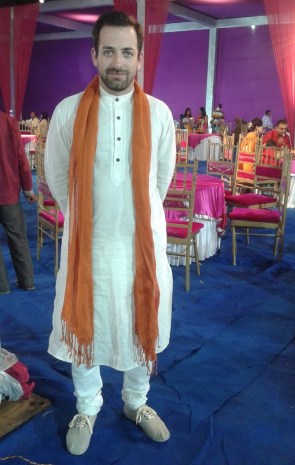
That’s worn off, it seems. Indian media got a whiff of how thick he lays on overt shows of multiculturalism. Corny and embarrassing, he made an exhibit of himself. You can wear Indian garb without drawing too much attention to yourself. Trudeau wore juutis to meet SRK.  It’s hardly apocalypse, though. Just clothing. I’d rather have a leader who tries too hard to appear multicultural than one mostly silent in the face of Muslims being lynched, or another who is soft-on-Nazis.
20160222_232855

The author at a wedding in Delhi, February 2016.

Oddly I’ve just been reading Khushwant Singh’s old essays on the roots of communal violence in Punjab. The Atwal episode is indeed strange and unjustifiable– a mistake was made. There are questions not just about how Atwal got invited, but about how he was suddenly allowed to enter India, when Jagmeet Singh was denied a visa. More will be learned about this. Right wing Indians suspect Trudeau’s government covertly supports Khalistan independence. I doubt Justin knows what that is. Likewise, it’s amusing how the attack dogs in conservative media here are suddenly experts on Khalistan.
 
While Trudeau’s India trip went stunningly bad, it’s not like the stakes were very high. What would real ties with Modi–the Hindu nationalist killer of gujarat–look like? What was to be gained here was relatively low in dollar value, high in cultural exchange between nations with a strong, historical fondness for each other…ie a great trip for Trudeau would have brought about results mostly symbolic anyway. India’s economy has lost its sheen post-demonetization/gst and Nirav Modi has the spotlight back on ol’ fashion crony corruption. Trudeau is in Delhi now with Hayley Wickenheiser and Ladakhi hockey players on an exchange–My loves, combined! Canadian Ice hockey and not just India but Ladakh coming together, it’s a warm thought.
IMG_20170812_142012_HDR

Ladakh!! August 2017.

Modi has less to gain than Canadians may think by posing with Trudeau. They each represent countries that get along well, apart from that they have nothing in common. Some from India’s right celebrate trump’s birthday by eating cake in Jantar Mantar. Trudeau may be more useful as a person to be distanced from. Not even his worst detractor here will call Trudeau a strong-man leader. Modi’s coolness wasn’t an accident, but the Canada-India cultural connection is too strong for him to sideline Trudeau altogether. They hugged in the end.
 
But Modi ran to the airport to hug trump the instant he landed because he feels a kinship with a leader who also leads via personality-cult and fascist tendencies. And trump has new condos to sell in India, so he pretends to care about India. Indeed, trump Jr is in India right now talking with billionaires, to try to get their money.  Trump backs India enough to hug Modi and do the photo op because it suits his personal economic interests, but will deny H1B visas to Indians seeking to come to America because ultimately they’re not white.
 
That’s my view of things, from the vantage of TO. By the way, I love and miss you India!! Reminder: a country is much, much more than its leader. Indeed, national leaders almost never reflect their country’s actual inhabitants.
IMG_20170701_221146

Canada at 150 in New Delhi at the Hyatt Regency Hotel.

“Me Too” backlash is ridiculous

27 Saturday Jan 2018

Posted by jdhalperin in Uncategorized

≈ Leave a comment

Some people are mad (or scared!) culture seems finally determined to protect women from sexual assault and rape. They may insist protecting women is a good thing, yes, but the effort has gone too far!

“It’s a Witch Hunt!” they say. No, it’s not. There are no such things as witches. Creeps and rapists exist. They’re everywhere.

OK, but now any woman can say anything and just like that, an innocent man’s life is ruined. Actually, when a female victim comes forward, it’s she who gets piled on, threatened, her reputation attacked. There are very real barriers keeping victims from speaking out publicly. The notion that women are lining up en masse to make up lies just to destroy innocent men is ridiculous.

Why is there more concern about these theoretical men who could maybe have their futures ruined, instead of all the actual women whose past, present and futures contain suffering?

“OK,” they say, “but not every creepy thing is rape!” Who can’t tell between a grope and forced penetration? Women know the difference. Any normal person does. They’re all unacceptable, but they’re not interchangeable or identical. This is easy to understand.

The’re a fear that employers and political parties are just throwing anybody from Aziz to Weinstein under the bus together. Well, companies and political parties have always clamored to protect their reputation / brand. When have they ever cared more about ethics and legal justice for workers than their own self-interest? The only thing that’s changed is, now, enough people consider sexual assault to be bad that they want to disassociated themselves from it.

The notion that men can’t make jokes in the workplace anymore, because anything will get them fired…is it really so onerous, to ask professionals to be professional? I held some zingers back. It kind of was a crime! They were good ones. But, damn it, I was a committed professional in my last office.

People are very quick to defend an accused man, even before anyone knows what he’s accused of. An illustrative example is Patrick Brown, the Conservative candidate for Ontario until a few days ago. His entire staff stepped down when it became known that a report accusing him of sexual assault was imminent. Brown denied all guilt. Many supported him. I heard his backers suggest it was merely a butt grab…even before they had any idea what he was accused of.

Turns out the accusation is that as a federal MP he gave alcohol to an 18-year-old and asked her to suck his dick. Words to the effect of that or “put this in your mouth.” She did, then she was uncomfortable and stopped. Another woman accused him of giving her alcohol when she was 18, and throwing her on the bed trying to kiss her. He maintained his innocence, his party tossed him out.

I’m not sure hatred for Kathleen Wynne was the only reason people rushed to defend Brown, because women in general are doubted. Rather than try to glean reality accurately, there’s a tendency to minimize, to reduce all accusations to the mildest one any man has ever been accused of.

Brown is an interesting case, because journalists and insiders apparently knew about him long before. They interpreted this story as finally it’s coming out, whereas this came out of the blue for most people, myself included. Who else knew, and when? That can be asked of every case.

Recall, even Weinstein initially insisted on his innocence and people believed him. Even though now apparently everybody knew. It’s been since reported in New Yorker’s “Army of Spies” that he hired former Mossad agent to spy on women he abused, to make sure they didn’t come forward, and to make sure journalists didn’t report on him for it.

There’s a fundamental difference between the court of public opinion and actual courts. An accused has the presumption of innocence when the state can imprison them. This is as it should be!

But by granting accused men the presumption of innocence in the court of public opinion, they assume women coming forward are guilty: it’s impossible to assume they’re both equally innocent at the same time. The neutral thing is keep your opinion suspended until more is known. Though I admit, I am now inclined to believe women.  Remember, this court is just the collective society’s opinion. It can’t punish anyone. Public opinion never fires someone, only companies or political parties do, and it’s based on their perception of how public opinion will affect them.

The flood of men being called out is because there’s a decades-long backlog. It’ll slow down, hopefully, when men improve.

Also, ignore boomers when they inevitably say ridiculous things like “in my day, we didn’t consider that assault!” as if their obsolete standards should matter in this day they just acknowledged we’re not in. Do they think assault should be tolerated now, because they tolerated it?

More to the point, who cares about them? Black people had separate water fountains in the US until 1964, and the last Canadian Government-run residential school closed in 1994. It would be a needless shame if we calibrated today’s world according to what that generation found OK.

I should add, nothing above is really partisan or buzzkill-y. Have sex! Enjoy! Fuck! Have afternoon anal for all I care. Just have it be consensual, which isn’t a big ask. If your’e doing it all right she won’t merely give you permission, she’ll repeatedly beg you to fuck her harder.

[Note: Jan 30–I don’t want to be mistaken for sounding flippant last para: I should have made my larger point clearer, that if a man/woman sends “mixed signals” it should interpreted as a red light not a green.

Also, I used salty language here perhaps unadvisably but not mindlessly, to indirectly combat the misguided notion I fear is kinda prevalent among men, that concern for safety/comfort of your sexual partner is somehow for prigs or killjoys.]


On Aging: An increasingly growing problem

29 Friday Dec 2017

Posted by jdhalperin in Uncategorized

≈ Leave a comment

Tags

aging, Happy new years, New years, parenting

On my forehead stand a couple relics, hairs that have bravely refused to recede. They demarcate the old boundaries of my hairline. A stinging reminder of what was. Proud but sad, like a luxury hotel in an abandoned country.

I noticed them years ago when a Cool Barber downtown cut them off. Why is he applying a razor to my forehead? It was my first time at a Cool Barber so I thought maybe that was a trend? What I’m saying is, it was inconceivable to me that my hairline could recede.

When a buddy told me in 2014 that I was in fact losing some hair, I feared he was losing his mind. Me? When time begins to deteriorate the body, it doesn’t usually announce itself. Timing and severity is the difference between the balding 20-year old and the Silver Fox whose thick grey hair signals, unfairly, both old age and youth. But my situation seemed doubly unfair: Not only am I subject to hair loss, but why do I have in several places where hair isn’t strictly necessary, but not my head? What kind of shit is this, fate, you bastard?

My dad used to point to the skin on his head and say to me: “Look, son: this is your future.” I laughed. It was funny then and even now, despite the statement’s latent horror. The unavoidable fact is I am older than I used to be.

People say when you return home after skipping town things stay the same. That isn’t quite true. The cost of Toronto housing has become three or four tiers more insane and my social circle includes literal babies. The sign you have completed one major revolution in life’s cycle is hanging out with people well under the legal drinking age.

How, when did it come to this? Timeless questions. Age and time was once automatically measured and felt when it was linked to a school year. Time was divided into neat sections, then every few months was a milestone. Summer. As reward for completing some little time unit, go drink and smoke in the woods for two months (camp, fun place). Then start it all again. Repeat. Such was time. One day there is nothing left to graduate.

But my god, I’m not dying! I’m 33. Growing up, especially for males, was to have an immortality complex. The first signs of aging doesn’t mean death is around the corner, but it’s a sign that I am in fact subject to death. This is new and tbh not altogether pleasant.

With age comes responsibilities, some great and inevitable, but I don’t want age to determine things.

One of the best nights I had in India was hanging out with a 55-year-old friend, drinking and singing songs on guitar until 5am. In North America and in consumer society in general people are slotted into demographics. The more they are targeted, the more its reinforced and they come to think of themselves in narrow age terms. This is reductionist and limiting. People feel they can’t learn new skills or art, adventure. Age groups do not mingle here. It’s not like that elsewhere.

In 2016 I went to a rager Holi party loaded with babies and grandparents. That obnoxious class of people—20-somethings—were in abundance too. There was a kiddy pool, fully-catered food and open bar. I was wet, full and drunk. Some military gentleman hosted it in his Defence Colony home. The dance floor was hot, karaoke was bumping. I wasn’t sure what affect bhang would have on me, so I took it twice. Everyone went home by 4:30pm.

This party would never happen in Canada, not just because Holi is Indian but age here creates rigid barriers. Silos. Surrounded by people of different ages, people perform. The young strive to appear mature. The older, mature enough. People try to be an age, instead of themselves.

This different schema/outlook has parenting implications. My good Delhi buddy is a 40-year-old father with an 11-year-old kid. The boy came to some parties and saw us smoking hash. It’s a funny time in Toronto as we await Canada legalizing weed—there are people (crusty obsolete weenies) who would call child services and report this maniac of a dad, even as conservative politicians who recently demanded mandatory minimums for possessing weed jostle to become drug dealers. (Great article on Julian Fantino’s hypocrisy) My buddy justified it on very principled, philosophical grounds. In thrust, “I live a moral life, so why should I have to hide anything from my child?”

Aging requires answering one fundamental question: Will I live how my parents/community did, or carve out something different? There is no right answer There are probably elements of both. It’s worth saying, some otherwise indefensible values are defended simply because it’s the traditional way of doing things. But the familiarity and sense of belonging to one’s own culture can be meaningful, too.

This will affect where people decide to live, whether to raise a family, what kind of values underlie all this in our adult lives.

Actually, I no longer believe there is any such thing as “adults”. When you’re six, the nine-year-old at the playground is intimidating because they’re enormous and, being nine, they know life. I wonder what senior citizens think, as they watch people in their 60s and 70s fuck up the planet so badly. As a kid you see a friend’s parents, or your own, and you assume they’re responsible and wise. No, some are just children ravaged by time, so they look like that. Really they have coke problems, mid-life crises or other complexes. Maybe they’re terminally immature.

Age guarantees nothing. There are many very wise children and elderly maniacs with no grip on reality. Don’t get me wrong all things being equal, age brings wisdom and I respect people who lived through stuff. But all things are not equal, and the notion that people are on a guaranteed track marching forward towards Responsibility and Wisdom simply because they haven’t died yet is not true.

Wordsworth and Blake were onto something when they praised children. I’ve never seen an infant commit genocide! Everyone loves childhood innocence. What about adult guilt?

My hope is AI replaces everybody so we can all chill for a living. I’d like for us to all age gracefully, without being so fixated on the look rather than the health of our bodies. I don’t want to be forced or nudged into abiding by social mores concerning age that aren’t mine.

I won’t be a different man when those lonesome, heroic forehead hairs finally admit defeat. Other hairs will surely go, too. I accept my age now. It’s OK! Again, I’m not 101. But when I am fatter and even more severely weathered I hope there’s still a party for me somewhere, playing guitar until late. If there isn’t, I’ll make my own. Even if I’m saddled with those ever-present things going around these days, children.

Happy New Year’s, everybody!


Male sexuality post-Weinstein

22 Wednesday Nov 2017

Posted by jdhalperin in Statements

≈ Leave a comment

Tags

cuck, male sexuality, MRA, rape, sexual assault, sexuality, weinstein

I usually keep my personal life out of my writing, but it’s impossible to write about the flood of men accused of sexual assault without some reference to my own experience as a male in the 90s and 2000s.

It’s weird—ask any guy and they’ll agree that of course (of course!) sexually assaulting women is wrong, but there’s a feeling in the air that this surge of men being accused of doing just that is dangerous or somehow bad.

I’d like to try explaining this.  Men have taken a hit lately, and for good reason, but I don’t want my explanation to read as an attack on men, or an apology / justification for assault or bad treatment. Just perceptions in a difficult time.

—————————————————————————————————————————-

Some men are (understandably, but regrettably) confused now because we grew up in a hyper-sexual world predicated on male sexual desire, and we are being bombarded with incontrovertible evidence that this world was anything but innocent. We, men, are and feel implicated in it.

Let’s be clear, women have been describing what‘s currently in headlines for years, and we didn’t listen. We didn’t want to. That world was very fun for us, and we didn’t want the party to stop.

Imagine existing in a world that accepts and caters to the deepest impulse raging through your body. That’s what it was to be male growing up in North America in the 90s and 2000s.

Imagine, the jokes, movies, the socially acceptable professional / unprofessional dynamics in so many ways all reflected and encouraged precisely what you most badly wanted to do. Both nature and nurture said the same thing: go for it.

Would anybody turn this off voluntarily?

This is about power—the reason good men (not Nice Guys, actual good men) may be uncomfortable today or even worried about women publicly describing how men have assaulted them is, for the first time, the world is making a demand on men, and we’re actually being expected to obey it.

That the demand is an ultra small demand—don’t be greasy let alone actually rape women—doesn’t change the fact that it’s a demand. It’s not the substance of the demand causing discomfort really, it’s that there’s any demand at all. (This is an explanation, not a justification for the discomfort.)

Male impunity is gone in the present and the past, and there’s a backlog of behavior being held accountable that was never supposed to be held to account.

In short, for the first time, men are not in total control. Ceding power is perceived by some men, MRA types or alt-right fuckers, as weakness. The connection they make between social power and sexual prowess is explicit in their use of the term “cuck” (from cuckold, as in a male whose wife has sex with another man) as a general pejorative. Males who don’t dominate are weak, to this type. Trite, brain dead alpha macho shit flourishes here. Of course progressive types can be misogynists who assault women too, which only shows that this transcends politics: it’s a male problem.

But every normal person across the political spectrum agrees that sex crimes against women (or men) are wrong, so I want to look at the culture of my youth, which at the time I (like everyone) enjoyed but now seems incredibly unhealthy and toxic.

In one of countless examples I can name, my friends and I lamented what we perceived as a crackdown on fun, when the summer camp I went to ended a staff rec tradition of the “Sex Olympics”, where among other things, female staff (16+) competed to see who could best deep throat popsicles. That this ever existed seems as ridiculous now as cancelling it did then.

But of course the Sex Olympics seemed like a reasonable thing to do in 2001. That was for staff. As campers we were brought up in this culture, and if 13-year-olds could inhabit a milieu that was near in spirit to hardcore porn, why shouldn’t people 16 and up? I called this the pussification of society. Casual misogyny abounded here. At the time, it was life and life as a young man then was fun.

I wonder about people who read my facebook posts supporting the female accusers, who saw me drunk as hell on a dance floor grinding with a random or telling or laughing at obscene ribald jokes, and think me a hypocrite. Well, I doubt anybody has an unblemished record, and this isn’t really about me. Every guy should be frantically searching their memory for bad shit they might have done, otherwise they’re inexperienced or part of the problem.  I leave it to them.

Women have described what’s in the headlines for years, but it’s reached the point where it’s simply impossible to deny. Thankfully, women are finally being believed and the public is getting a feel for the scale of the problem.

So, how to move forward?

Civilization is, in essence, order imposed on the lizard brain. Civilization is the collective act of using human intelligence to lift us above the conditions of feral animals, and choosing how life should be then enforcing it. At its root, art is ordering chaos. Laws do the same. Art and laws are civilization.

But, that we have the capacity for rational thought obscures the fact that rationale is not what primarily motivates us. The lizard brain has a much larger say than we want to believe. That’s why progressives can prove to be just as sick fucks as anybody else. Not having principles and setting them aside amount to the same.

The facts are as follows: human beings survived because of evolution, and evolution implanted in us the innate desire to want to fuck. It’s why we think of sex every seven seconds. Among other things, this sex drive led to the survival of our species (good!) and terrible consequences for women (terrible!).

I’ll say something my leftist friends have given me shit for: males and women are hard-wired differently. To be crystal clear, I believe nothing is more important than an individual’s right to be / do whatever they want, and I hate narrow or even broad gender stereotypes. The idea of telling anyone how to live, or of being told, repulses me. But can it be coincidental that over the course of history, the physically dominant gender has dominated?

I took a course in evolutionary psychology (EP) where the class text was written by a female feminist named Anne Campbell. This was by design, as leftists are suspicious of EP because they fear (sometimes correctly) hard-wiring is invoked in an attempt to justify male superiority, or the naturalistic fallacy, that something is desirable and maybe even inevitable for being natural. No. 

EP just posits that something can be said to fit into “human nature” if it is found to exist across time and across the planet. In other words, to qualify, an underlying behavior must occur basically always and everywhere. Can anyone name an era and place where women held real power? Sure, Google may turn up an isolated indigenous matriarchal society, but what does it say that you need to Google it? In the enlightened West women couldn’t originally vote. Same with celebrated Ancient Greece. The leading military figures and robber barons, the people with real power, have all been men.

The notion that women are people does not come naturally to men, who categorize them in two groups, women to be and not to be fucked. Hot or not. People need to unlearn a lot of messed up ideas they inherited, and ones pre-programmed in their brain.

It’s not for me to condemn male behavior—every person only knows what they’ve done in their life and that’s their responsibility. Of course women are the victims of patriarchy, but there isn’t one social institution that fosters any real sense of philosophy for its own sake. How to be friends with people, how to feel and be, how to love. Men suffer from this too, even the ones who behave badly and impose suffering on others.

Chivalry is essentially rituals around men ceding power to women—holding the door open, pulling out their chair, taking off a coat to warm them when it’s cold. Subconsciously, the idea boils down to: I’m physically more powerful than you, but I will use my power for you, rather than against you. Men must continue doing this, but writ large rather than in small isolated and ceremonial acts, and in ways that don’t directly benefit men. If chivalry is just a way to fuck a girl, it’s not really chivalrous.

The point is to give up power because it’s the right thing to do. I doubt this will happen. Even as more guilty men fall, I doubt things will fundamentally change. I hope I’m wrong.

The beast is in so many social institutions and reflected back at us because it’s in us in the first place. Men. The cycle moves in both directions. It’s in our lizard brain, so it’s in our movies and conversation, the office, the streets, the home. Everywhere. Men haven’t been asked to reckon with this, to amend our behavior.

Well of course we were asked, but we denied there was a problem. We denied we were the problem. Denying it was wrong then, but it’s impossible now. No guy can claim innocence ever again.

Every guy is hopefully having a private reckoning, assessing how they behaved in the old world by the new standards. Assuming your conduct was just gross or shameful and not illegal, there were excuses, even if bad ones.

But what you do now moving forward in the post-innocence era is up to you.

In India from Canada–jumping between economies, consumerism, money and other thoughts

31 Tuesday Oct 2017

Posted by jdhalperin in Uncategorized

≈ Leave a comment

Tags

India, travel

The following is simply a reflection of my own experience after living in India for a year and a half.

Every county has a range of shops and stores, from cheap to expensive and in between, covering everything from food and fashion. But if any country has the full range, it’s India.

Really rich Indians make Forest Hill people look like paupers, and they shop and live accordingly. The cheapest shops in India are very cheap. A local merchant, a vegetable wallah or whatever, can charge a white man like me way more than he’d charge an Indian, unable to believe his luck he can rip someone off so bad. But I’m used to Toronto prices, so I feel guilty I’m ripping him off. Both things are true at the same time.

If you want to spend a lot of money by Toronto standards in India, you can. There is a class of Indians who have fuck-you money, who never look at price tags. This exists, probably in larger number than Torontonians suspect, even if it’s barely a fraction of the Indian population. A quick Google search tells me that the average annual Indian income is $616 US. This is the figure, though another quick Google search says there are 236,000 Indian millionaires. The total population is roughly 1,300,000,000 (poor people do not immediately jump into the census when born) but some of these millionaires are actually billionaires, too, and I wonder what India’s average annual income would look like if you removed a handful of people at the very top.  Millions of people make way, way less than $616 a year.

Before arriving, I was curious to see how evolved consumerism and ad culture was in India, or Delhi at least. The food scene is intriguing. Food delivery is very common: There is an enormous surplus of labour, and they jump on one of a million motorcycles in Delhi and deliver McDonald’s or whatever else.  Smaller commercial restaurants may outsource their food delivery. There is always someone to do anything for a tiny amount of money.

Smaller local non-chain restaurants are a different story. They often don’t deliver. If the menu says a masala dosa costs 60 rupees ($1.20 Cdn), that’s what it costs. No tax. Somehow, this is just fine. Modi’s new HST tax means 18% is added, and this applies in fancier sit-down restaurants or North American chains. In smaller local places, the price is the price.

But being a white Torontonian yuppie scum meant I could toggle between economies when convenient. Obviously people with more money can buy what they want, this isn’t a revelation, but life has a very different quality when even luxuries are fundamentally affordable, when strangers assume of me, rightly, that I can pay for what they charge for a  dentist, between $22-30 Cdn (one time they did some free orthodontistry work too) or medical, or whatever food. Maybe it’s wise to save, but there is no cost in life if I decide to buy some nice food or whatever.

Delhi is a dirty city. The air is poison. I should say, street sweepers and others do a great job of cleaning, everyday. Shockingly poor people scavenge for garbage. In Lajpat Nagar 1 where I lived, there was a dump near me and people just go around picking stuff up.

Without getting into deeper reasoning or socio-cultural explanations for the root of Indian garbage habits, in this dirtier city I decided to buy a fancy face wash. Exfoliating, with rose and honey and apricot. This luxury item, an Indian product, cost like $2 and some odd cents. French hygiene products, for wealthier Indians, cost more than they do in Toronto.

I could buy things from the economy where prices are calibrated for poorer Indians, or if I felt like it from the foreigner economy. If I want to buy a super cheap souvenir, I pay local prices. The Lajpat Nagar II main market sold bangles, I think it was $1 for a dozen. In Toronto, the other day I happened to be at a local so-called Found Objects store selling bangles, and laughed to see each individual bangle for $2. 100 rupees for a single bangle!

Haircuts in my neighbourhood cost $1-3, and a head massage, those blessed things, could be $1-7. (A head massage is actually the head, shoulders, back, arms, and they crack your knuckles, and also sometimes your neck.). One time I paid $2 for a haircut and a head massage.

But Delhi has Khan Market (read: Con Market), too.  It is apparently among the world’s most expensive commercial real estate. When I got homesick, and yearned for the quintessential Toronto experience of being ripped off, I would come here.

About $20 Cdn here got me my beloved bagel lox and cream cheese, with fries and two double espressos. Indulging in India costs less than everyday Toronto.

Khan Market has lots of great yuppie crap, from the Body Shop (foreign soap) to $100 sushi meals with like only four rolls because the damn fish is flown in from god knows where and isn’t exactly overly fresh. The price of exotic items are, fittingly, not calibrated for normal Indians. If it isn’t produced in India, regular Indians probably don’t need it, because historically they never had it. (By “regular” I mean the non-professional types I worked with at the station.)

And again, “affordable” is a relative term. In India, unless it was for the people with Fuck-You money, about everything was affordable to me. Yet I made the legal minimum wage, the lowest salary a foreigner is allowed to receive by law (less, given my cheap ass company worth billions). But I never had to look at my bank account to decide if I could afford a nice lunch.

The truth is I made an obscene amount by Indian standards, and a pathetic amount by Toronto’s. A colleague nearly ten years older and with more than 15 years experience in Indian journalism, with a higher title and level of responsibility in the office than me, made less than half of what I did.  Yet I worked there knowing I’d have to reckon with Canadian prices eventually, and that housing in Toronto increased by more than 20% in the time I was away, so that a detached house in Toronto costs well over one million dollars. (50 million Indian rupees). Rent soared, too.

So I knew I was simultaneously rich and not rich. The way in which I was not rich is actually decadent as hell. People making Canadian salaries can go to many countries in the world, and by simple virtue of having been paid Western wages, can live like kings. This does not work the same way in reverse.

I find the relative wealth of the West disturbing and impossible to justify. I’ve seen Indians who work at least 12 hour days 7 days a week, and they’ll make next to nothing. This is one telling symptom of both a national and international economy predicated on absolute bullshit.

I could have delivered to me a smoked salmon sandwich, on a fresh ciabatta bun with craime fraiche and grainy mustard, and two stupid little heart-shaped sugar cookies for about $8-9. Of course there are cheaper things to eat. Spending this much was beyond the possibility for many colleagues, but in Toronto this may get you an appetizer. North Americans who know nothing about India, understandably, may be surprised to learn continental fare is available.

In Lajpat Nagar 1, I occasionally ate chicken, rice and roti made by a woman on my street. It cost almost $2. Very spicy and good! My Indian colleagues were shocked I ate this, as it could be sketchy in fact. Meh.

Street food, oh man. Basic vada pavs, fried potato with nice spices and a fresh yummy bun, cost I think 30 rupees in places. 60 cents. This is not a small amount of money for many locals.

Again, that India is cheaper than Toronto is not a revelation. But the feeling of freely being able to switch between these economies brings some uncomfortable questions. Being able to parachute into a country and live like a king while millions there starve is weird. I’m not responsible for this, but nonetheless you can’t be there and not see and feel how wrong it is. It’s not exactly guilt, because I know I’m not the guilty one, but I’m certainly living a very fine life based on something that does not feel right.

I’d wonder, could an economist explain this in a way that makes sense? Is it just that North America has such valuable currency because the US military is present around the world ensuring that US business interests are looked after? I suspect it’s to do with the latter, but it’s a damn complicated world and this feels like an oversimplification too. But it does seem beyond coincidence that the US dollar is proportionately as high as their global military presence.

But to see people born there, living on the street…there are economic and geo-political lenses this can be seen through, but the situation urges you to see it through basic existential terms. They were just born there, I’m just born here, and whatever the other reasons are, as complicated and diverse as they are, they come second. Not first.

Hash is obscenely cheap, even if, as I understand it, the price has gone up markedly. It is currently $30 Cdn for a “tola”, or ten grams(!!!), of potent Himalayan charras.  In Canada this money gets you 2 grams if you’re lucky.

Like I said, the average Indian annual income in 2013 was $616 US. I made $3,000 Cdn, monthly. This sounds like a brag in light of that fact, but remember, I could not have legally made less money. There are white people in India working illegally for charities and NGOs and things like that, and they make less. But it’s true that if you see a white person in India, they had enough money to buy the plane ticket to get there. That the legal minimum was such an obscene amount of money there speaks to how white people have everything work in their favour. Legally, and even culturally in practice, there is always a tailwind for white people.

Before coming to India I was paying Toronto rent and working as a private guitar teacher. No salary, no guaranteed income. I managed to sell some writing here, less reliable than teaching. I had a flatmate in Toronto, where my share of rent was about $1100 monthly. I lived alone in a nice apartment in a good area in South Delhi, and rent was $400 a month. I knew people who paid in rent $120-250ish Cdn.

One time I noticed The Gap was coming to India. Big news! Every Western brand has automatic prestige in India, because it is simply Western. Indians automatically accord respect and importance and high-status to anything Western, even if the thing itself is made in Bangladesh and is merely advertised by North American 20-somethings.

I saw signs, breathlessly praising the upcoming opening of The Gap. Then it opened, and I was curious to see what things cost. A t-shirt, $30 Cdn, same as here. That is insane, I thought, and aside from wealthy Indians who want to signal that they can afford North American prices, Indians won’t go for that. Indians know the price of things and do not waste a single rupee. Paisa vasool. “Finally, The Gap Is Here!” a sign read, or something like that. I thought and hoped Indians were too smart to be taken in by these prices. Next time I came, it read, “Gap Open! Up to 90% off!” Good! Fuckin parasites.

Indian Terrain is a chain store in malls and locations around Delhi and other Indian cities. If I buy a nice button down shirt it can cost about 2,000 Indian rupees, or $40 Cdn. The shirt will be much higher quality than H&M, but actually $10 more expensive, perhaps. But it compares in quality to Club Monaco, where shirts not on sale can range from $40-$120.

Yet In Old Manali, I bought a beautiful button down shirt hand-stitched by the fellas in the store for $10 Cdn, 500 rupees. I know there are people in India selling hand-made shirts with the same fabric for even less.

One thing I noticed, actually, is that poor people in Delhi and elsewhere in North India have clothes that fit well. I speculate on the reasons: most Indians are smaller. Malnourishment is a real problem. Not many people wear XXL. Clothes need to be made in fewer sizes. People in Toronto buy ill-fitting clothes maybe because there are more wrong sizes to buy. This is probably a very dumb gora observation, but I wonder if there’s anything to it.

A few weeks after landing in India, I wondered if I, standing at just over 5”8, was the largest man in the country. I towered over many people who are clearly poor and seem to have suffered from stunted growth. Several of the “office boys” and janitors at work, and people like them in the city. I find that phrase “office boy” demeaning and classist, but it’s a common phrase most Indians would never think to put quotation marks around.

But also, better fit may have to do with Indian merchants being more capable than their Canadian counterparts. People who sell the clothes commonly make them too. There is less division of labour. Shops make and sell, some just sell what’s been pre-made. But even in a commercial store like Levis, you just buy jeans according to waist size, not length—they measure the leg length and cut it there in the store while you wait. I wonder if poor Indians get custom clothes them because tailoring is so common there, so it’s just a part of buying clothes. Here, there’s a premium on “made to measure” or “bespoke” clothing, and the cost goes up by 1000%. I think the idea of having loads of pre-made shirts from factories to sell is relatively new in India, dating back to the early 90s when the economy “liberalized”, ie began its slow, slow opening to Western countries. (Ask a Western businessman if it’s easy to do business in India, and he will say “no” or laugh, no matter what Modiji tells you).

Alas, this is one of those things I could not learn, because it’s so rare for poor Indians to speak or understand English, and my Hindi is pathetic. Hindi meri bakwas hai. I wonder if middle, or upper-middle class Indians will think my speculation is ridiculous. Or maybe it’s accurate. Maybe some journalists I know could answer it, but for the most part, from what I could gather, most middle or upper class Indians have no desire to speak to poor Indians. They stopped seeing them a long time ago.

I would occasionally see Indians wearing clothes that clearly came from the West, through charities I guess. Oldschool Nike t-shirts! In Ajmer, Rajasthan, I saw a dude who had no shoes and a ragged lungi but wore a t-shirt that said “Bury me in my ones. Nike Air.” Think about that. This dude was not into basketball/hip hop culture. I’ve seen a few poor Indians wearing Wu Tang gear, guys who I suspect have not entered the proverbial 36 chambers.

Let’s chart the life cycle of that t-shirt: Probably originally made in Asia by a worker paid pennies hourly, bought by a North American for $25+, given back to charity maybe just to be nice or perhaps it went out of style or some other reason, back to Asia to a guy who has no clue what Air Force Ones are. The shirt never changes in substance, just its value is inflated like hell in North America because its worth is abstract. In India, it first represented an impossibly low wage, then was a symbol on a man, then fabric on a man. Both are reality, but North American reality is often psychological, existing mostly in the mind. (Of course the shirt has a tangible existence in both places, but it is not valued at $25+ because North Americans value cloth on their body more–signaling “Nike” is the value.)

Being back in Canada, where the value of products is largely abstract, making it susceptible to endless manipulation and  inflation by obscenely wealthy and exploitative companies, life seems to be moored to something less real. Psychology understanding of a shirt’s brand is real, but this reality is decadent compared to the tangible desire to cover your body in cloth. My Indian friends and colleagues would kill me if they’re reading this, because I’m not talking about them and Indians hate to be thought of as poor. They have a chip on their shoulder, understandably. The British robbed them blind. At one time, India had 25% of the wealth on Earth.

So as a white guy walking into Delhi, working for an international news station, I immediately had top shelf connections. The world of Indian journalism is small. Like all over the world, only upper and middle class people become journalists. They are the ones who go to college for it, or can afford giving time to work in unpaid internships. Indian news stations don’t have dalits working there. Everyone has worked in every other office, they do the circuit. They all know each other, and the circle is small.

I had done nothing there but arrive, and the country felt insanely open to me. I could travel anywhere, buy anything I wanted in it (not a car or a house, maybe, the latter because there are rules regulating foreigners buying property, and anyway I didn’t have that much money).

On my second day in India I met the premier of Ontario. I has welcomed inside a bunch of embassies. I regularly went to the Press Club and the Foreign Correspondence Club. To be sure the latter two aren’t very exclusive, my then-editor in chief had a membership and we went there to eat cheap kebabs and drink cheap beer and whiskey. One of my hosts worked at the US embassy, and she met David Letterman while I was there. I went to a wedding at the home compound of the President of India. I had a press pass, and cars in Delhi have “press stickers” to say to police and everyone else, “don’t fuck with me or I’ll report you”. There was power. Especially as a white man. And I had done nothing there. I repeat, nothing.

More than access or stories, it’s the way people approached and perceived me that is shocking. I was a sensation. I was one of the only white people to work in my office building, and people treated me with more respect than I deserved. I’m just a guy! Poor and definitely wealthy Indians too enjoy being seen with a white man.

At work, I was able to push back in ways my Indian colleagues were not. It was understood that for all the talk of not having a traditional hierarchy in the office there was still a hierarchy, but I didn’t really give a fuck about that. I wasn’t an asshole, but I resisted being pushed around in ways my colleagues were not able to, I expected the company to live up to the contract it signed and I repeated my expectation to them until they sometimes kinda did, which is an utterly foreign concept in an Indian office. I never called my bosses “sir”.

My existence was enormously sheltered and privileged. Uber is there in Delhi and cheap as hell. Rides within the city are $1 to share, or $2 to ride alone. Plus in my first year, my company paid for every single Uber I took, work-related or not. I took the Metro occasionally, it was about 30 cents a trip. But saving a dollar or two to be crowded and sweaty and have to make up the last mile to and from the metro station with a rickshaw driver who understood no English made no sense.

I’d sometimes pay a rickshaw driver to take me to the metro (subway), or from the metro to where I needed to go. Since the company was paying for my Uber and the metro came from my pocket, it made no sense to take the longer, more expensive and more confusing way. Thus, again, living was easy and sheltered. I’d see people living, sleeping under a flyover from an air conditioned car. This is a trite, packaged image, but I literally did see it everyday.

Weeks after being back, I find I’m surrounded by wealth and abstract/brand cravings, so they people are unsatisfied despite possessing more wealth than most of the world could ever dream of. This sounds like a criticism of these individuals, but really it’s the influence of consumer society, ie mental poison. It drives the rich mad.  It’s also something I knew before and everybody knows, and there’s nothing more trite than coming back from India and pointing out the gap between wealth and happiness. Look, India has spiritual people and spiritual frauds all over the place and Toronto has beautiful caring soulful people, poor and wealthy alike. But the hollowness here is palpable and everywhere, and I want to shrug it off but it is so fundamental to the world, the external world and people’s inner life, that I simply despise it.

← Older posts
Newer posts →

Twitter

Follow @JDhalperin
Tweet

Enter your email address to follow this blog and receive notifications of new posts by email.

Join 1,022 other subscribers

Essential sites

  • Grateful Dead Chords/Tabs
  • Neil Young Chords/Tabs

My Writing

  • Huffington Post
  • Maclean's
  • Music Writing
  • The Star
  • the Walrus Laughs
  • Toronto Review of Books
  • Toronto Standard
  • World Is One News

Topics

  • Comedy (18)
  • Literature (13)
  • Music (1)
  • Politics (28)
  • Sports (16)
  • Statements (36)
  • Uncategorized (44)

Create a free website or blog at WordPress.com.

Privacy & Cookies: This site uses cookies. By continuing to use this website, you agree to their use.
To find out more, including how to control cookies, see here: Cookie Policy
  • Subscribe Subscribed
    • Jeff Halperin
    • Join 52 other subscribers
    • Already have a WordPress.com account? Log in now.
    • Jeff Halperin
    • Subscribe Subscribed
    • Sign up
    • Log in
    • Report this content
    • View site in Reader
    • Manage subscriptions
    • Collapse this bar
 

Loading Comments...