In India from Canada–jumping between economies, consumerism, money and other thoughts

Tags

,

The following is simply a reflection of my own experience after living in India for a year and a half.

Every county has a range of shops and stores, from cheap to expensive and in between, covering everything from food and fashion. But if any country has the full range, it’s India.

Really rich Indians make Forest Hill people look like paupers, and they shop and live accordingly. The cheapest shops in India are very cheap. A local merchant, a vegetable wallah or whatever, can charge a white man like me way more than he’d charge an Indian, unable to believe his luck he can rip someone off so bad. But I’m used to Toronto prices, so I feel guilty I’m ripping him off. Both things are true at the same time.

If you want to spend a lot of money by Toronto standards in India, you can. There is a class of Indians who have fuck-you money, who never look at price tags. This exists, probably in larger number than Torontonians suspect, even if it’s barely a fraction of the Indian population. A quick Google search tells me that the average annual Indian income is $616 US. This is the figure, though another quick Google search says there are 236,000 Indian millionaires. The total population is roughly 1,300,000,000 (poor people do not immediately jump into the census when born) but some of these millionaires are actually billionaires, too, and I wonder what India’s average annual income would look like if you removed a handful of people at the very top.  Millions of people make way, way less than $616 a year.

Before arriving, I was curious to see how evolved consumerism and ad culture was in India, or Delhi at least. The food scene is intriguing. Food delivery is very common: There is an enormous surplus of labour, and they jump on one of a million motorcycles in Delhi and deliver McDonald’s or whatever else.  Smaller commercial restaurants may outsource their food delivery. There is always someone to do anything for a tiny amount of money.

Smaller local non-chain restaurants are a different story. They often don’t deliver. If the menu says a masala dosa costs 60 rupees ($1.20 Cdn), that’s what it costs. No tax. Somehow, this is just fine. Modi’s new HST tax means 18% is added, and this applies in fancier sit-down restaurants or North American chains. In smaller local places, the price is the price.

But being a white Torontonian yuppie scum meant I could toggle between economies when convenient. Obviously people with more money can buy what they want, this isn’t a revelation, but life has a very different quality when even luxuries are fundamentally affordable, when strangers assume of me, rightly, that I can pay for what they charge for a  dentist, between $22-30 Cdn (one time they did some free orthodontistry work too) or medical, or whatever food. Maybe it’s wise to save, but there is no cost in life if I decide to buy some nice food or whatever.

Delhi is a dirty city. The air is poison. I should say, street sweepers and others do a great job of cleaning, everyday. Shockingly poor people scavenge for garbage. In Lajpat Nagar 1 where I lived, there was a dump near me and people just go around picking stuff up.

Without getting into deeper reasoning or socio-cultural explanations for the root of Indian garbage habits, in this dirtier city I decided to buy a fancy face wash. Exfoliating, with rose and honey and apricot. This luxury item, an Indian product, cost like $2 and some odd cents. French hygiene products, for wealthier Indians, cost more than they do in Toronto.

I could buy things from the economy where prices are calibrated for poorer Indians, or if I felt like it from the foreigner economy. If I want to buy a super cheap souvenir, I pay local prices. The Lajpat Nagar II main market sold bangles, I think it was $1 for a dozen. In Toronto, the other day I happened to be at a local so-called Found Objects store selling bangles, and laughed to see each individual bangle for $2. 100 rupees for a single bangle!

Haircuts in my neighbourhood cost $1-3, and a head massage, those blessed things, could be $1-7. (A head massage is actually the head, shoulders, back, arms, and they crack your knuckles, and also sometimes your neck.). One time I paid $2 for a haircut and a head massage.

But Delhi has Khan Market (read: Con Market), too.  It is apparently among the world’s most expensive commercial real estate. When I got homesick, and yearned for the quintessential Toronto experience of being ripped off, I would come here.

About $20 Cdn here got me my beloved bagel lox and cream cheese, with fries and two double espressos. Indulging in India costs less than everyday Toronto.

Khan Market has lots of great yuppie crap, from the Body Shop (foreign soap) to $100 sushi meals with like only four rolls because the damn fish is flown in from god knows where and isn’t exactly overly fresh. The price of exotic items are, fittingly, not calibrated for normal Indians. If it isn’t produced in India, regular Indians probably don’t need it, because historically they never had it. (By “regular” I mean the non-professional types I worked with at the station.)

And again, “affordable” is a relative term. In India, unless it was for the people with Fuck-You money, about everything was affordable to me. Yet I made the legal minimum wage, the lowest salary a foreigner is allowed to receive by law (less, given my cheap ass company worth billions). But I never had to look at my bank account to decide if I could afford a nice lunch.

The truth is I made an obscene amount by Indian standards, and a pathetic amount by Toronto’s. A colleague nearly ten years older and with more than 15 years experience in Indian journalism, with a higher title and level of responsibility in the office than me, made less than half of what I did.  Yet I worked there knowing I’d have to reckon with Canadian prices eventually, and that housing in Toronto increased by more than 20% in the time I was away, so that a detached house in Toronto costs well over one million dollars. (50 million Indian rupees). Rent soared, too.

So I knew I was simultaneously rich and not rich. The way in which I was not rich is actually decadent as hell. People making Canadian salaries can go to many countries in the world, and by simple virtue of having been paid Western wages, can live like kings. This does not work the same way in reverse.

I find the relative wealth of the West disturbing and impossible to justify. I’ve seen Indians who work at least 12 hour days 7 days a week, and they’ll make next to nothing. This is one telling symptom of both a national and international economy predicated on absolute bullshit.

I could have delivered to me a smoked salmon sandwich, on a fresh ciabatta bun with craime fraiche and grainy mustard, and two stupid little heart-shaped sugar cookies for about $8-9. Of course there are cheaper things to eat. Spending this much was beyond the possibility for many colleagues, but in Toronto this may get you an appetizer. North Americans who know nothing about India, understandably, may be surprised to learn continental fare is available.

In Lajpat Nagar 1, I occasionally ate chicken, rice and roti made by a woman on my street. It cost almost $2. Very spicy and good! My Indian colleagues were shocked I ate this, as it could be sketchy in fact. Meh.

Street food, oh man. Basic vada pavs, fried potato with nice spices and a fresh yummy bun, cost I think 30 rupees in places. 60 cents. This is not a small amount of money for many locals.

Again, that India is cheaper than Toronto is not a revelation. But the feeling of freely being able to switch between these economies brings some uncomfortable questions. Being able to parachute into a country and live like a king while millions there starve is weird. I’m not responsible for this, but nonetheless you can’t be there and not see and feel how wrong it is. It’s not exactly guilt, because I know I’m not the guilty one, but I’m certainly living a very fine life based on something that does not feel right.

I’d wonder, could an economist explain this in a way that makes sense? Is it just that North America has such valuable currency because the US military is present around the world ensuring that US business interests are looked after? I suspect it’s to do with the latter, but it’s a damn complicated world and this feels like an oversimplification too. But it does seem beyond coincidence that the US dollar is proportionately as high as their global military presence.

But to see people born there, living on the street…there are economic and geo-political lenses this can be seen through, but the situation urges you to see it through basic existential terms. They were just born there, I’m just born here, and whatever the other reasons are, as complicated and diverse as they are, they come second. Not first.

Hash is obscenely cheap, even if, as I understand it, the price has gone up markedly. It is currently $30 Cdn for a “tola”, or ten grams(!!!), of potent Himalayan charras.  In Canada this money gets you 2 grams if you’re lucky.

Like I said, the average Indian annual income in 2013 was $616 US. I made $3,000 Cdn, monthly. This sounds like a brag in light of that fact, but remember, I could not have legally made less money. There are white people in India working illegally for charities and NGOs and things like that, and they make less. But it’s true that if you see a white person in India, they had enough money to buy the plane ticket to get there. That the legal minimum was such an obscene amount of money there speaks to how white people have everything work in their favour. Legally, and even culturally in practice, there is always a tailwind for white people.

Before coming to India I was paying Toronto rent and working as a private guitar teacher. No salary, no guaranteed income. I managed to sell some writing here, less reliable than teaching. I had a flatmate in Toronto, where my share of rent was about $1100 monthly. I lived alone in a nice apartment in a good area in South Delhi, and rent was $400 a month. I knew people who paid in rent $120-250ish Cdn.

One time I noticed The Gap was coming to India. Big news! Every Western brand has automatic prestige in India, because it is simply Western. Indians automatically accord respect and importance and high-status to anything Western, even if the thing itself is made in Bangladesh and is merely advertised by North American 20-somethings.

I saw signs, breathlessly praising the upcoming opening of The Gap. Then it opened, and I was curious to see what things cost. A t-shirt, $30 Cdn, same as here. That is insane, I thought, and aside from wealthy Indians who want to signal that they can afford North American prices, Indians won’t go for that. Indians know the price of things and do not waste a single rupee. Paisa vasool. “Finally, The Gap Is Here!” a sign read, or something like that. I thought and hoped Indians were too smart to be taken in by these prices. Next time I came, it read, “Gap Open! Up to 90% off!” Good! Fuckin parasites.

Indian Terrain is a chain store in malls and locations around Delhi and other Indian cities. If I buy a nice button down shirt it can cost about 2,000 Indian rupees, or $40 Cdn. The shirt will be much higher quality than H&M, but actually $10 more expensive, perhaps. But it compares in quality to Club Monaco, where shirts not on sale can range from $40-$120.

Yet In Old Manali, I bought a beautiful button down shirt hand-stitched by the fellas in the store for $10 Cdn, 500 rupees. I know there are people in India selling hand-made shirts with the same fabric for even less.

One thing I noticed, actually, is that poor people in Delhi and elsewhere in North India have clothes that fit well. I speculate on the reasons: most Indians are smaller. Malnourishment is a real problem. Not many people wear XXL. Clothes need to be made in fewer sizes. People in Toronto buy ill-fitting clothes maybe because there are more wrong sizes to buy. This is probably a very dumb gora observation, but I wonder if there’s anything to it.

A few weeks after landing in India, I wondered if I, standing at just over 5”8, was the largest man in the country. I towered over many people who are clearly poor and seem to have suffered from stunted growth. Several of the “office boys” and janitors at work, and people like them in the city. I find that phrase “office boy” demeaning and classist, but it’s a common phrase most Indians would never think to put quotation marks around.

But also, better fit may have to do with Indian merchants being more capable than their Canadian counterparts. People who sell the clothes commonly make them too. There is less division of labour. Shops make and sell, some just sell what’s been pre-made. But even in a commercial store like Levis, you just buy jeans according to waist size, not length—they measure the leg length and cut it there in the store while you wait. I wonder if poor Indians get custom clothes them because tailoring is so common there, so it’s just a part of buying clothes. Here, there’s a premium on “made to measure” or “bespoke” clothing, and the cost goes up by 1000%. I think the idea of having loads of pre-made shirts from factories to sell is relatively new in India, dating back to the early 90s when the economy “liberalized”, ie began its slow, slow opening to Western countries. (Ask a Western businessman if it’s easy to do business in India, and he will say “no” or laugh, no matter what Modiji tells you).

Alas, this is one of those things I could not learn, because it’s so rare for poor Indians to speak or understand English, and my Hindi is pathetic. Hindi meri bakwas hai. I wonder if middle, or upper-middle class Indians will think my speculation is ridiculous. Or maybe it’s accurate. Maybe some journalists I know could answer it, but for the most part, from what I could gather, most middle or upper class Indians have no desire to speak to poor Indians. They stopped seeing them a long time ago.

I would occasionally see Indians wearing clothes that clearly came from the West, through charities I guess. Oldschool Nike t-shirts! In Ajmer, Rajasthan, I saw a dude who had no shoes and a ragged lungi but wore a t-shirt that said “Bury me in my ones. Nike Air.” Think about that. This dude was not into basketball/hip hop culture. I’ve seen a few poor Indians wearing Wu Tang gear, guys who I suspect have not entered the proverbial 36 chambers.

Let’s chart the life cycle of that t-shirt: Probably originally made in Asia by a worker paid pennies hourly, bought by a North American for $25+, given back to charity maybe just to be nice or perhaps it went out of style or some other reason, back to Asia to a guy who has no clue what Air Force Ones are. The shirt never changes in substance, just its value is inflated like hell in North America because its worth is abstract. In India, it first represented an impossibly low wage, then was a symbol on a man, then fabric on a man. Both are reality, but North American reality is often psychological, existing mostly in the mind. (Of course the shirt has a tangible existence in both places, but it is not valued at $25+ because North Americans value cloth on their body more–signaling “Nike” is the value.)

Being back in Canada, where the value of products is largely abstract, making it susceptible to endless manipulation and  inflation by obscenely wealthy and exploitative companies, life seems to be moored to something less real. Psychology understanding of a shirt’s brand is real, but this reality is decadent compared to the tangible desire to cover your body in cloth. My Indian friends and colleagues would kill me if they’re reading this, because I’m not talking about them and Indians hate to be thought of as poor. They have a chip on their shoulder, understandably. The British robbed them blind. At one time, India had 25% of the wealth on Earth.

So as a white guy walking into Delhi, working for an international news station, I immediately had top shelf connections. The world of Indian journalism is small. Like all over the world, only upper and middle class people become journalists. They are the ones who go to college for it, or can afford giving time to work in unpaid internships. Indian news stations don’t have dalits working there. Everyone has worked in every other office, they do the circuit. They all know each other, and the circle is small.

I had done nothing there but arrive, and the country felt insanely open to me. I could travel anywhere, buy anything I wanted in it (not a car or a house, maybe, the latter because there are rules regulating foreigners buying property, and anyway I didn’t have that much money).

On my second day in India I met the premier of Ontario. I has welcomed inside a bunch of embassies. I regularly went to the Press Club and the Foreign Correspondence Club. To be sure the latter two aren’t very exclusive, my then-editor in chief had a membership and we went there to eat cheap kebabs and drink cheap beer and whiskey. One of my hosts worked at the US embassy, and she met David Letterman while I was there. I went to a wedding at the home compound of the President of India. I had a press pass, and cars in Delhi have “press stickers” to say to police and everyone else, “don’t fuck with me or I’ll report you”. There was power. Especially as a white man. And I had done nothing there. I repeat, nothing.

More than access or stories, it’s the way people approached and perceived me that is shocking. I was a sensation. I was one of the only white people to work in my office building, and people treated me with more respect than I deserved. I’m just a guy! Poor and definitely wealthy Indians too enjoy being seen with a white man.

At work, I was able to push back in ways my Indian colleagues were not. It was understood that for all the talk of not having a traditional hierarchy in the office there was still a hierarchy, but I didn’t really give a fuck about that. I wasn’t an asshole, but I resisted being pushed around in ways my colleagues were not able to, I expected the company to live up to the contract it signed and I repeated my expectation to them until they sometimes kinda did, which is an utterly foreign concept in an Indian office. I never called my bosses “sir”.

My existence was enormously sheltered and privileged. Uber is there in Delhi and cheap as hell. Rides within the city are $1 to share, or $2 to ride alone. Plus in my first year, my company paid for every single Uber I took, work-related or not. I took the Metro occasionally, it was about 30 cents a trip. But saving a dollar or two to be crowded and sweaty and have to make up the last mile to and from the metro station with a rickshaw driver who understood no English made no sense.

I’d sometimes pay a rickshaw driver to take me to the metro (subway), or from the metro to where I needed to go. Since the company was paying for my Uber and the metro came from my pocket, it made no sense to take the longer, more expensive and more confusing way. Thus, again, living was easy and sheltered. I’d see people living, sleeping under a flyover from an air conditioned car. This is a trite, packaged image, but I literally did see it everyday.

Weeks after being back, I find I’m surrounded by wealth and abstract/brand cravings, so they people are unsatisfied despite possessing more wealth than most of the world could ever dream of. This sounds like a criticism of these individuals, but really it’s the influence of consumer society, ie mental poison. It drives the rich mad.  It’s also something I knew before and everybody knows, and there’s nothing more trite than coming back from India and pointing out the gap between wealth and happiness. Look, India has spiritual people and spiritual frauds all over the place and Toronto has beautiful caring soulful people, poor and wealthy alike. But the hollowness here is palpable and everywhere, and I want to shrug it off but it is so fundamental to the world, the external world and people’s inner life, that I simply despise it.
Returning to Puck after India

I feel elated to have hockey back in my life again. Puck was too fundamental to my childhood, adolescence and also adulthood to feel alien now, but a lot has changed.

The feeling of knowing Saturday night will begin again with puck is incredible. But the Leafs are different. They are good! Actually! Being a Leaf fan is to be emotionally fragile about them, and I’m trying not to invest feelings, but having dominant players to root for is a pleasant shock.

In India I didn’t mourn the loss of puck. I was busy and very stimulated and the absence of puck had no impact on my life for the first year. But after about twelve months it was playoffs, and the Leafs were in. I woke up at 3:30 am, lit some charras and watched the best pro hockey I’ve seen in probably 15 years. Matthews. The timing, and the place of it, was strange, but once the puck dropped it was like riding a bike.

I had contacted the Canadian embassy in Delhi to see if I could attend their NHL playoff screening, but they responded that not only couldn’t , no such screening existed. Why even have an embassy, then? They didn’t explain this either. They recommended I buy some Rogers service to stream the game. No, I felt safe from Rogers this far away and refused to let them gouge me, so I streamed it online, which was surprisingly reliable.

In the past, when any regular season let alone playoff game was on, I could be heard screaming abuse at players and refs in a room by myself. The players, too, in the 90s-early 2000s mirrored my insane intensity. They sometimes spat in the face of opposing players face, then jumped in their bench and punched this same face. One major strain of NHL hockey was real sheer burning hatred, and this was released not by outscoring opponents but by beating the shit out of them. This satisfied me, because even if we didn’t win the Cup, and we most certainly didn’t, at least we won a round or two and hurt some rats.

From the bit I’ve seen, NHL hockey has softened enormously and the results are spectacular. A Leaf collided with a Sen last night, and instead of a facewash or chirp or a hack or slash, they each seemed concerned for the other’s well being. Then they just…moved on. Look: the truth is these are obscenely overpaid and obscenely talented kids playing a game they love. What team they play for is arbitrary. It’s a game. I used to think a human being’s character and moral worth was solely determined by what team drafted them–it’s hard to believe I was ever so stupid. (Actually, is it?) Refs now are actually enforcing the rules of hockey, instead of allowing them to be skirted by enforcing The Code of the game, and now hockey games are won by playing hockey. Goonery seems gone, and I don’t miss it a bit.

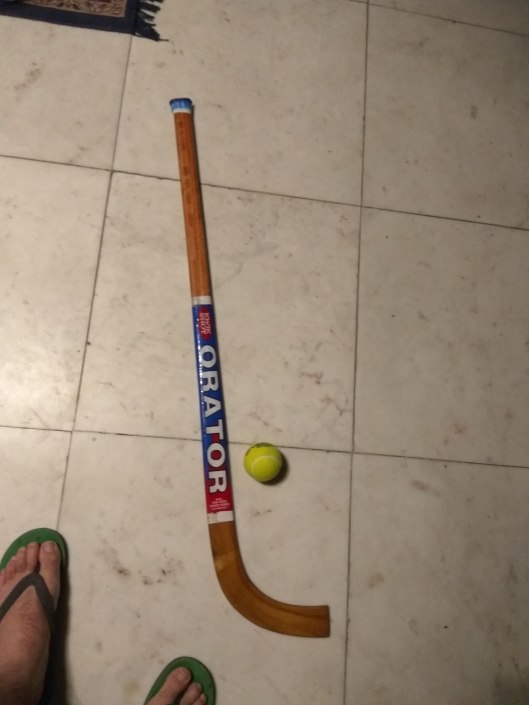
In India the closest thing I could buy to a hockey stick was a field hockey stick, or what in India is called a “hockey stick.” It was a dinky stupid little thing, but I could stick handle a tennis ball around when aching to play, and this approximation of actual hockey, deeking out inanimate objects, was the closest thing I could find.

IMG_20170616_221457

I just returned from playing my first ice hockey game with full equipment, goalies and refs and all, in probably 7 years. And that game was my first in years, too.

I bought real twigs the other day! I told the gentleman at Sport Check I needed help, because the equipment all seemed so new. There were no Easton Aluminums, Koho or Titans. There were no Sakic curves. They’ve been composite for years, but even when I was playing shinny I had a wooden twig. The knowledgeable employee told me things I find incredible. All sticks have very large curves now, no heel curves. “It’s all about the sauce these days.” He means saucer passes, raising the puck on a pass over an opponents’ fore-checking stick so it lands on the other side for a teammate. Skill.

Skates cost between $89-1000 (About 5,000 to 50,000 Rupees!). Skate sharpening now isn’t just sharpening a blade, there are different kind of cuts, with ratios that apparently do mean something to players who can tell the difference. The advances in gear are substantial—sticks/skates are impossibly light, they flex to your foot, skates are protective (if you have money, otherwise break a foot blocking a shot, you poor bastard you deserve a broken foot), the helmets even apparently are better.

At the rink today a sign proclaimed: “Relax, it’s just a game.” This was not the messaging I heard as a kid. Don Cherry taught that the failure to block a shot or forcefully clear the front of the net was a national disgrace. I’m not sure it ever occurred to me that hockey was only a game. There were duties, often semi-violent to violent. I took it oddly seriously as a 12-14 year old, my golden-era as a select player. I was a good house league player until 19, ie mediocre to decent in the actual world.

Today I played with some buddies and had an incredible time. I was gassed halfway through the first (maybe a quarter way), but took some late rushes as a D man, made a few passes, deeked a few people, got burned on some odd man rushes going back (it was not a cerebral lapse, I was pinching because I just didn’t have the juice in my legs to get back and accepted it then and now), and we won 5-2. Their goalie made a few surprisingly good saves on me when I went roof, but I got an apple. I didn’t have my head up with the puck to know where guys were, I felt behind in that respect. But made some good and unexpected passes. And botched some. It was kind of a blur. I couldn’t believe that once ice-time was something I desperately wanted more of. Oh my god. Winning the game was second to making it out alive. 17-15-15 minute periods, stop time and only two full lines. Killer.

But this time a teammate talked about his kids. The parents at my game were not watching from the stands they were on my team. Playing puck as an old bastard is extremely chilled. Our team and the opposing one was not very high-level, but there was definitely talent. There was healthy competition—ie there barely was any. No chirping, body checking, slashing, slew-footing. I was a sub only playing because most of the guys actually on the team had a bachelor party, but I tried not to botch it too bad and hold my own. My commitment wasn’t ferocious. It turns out hockey actually is just a game. This counts as a revelation.

Leafs are good and I just might skate again. Sports isn’t only a con perpetrated by obscenely rich owners who get citizens to buy them stadiums with public money then make tickets affordable only as a business write-off. The pathological profiteering of the Leafs ownership is bearable, and hardly even detectable from TV, when the team is actually run by bona fide hockey guys (Babcock, Shanahan, Lamoriello). I don’t notice the prices because I don’t pay for seats, merchandise, ACC beer or anything. Auston Matthews speaks for himself.

Maybe I’ll regain what wheels I barely had, so if I need to sub in I’ll have some juice for the third. And for shinny too.

I was onto something, surrounding myself as a kid with this game. Having puck in my life again feels wonderful!

How advertising undermines freedom

The “West” actually has less freedom than it thinks it does, thanks to the proliferation of advertising and marketing. I know advertising and marketing are not synonymous, but for the purposes of this essay one will be shorthand for both.

I’d like to describe the problem by means of an allegory. I will borrow from Milton’s Paradise Lost, a story well-suited for the purpose.

Paradise Lost

In Milton’s re-telling of the Old Testament’s Adam and Eve story, God has advance knowledge that Eve will definitely eat the apple (thereby forcing humanity to fall into sin: history’s unhealthiest bite of fruit), yet it is stated that she had the freedom not to eat it. Consider this: can Eve really have the freedom to refrain from doing something if God knows she will do it? If she doesn’t eat it, a choice allegedly within her freedom, then God’s knowledge is wrong, which is impossible, because God is infallible. If in fact she is bound to eat it because God knows she will, then she cannot be said to be truly free.

The apparent paradox of the situation falls apart when reality instead of the theoretical conditions posited are applied; this is a fictional story about another fictional story and the God posited in it does not exist, so neither can any of the conditions.

But the allegory applies today to consumers/citizens (Eve) and advertisers (God). In this sense, advertisers have preordained knowledge citizens will buy into consumer culture, even orient their life around it, despite having the freedom not to.


Are people free, then?

Their advanced knowledge about consumer/market behaviour is not omniscient, but reliable and improving all the time. Becoming more god-like.

In this sense, how much freedom do people ruthlessly subjected to advertising truly have? An important amount! There is an enormous difference between governments actively depriving citizens of their actual freedom, and being given freedom with the foreknowledge that it will be exercised narrowly. Advertising does not equal freedom eliminated, certainly not on a legal level. But at least psychologically, ads’ increasing volume and sophistication (of the ads themselves and the accuracy in targeting) does undermine people’s agency in their own life. This is problematic.


Outside influences are inevitable, though

But it’s also impossible to imagine a scenario where nothing external influences a person’s life. Humans live in communities where, thankfully, we must encounter people and institutions. Outside influences change our minds and behavior. This is good and inevitable. In this sense, freedom cannot be thought of as a person’s life being guided merely by the intrinsic things inside them, or free from outside messaging, like ads. The question is, then, what is the nature of the outside forces seeking to influence people? Whose side are they on, theirs or ours?


Give people a break!

Some people, often self-satisfied, scoff looking at the latest stupid/expensive/useless shit to hit the markets, and say “what kind of idiots buy this shit?” Many products are indeed useless and expensive and the rest.

But it’s unfair to assemble teams of sophisticated psychologists, artists and others for the express purpose of seducing masses of people, bombard them with million dollar ad campaigns, then blame the targeted people for succumbing.

You can hate the vapidness, triteness and all the exploitation of consumer culture without thinking every participant is an idiot. It’s not just unfair but irrational to subject people to what amounts to mind-control, then blame them for being controlled to some degree. Marketers conduct tests until they know the targeted demographic will respond. How, then, can the demographic be blamed for responding?

To be sure, the larger social issue is bigger than the merits of a single ad or product, but about buying into a concept of life, buying into the end product of an accumulation of ads. This is consumerism.

Narrow economic outcomes are dictating the psychological well-being of millions of people by coercing them psychologically. Many people in Toronto, other Western cities too, are surrounded by money and misery. Why? People are spiritually bored, there is no outlet. Aside from the daily work grind, having babies and going to the gym, meaning is in short supply. The messaging they are bombarded by doesn’t fulfill them. Of course they don’t. They are meant to take, not give.

Is advertising evil?

No. Advertising is inherently amoral—advertising is done for causes good and evil. But every evil cause can use advertising to pass itself off as virtuous. From cigarette companies targeting children, to Narendra Modi’s BJP Party spreading bogus stories via WhatsApp. The point isn’t that all advertising is evil, it’s that any evil on Earth can use advertising to further its purposes.

Besides, nobody totally avoids the consumer shit around us, not even the smug pieces of shit who write articles about how stupid it all is. If you want to be an activist for exploited labourers, it’s an extremely worthy cause. But for most people the point isn’t to abstain from consumer culture entirely, it’s to prevent life from being reduced to its (often empty) values, to maintain some kind of unique inner-life in the face of ads.

This doesn’t excuse the worst sins of the ad industry or those who use it sinfully, just that public ire should be directed chiefly at the perpetrators.

On the surface the participants in ad culture, the middle- and upper-middle class around the world, look like its benefactors not its victims. There is some illusion here. Only professionals or people who come from money (often the same), or that ultra-rare species the self-made-man/woman , can afford to comfortably participate in top-shelf consumerism. They will buy “local” things, which are expensive because a white person made them. To appear like they belong, the less affluent social aspirants either buy things they can’t afford or buy Fast Fashion, things cheap because a white person merely markets them.

The middle and upper-middle class people are of course not the worst victims–that would be the factory worker in Bangladesh, etc. But they are pressured relentlessly in different ways to pay for social status, to calibrate their values according to lines people from dire regions find incomprehensibly decadent, and in this way they are parted from their money and often left wondering why they are so miserable in a rich society. I tried to explain the mental health crisis, the rise in suicide, to my Indian colleagues–I suspect it has something to do with this.

They/we enable consumerism, but are victims too. No doubt some people disagree. They find their place in this arrangement to be wonderful. OK. Many people born into a favourable place in it loved slavery, too.

The above is oversimplification perhaps, but I don’t think it’s inaccurate. It’s complicated, this ad shit. These are just some thoughts.


Some thoughts

A buddy was telling me that Nietzsche often wrote in little bursts, or aphorisms. I am not Nietzsche, to put it lightly, but that mode is an efficient way to get a wide variety of things on my mind off it.

  1. Restaurants in Toronto are increasingly wonderful, but there’s a kind of person who only enjoys the best ones because a publication endorses it. This person eats status, not food. The people who want a good chill with good good look identical to the status eater; the point isn’t to judge who is who, it’s that people ought to consider what kind of restaurant-goer they are.
  1. I considered bringing my Leafs jersey to India, but expect that team’s shame has travelled that far, and mutilated beggars with leprosy will feel sorry for me.
  1. Capitalism is a Ponzi scheme, but instead of new investors to keep the fraud known as the economy afloat, they raise inflation to insane levels and incrementally enforce austerity measures on poor people.
  1. The musician’s goal is to transcend the physical instrument, so that when they feel a sound or hear it in their head, the fingers simply move so that they produce that sound. This is a hard stage to reach, but is only a prerequisite to the next stage: the sounds you hear and feel must be good ones.
  1. Human rights and consumerism each have a Sisyphean aspect, an endless escalator, I find interesting, even if there’s no causal connection; addressing one oppressed group inevitably but accidentally excludes another, or a subdivision of it, but including them excludes another, and so on. While in consumerism things like car models are of a year time hasn’t reached yet. In 2016 they sell the 2017, etc. Burgers were promoted for their size, then grade, then for the extent they were organic/natural, then the aioli, then for its gourmet cheese, some other highly local or exotic ingredient…it never ends. On the one hand, it’s delicious, but often the real purpose isn’t to serve a delicious, it’s to advertise the ingredients to justify the higher cost.
  1. Money/currency being unshackled from the gold standard has a parallel in consumer goods; neither currency nor goods have any intrinsic worth anymore, so since things are only worth what people will pay for them, making people insane makes their value insanely high.
  1. Young males, and immature older males, are an absolute threat to females, and have no idea that they are. Their obliviousness is mirrored in themselves, as fuckboys are anything but self-actualized. Intellectual or self-proclaimed progressive males, of course, can be slimey towards women too. When considering this topic, seek input from females, which I don’t say because it’s a trendy progressive thing to say, but because I’d ask a musician about music or a scientist about science.
  1. Novels can be assessed for their social and artistic worth. Each written document is a separate entity that may have value in one category, both, or neither. “Don’t write for the day, write for the ages” is the battle cry of aesthetic artist, but those who wave this flag either get enough sustenance from this niche specialty to look at the world’s ills and shrug, they separate aesthetics from their socially engaged essays or, more likely, they aren’t marginalized. It’s noble to be dedicated to functionless art, but it’s wrong to sneer at the artist whose art uplifts or serves people who need that.
  1. Serious thinkers let go of certainty. Anyone who believes they’re infallible isn’t just wrong, they will suffer; embracing uncertainty permits spitballing halfbaked ideas until they develop into better ideas, while those who believe they’re always right shy from saying anything potentially wrong, and this ego deprives them of a great tool for learning, or developing ideas. Also the incorrigible think everyone around them is stupid, and this embitters them.
  1. The only person more despised than a liar is the person who tells the truth.
  1. People sometimes brag about the volume or quality of what they read. Some art presupposes a certain intelligence in the audience, but remember, idiots claim to love and understand great art. Anyway, anyone can read a novel if they look at all its words. Bragging should be reserved for the person who wrote it, not read it, and the point of reading isn’t to own a cultural claim but to experience pleasure or, better, ecstasy.
  1. I get why wealthy white people don’t read about the marginalized—it’s uncomfortable and they don’t see an immediate need to do so. The ignorance it breeds, tragic but understandable, continues bc most major papers have predominantly white writers. Editors should fix this, but they reasonably assume that publishing important but unpopular writers won’t save a dying industry. Their position is about hopeless.
  1. Compassionate, intelligent people can be extremely racist, because racism doesn’t derive from a deficit of these things, but from being unaware of how things are when you have a different body. We’re hard-wired to live in smaller communities because we evolved in tiny bands for 10,000 years, and multiculturalism in a globalized world is new and hard for not being suited to our brain in its default setting.
  1. The caveman who ruled the cave by various permutations of brawn and intelligence—who supplied food by hunting, pleasure by charisma, safety by cleverness, or some mix—is regarded roughly the same way by his community as the Porsche driver, the Hollywood celeb, and the good family provider. The underlying impulse has never changed, only the expression has. Responding to these qualities are ingrained in us, but look for more in a lover than excellent survival skills. Maybe humans alone have the capacity to process and appreciate abstract, complex things, so revel in this.
  1. The prude bore who dismisses art because it’s lewd or funny is the most sad but contemptible idiot. This describes every government sensor, but also self-important smug academic types. Lewdness alone doesn’t make art good, obviously, but consider that masterpieces like Madame Bovary, Ulysses and Lolita were not just frowned upon when released, but were made illegal.
  1. I imagine even the biggest meathead sports fan would be mildly affronted to learn how much of their tax dollars go to subsidize billionaire sports owners. Cities pay hundreds of millions of dollars so the owner has a free or hugely discounted stadium, usually in a prime downtown location, needed for him to generate tens millions of dollars annually. The cities never get paid back. Diehard sports fans should question if this is a waste of money, and those who hate sports but love education and clean water should be rioting.
  1. Everyone knows that the only force that commands respect is physical force, yet many who watch oppressed people riot from afar sympathize with the cause, but wish they expressed justifiable anger peacefully, forgetting violence is all that’s ever created change. I don’t like violence either, but I get it. (Not all violence is justified, of course.)

18. It’s a shame that the truest things are often expressed in such corny banal terms, but that doesn’t invalidate the underlying sentiment. Love is nearly impossible to write about. It often appears on walls in stand-alone form, “love,” as if that alone says it all. It’s a directive, a reminder. Don’t confuse the sophistication of a phrase for the truth of it. A lot of garbage is expressed very cleverly, too.

19. Ace Ventura has a 45% on Rotten Tomatoes, so on the Halperin meter I rate Rotten Tomatoes 0%. I hate it when brilliance dressed in silliness is thought to be stupid, and there isn’t a prison sentence long enough for the people who gave this movie a failed rating. Ace Ventura is a modern masterpiece, comparable to Gogol’s Dead Souls.

19. If you light a candle at night and listen carefully to Robert Johnson, you will feel the ghosts that eluded you as a kid when you looked in the mirror and said “Bloody Mary” three times.

20. As TVs grew in size and quality, the systems people commonly hear music on got worse. MP4s, Apple’s music, compress the sound waves so they fit onto little devices, so they sound terrible. The difference between a good phonograph and digital music is as palpable as that of a colour and a black and white TV. Seriously.

21. The most brutal, vicious, and psychologically demanding sport in the world is chess.

22. Creating a laugh where otherwise there’d silence is the closest thing to a godly act. It’s creation, and the pleasure borders on ecstasy and the sublime. It’s just from the gut. A genius without a sense of humour is an enormous waste.

Keep weddings chilled

Planning a wedding is a bitch. I assume people love the idea of marriage way more than the cost and aggravation of planning the wedding. If you’re wealthy and you love planning parties, have fun and please invite me. But for many, the money, time and anxiety spent on planning a wedding would only make sense if the success of the party determined the success of the actual marriage.

I suspect many would elope but for their disappointed mother. No matter how much the bride or mother (or some modern, heroic man) claim they want to plan a wedding, doing so is a huge burden. I imagine people feel pressure not to have the most basic party of their circle of friends, and to hover at average or higher. Elaborate flower arrangements are not the heart of the party—money is best spent on food, booze, music and plus ones.

The Wedding Business knows how much people value their wedding day, and they extort accordingly. In the way governments unshackled from the gold standard print their own money and determine the value of this currency, so the wedding industry says that actually a room, a band, a photographer no longer costs Y, but Y x 3. Love causes inflation and attracts vultures.

To be fair, the bride and groom can be the source of wedding mania as much as its victims. People getting married are liable to get swept up in their own self-importance and ask friends to spend hundreds, if not thousands, on things like a dress or the bachelor/ette party before the wedding even starts. If your people have Vegas money, cool, but often some in the group don’t, and feel pressured not to miss a friend’s celebration. This pressure breeds. People become inwardly resentful, if not outwardly, and suddenly there’s a beef where there should be love.

In my experience, bachelor parties are best inexpensive and core-focused: go up north, drink whiskey, smoke hash and play guitar. Indeed, this would make a flawless wedding. The lucky people attending such a party are grateful they weren’t asked to shell out, and can just chill meeting the good friends of whoever’s getting married. Then they know each other at the actual wedding, which is the point.

Also, spending several hundred so a circle of guys can watch their friend awkwardly deal with one or more strippers is just weird for every single person involved, and can be safely done away with. The formulaic bawdiness is trite and played out, and that everyone needs to be very drunk to endure the thing says it all.

I have no first-hand experience with bridesmaid politics but understand it can be a world of pain. After we help Syrian refugees, Canada needs a national strategy to save the victims of bridezillas.

Co-ordinating all the moving pieces surrounding a wedding and all the accompanying parties is hell, so remember this and be generous if an aspect of somebody’s irks you. Getting invited to a friend’s is an honour: I’ll do my part by cracking jokes with strangers at my table and getting drunk enough to actually dance. But if I get left off the invite list, it’s one less present to buy and I will continue to be your friend. We’re grownups. In return, don’t ask your people to do stuff for your wedding they really don’t want to do.

Some associated costs need to be graciously sucked up, even if you don’t love them. Maybe the people with expensive bachelor/ette parties are exacting revenge on friends who gouged them, or if their wedding comes first maybe they want to ensure they squeeze people before they get squeezed themselves. This perpetuates cycles.

I wish people in love nothing but continued love, however they celebrate it, and hope everyone, those who are single or who are in dubious relationships, finds the happiness that people appear to have at their wedding. But just because two people are in love doesn’t mean everyone needs to lose their mind.

Niqabs, Syrian Refugees and Western Culture

Tags

, , , , ,

The niqab is a manufactured issue in this upcoming Canadian election that Conservatives opportunistically, shamefully amplified because their base is less than enamoured with Muslims. Another related disgrace is the Canadian response to the plight of Syrian refugees, the worst since the Second World War. Better divisive issues than focus on their past election tampering, abysmal environmental record, blind eye to murdered indigenous women, abandonment of Canadian military veterans, etc. To list every Conservative travesty threatens my word count, but I write today to defend “Western Culture.”

The literary bedrock of Western culture is the Bible and Homer. That’s why Joyce combines both strains in Ulysses, as the Jewish ad man Leopold Bloom meets the artist Stephen Dedalus (Greek name). The Hebrew and Greek come together over the novel. The Bible doesn’t bear on my topic as directly, but Homer’s Odyssey and Joyce have much to say.

Eumaeus is the real Homeric hero, not Odysseus. He is the poor swineherd who offers Odysseus, disguised as a beggar, food and comfortable lodging. Zeus decides that after ten years in Troy, mortals need to learn how to live in peace. How to be civilized. Zeus sets up a code of hospitality humans must obey in the new order: when a visitor comes, give them food, wine, a bed, and ask about their family. Odysseus spends the entire poem learning what Eumaeus does instinctively. (Odysseus has the Gods permission to slaughter the suitors because they subvert Zeus’ new order, by consuming his food and wine, sleeping in his home and trying to court Odysseus’ wife Penelope.)  

While it’s obvious today that god/gods don’t exist, we don’t need divine orders to treat people decently. Eumaeus might have shown Odysseus hospitality because he thought perhaps it was a god, but the truth it was Odysseus, a person who needed help. That should be enough. Western hospitality dictates that harried wanderers be helped. That’s what Western culture says to do. If you believe Canada shouldn’t do its part to assist desperate refugees fleeing the Syrian war, you oppose Western values.

As for the anti-Muslim sentiments stirred up but this fake niqab concern, Joyce would have been disgusted. Staunchly secular, schooled by Jesuits, brought up on Dante and the Bible, he didn’t believe in God but hated xenophobia even more. He as a Catholic made Bloom a Jew. There’s a scene in a bar where this Irish nationalist asshole called “the Citizen” challenges Bloom’s citizenship. Essentially Bloom, being Jewish, isn’t “old-stock” Irish enough for the Citizen. In a Biblical parody of Elijah, Bloom exits the bar in triumph, ascending to heaven in a chariot. Sense of belonging, what it means to be in a community, is a huge theme in Joyce. 

I’m tired of Western culture being thought of as xenophobic because people unfamiliar with it allow their own paranoia to replace Homer and Joyce as its embodiment. The irony is Conservatives fear-monger specifically in the mistaken belief they are defending Western values, when really they trample them. Western culture is innately pluralistic, except for when it falls short of its own standards. Distressingly, this seems to be happening now.

Charleston Church Massacre and White Racism

Tags

, ,

Nine totally innocent black people in a South Carolina church were murdered by a 21-year-old white man intent on starting a race war. For normal people there can only be one reaction–grief. Publishing this response when there can be no second might seem trite, as in why make a point of saying something when only that one thing can be said. But the only other option is not airing any response and I find that unacceptable.

When white people write about race they literally don’t have skin in the game. It often feels like philosophy play. No matter what conclusion they reach, the white writer’s safety is never in jeopardy. The implications of the article only affect them insofar as they care about the lives of the people who the article is about, ie non-white people. Black people are being killed in the street by citizens, and those ostensibly there to protect them, police.

I have a dual sense of race. In a cosmic or existential sense, there is no god and all people’s lives matter equally because we’re all bumbling about on this planet trying to have a good time living decently. Race is a social construct, skin pigment should be irrelevant. Except of course it isn’t.

I think racism stems from the unfortunate flipside of the drive that makes a mother instinctively love her baby. In evolutionary terms, 10,000 years ago in the Pleistocene, it’s easy to see the advantages of being close with one’s own tribe. Danger was everywhere, trust was necessary, and at a time when we spent life mere kilometres from where we were born we didn’t encounter even a fraction of the diversity we do today.

All humans have an ineluctable, diabolical genius for automatically sussing out people like them. We sort them into various categories based on blood, ethnicity, geographic ties, gender, religion, race, nationality, class. But ultimately these are subdivisions of two largest categories: alike and not alike. How similar is this person to me, and how are they different?

That’s why most people are disproportionately friends with people like themselves, and why the quaint liberal notion that people be judged solely according to the content of their character instead of these factors doesn’t really play out much in reality. It is a lovely notion, but it’s not usually how things go. We surround ourselves with people like us. (Cosmopolitanism has increased due to internet and cheaper flights–we see different people as less different or even as the same as us, but it didn’t start out this way, we had to climb out of our natural state.)

Loving your family because they’re family (or have some other of the above commonalities) can often be a lovely thing, or at least benign. But on a large-scale, a world of people preferring those like themselves inadvertently makes them opposed to those who are different as a byproduct. If you add this dynamic to crowd-think, racism is easier to understand.

It’s a fact that people are people irrespective of their skin colour, but saying this to a victim of racism is like telling someone with dead lost to a Holy War that there is no god. The underlying fact of it is irrelevant when in practice it can mean life and death.

I’ve heard Jews here scared to publicly criticize a provincial or federal policy lest they get audited say they’d feel safer hearing Muslims, perhaps living in arms-range of Hamas or ISIS, publicly denounce these two barbaric groups, even if the consequences for doing so has been death or worse (death of family members to send a message). Many Muslims do publicly denounce these groups, but there are understandable, practical reasons why they may remain silent. Many people who hate ISIS don’t bother to claim so publicly because they never say anything publicly. Silence doesn’t equal consent. On the flip side I imagine there are racist CEOs of companies only begrudgingly removing Confederate flags from stores now out of profit motive, sensing shoppers (thankfully) want this. It’s Pride now, and I imagine homophobic CEOs realise rainbow flags are good for business. Knowing a person’s private heart is complicated.

White people often think everyone is in a race but us, so when a white person does something they’re just a person doing it, not a person of a race. Many white people don’t feel compelled to publicly denounce white crimes because it doesn’t occur to us that we should. This white guy killed people in my name, and that’s unacceptable. Many other white people also hate this shit but don’t have a public platform to denounce it, but I do so I will.

I get that white people bemoaning the conditions non-white people live in can sound like giving themselves a sanctimonious pat on the back–look what a humanitarian I am! Gushy white liberal guilt makes for poor reading. But seeing it exclusively in these terms makes it about the author when what matters is the article’s subject, in this case those murdered for not being white. Anyway, it doesn’t take an especially enlightened humanitarian to denounce race wars or the death of innocent people. It’s the right position and it’s important, but it’s mundane and basic.  

It’s hard to talk about this stuff without it devolving into platitudes. Both social justice advocates and those who lament PC censorship both speak them. But consider, there isn’t a single worthwhile principle or philosophy that can’t be reduced to a corny platitude. When dealing with these issues it’s easy to scoff at this or that often repeated slogan or pre-packaged phrase, but align yourself with the substance behind it.

Dizzy Gillespie used to say that “everyone’s my brother until they prove otherwise.” If I had the power I’d “extend the chill” to non-white people, a phrase I like because it has a light touch on a heavy subject and carries the idea of allowing everyone to do what white people take for granted, innocently wander about enjoying life without fear, oblivious to even the thought, that for no reason it might suddenly end.

For now and from afar, it seems this ghastly crime is doing anything but starting a race war. I hope I’m right and I hope that continues.

Uninspired: thoughts about TO’s mayoral race

Tags

, , , ,

October 27, election night, is under two weeks away. So, some thoughts:

After dealing with that barbaric pig of a mayor it was distressing that the bar for political discourse was so low, barely a shade above Fordian levels. This is as profoundly unsurprising as it is pathetic. If there was widespread apathy about municipal politics before Ford, there was a mild hope that not only would political engagement increase, but the level of conversation would become more sophisticated given the new prominence of local politics in newspapers and in general chatter. To put it lightly, John Tory has made sure this hasn’t happened.

His campaign assumed the population at large was ignorant and unwilling to look at anything beyond a headline, and it appears this estimation was correct. Tory’s paltry arguments wouldn’t stand up in a real debate against a single person who knew what they were talking about, but when he’s up against Olivia Chow in a mayoral “debate” he uses a cocky dismissive tone and repeats trite/winning slogans, burying data and, that thing he and other Conservatives feel they have a patent on, common sense.

It’s ironic what a hypocrite he and the business community are on the transit file and on taxes in general: they generally accuse the left of being platitudinous, but actually it’s Tory who is running on repeating fancy sentences and no data, and who plans on squandering billions of dollars in unaccounted for money on transit that doesn’t meet the stated objectives experts say are needed (doesn’t relieve existing transit lines, or provide areas that need transit the most–Malvern, Jane and Finch, Rexdale– with transit).

If Olivia Chow had Tory’s ideas, the right would correctly lambaste her for being the archetypal lefty, not just a tax-and-spend, but a tax-and-spend concealing intent. Who in the business community believes something can be purchased without money? Or that there’s no important distinction between capital and operating budgets because “money is money.” Tory unrepentantly says this! If a woman uttered these ridiculous things she’d be publicly humiliated, but Tory still has credibility in people’s eyes. They don’t hear or weigh what he’s saying, they just see a tall old white man with decent hair, and a mellifluous radio voice. But he’s a total and utter fraud, as pandering and pathetically empty as they come. Ford with bourgeois decorum. This makes him less uncouth but no better, and more dangerous. His ideas and agenda are the same, and anyone who can’t see this is naïve, not paying attention, or unwilling.

I do sympathize with the person who wants to believe Tory is acceptable. Many perceive Chow through a nightmare lens, as if when she becomes mayor everyone must instantly forfeit the password to their online banking, so she can conveniently pocket your money when she is running low, or feels like it. It is as if the substance of the candidate’s platforms have no existence, only the perception of these people influences people’s vote.

In case you think substance does matter, her transit plan corresponds more with what experts recommend, the funding plan is comparably reasonable and secure. Never mind that she actually has experience pertaining to the job, time in Toronto and Ottawa. Tory has never won an election. He’s a seasoned loser.

But the average voter in Toronto isn’t sophisticated politically whatsoever. This is reasonable, maybe even commendable. While a knowledgeable and engaged body of citizens is essential to a functional democracy, politics is a sordid depressing world that doesn’t really reward the time spent thinking and talking about it. But people hear “taxes” and their mind is made up. Tory seems to view forming a platform as a meaningless task. Can you say he’s wrong, when people do only vote based on whose ad is better? That’s why Tory avoids calling his phantom dollars a tax or debt. Chow says the city needs money if it wants to make purchases, an undeniable truth the other candidates devote their platforms to denying.

I have never been in the Chow camp, and if my new hatred for Tory is seen as an endorsement for her, take that for what it is, an endorsement by default. I was a Soknacki supporter, and I miss David dearly, and hope he is on a well-deserved tropical vacation away from this squalid city that stupidly didn’t embrace him. I wish Toronto well, I have a profound love this my home city, but I also hope it goes down the toilet, only so Soknacki can feel validated. He deserves the I-Told-You-So.

From the outset I was neutral, maybe even hopeful, about Tory, but am surprised what a pure charlatan and simpleton he has proved himself to be. It’s not just bad for the city, though it is that, but his brazen duplicity is highly offensive to me personally. I hate it and I hate him. The sight of him makes my stomach sick. Do I need to write here about why his transit “plan” is a scam? No, it’s been written about over and over and over again, and if you haven’t read it it’s because of your apathy.

(Fine, a brief word: by definition Tory isn’t proposing “rapid transit,” the trains come every fifteen minutes. He touts the 22 stations, as if their location is irrelevant, but it doesn’t go where planners say transit is needed. One is in fucking Ajax, outside his purview. It’s hugely expensive, his estimate is $8-billion, $2.7-billion for the city, but no politician cites the actual cost and it’ll surely grow by billions, and that depends on getting funding from other levels of government which they have explicitly stated we can’t depend on. He said tunneling was unnecessary, then it was pointed out that he’d have to, and he agreed, and it costs $300-million a kilometer. His faults are truly this stupid on the surface, that’s why people with any loyalty to Toronto and intelligence have been lining up to blast him.)

I have just enough respect for Tory to debunk him, a courtesy I won’t extend to Doug, who of course is a fraudulent boor and a disgusting man by every meausre.

PS: in case any reader thinks I’m overstating things, I dare you: look at the three paltry pages of text Tory devotes to describing SmartTrack [sic], the centrepiece of his “platform,” and tell me I’m wrong.

Misery: the city after canoe tripping

Tags

, , , ,

I love Toronto, but since returning from a ten-day canoe trip all urban environments sicken me. The forests and rivers have placed the scourges of the city into sharp relief. I’m conflicted: I feel like I cannot readjust to city life without losing the serenity I built up in the woods. That nature recalibrates the soul is a cliché, which doesn’t make it untrue just simply vague, so let’s inspect this.

First, five buddies and I spent ten days in Northern Quebec, shooting the north part of the Coulonge and the Noir. Algonquin doesn’t have rapids as large as the ones we shot, and though there are sections of Algonquin where solitude is complete, we didn’t see a single solitary person from about day two to six. Now for what’s superficial about the city.

Author gets doused

Author gets doused, Noire River

The city offers many places for spiritual escape or release, some free, like parks, others not, like museums and other cultural institutions, gyms, or yoga centres where unilingual instructors speak ancient languages they don’t know, and more. That businesses in the city supply life-balance is not proof that the city cares about you, rather they exist to take your money while you recover from the city itself. This compacted parasitical dynamic, this secondary gouging as you seek solace from the primary gouging, presuppose that life in the city is so hostile it requires escaping. In a larger sense these releases from work serve a crucial systematic function, to prevent citizens and workers from going insane. It’s akin to the hip company with the office ping pong table—the company doesn’t want you to enjoy working, they just want you stress-free to increase your productivity for their sake, and really nobody wants to be seen playing ping pong because it reflects poorly. These institutions just seek profit, which is their prerogative and perfectly understandable. But self-interest disguised as selflessness is the commonplace, everyday lie of the city. City life is founded on guile.

In nature, there is no purpose or motive. Nature is neutral, and always will be. It demands and offers you nothing. The actual world is just…there. No ads offer happiness or spiritual respite for a price. It is the primordial world before systems of government or business made direct or indirect demands on people. In this physical and psychological space, free of bosses, solicitations and professional or social obligations, there isn’t total freedom, but the limits, restrictions and hardships imposed on you arise naturally. And not only are they reasonable but they are not subject to questioning; you can only bring the personal effects you are willing to carry, and you cannot blame your problems here on ignorant voters or The Man. Obstacles, whatever they are, simply arise and must be surmounted. There is no alternative. No excuse or complaint will change the fact that you must make it to your campsite or you’ll have nowhere to sleep, and must make a fire if you want heat to cook food, etc.

But let’s not romanticize things too much—camping is not merely you and the elements. If it was, a couple lovely days of reflection would be followed promptly by hunger and death. You bring equipment and food from the city and you do not enter the woods without an exit plan. The outside world is never hermetically sealed off. But life feels different because the nature of work is fundamentally different, and after all work is what occupies most of our time, both in the city and on canoe trip.

Strictly speaking, very few people do work in the city that needs to get done. Even teachers, doctors, social workers and other noble professions must be at least occasionally struck by the feeling that their work doesn’t have the impact that initially attracted them to the profession. Hats off to people who find purpose despite making money! These lucky bastards are the minority. Bureaucrats, pencil pushers, PR people and advertisers, financiers, the producers and hawkers of senseless tacky garbage sold cheaply or outrageous sums—all these should have the good sense to know their work is absolutely useless. The world simply has more people than useful functions; everybody needs a job, but there’s nothing to do. Having a job is useful, even if the job is useless.

I speak here in an existential sense. Of course workers receive money for food and crap to buy in exchange for their labour (unless they’re writers or are otherwise exploitable), but the cycle is roughly this: the economy, the largest determiner of “quality of life,” depends on employment, thus employment per se is a cause in and of itself. Thus, a low (or even high) paying job that actively harms humanity, destroys the worker’s soul, and consumes all their waking hours is thought to increase their quality of life. The economy is merely a measurement of the country’s collective financial affairs, and has nothing to do with the spiritual well-being of people. But politicians and polls see “quality of life” in these terms, and these forces and this mode of thinking hold serious sway in the city.

This faulty system would equally praise all wealthy people with access to healthy food and elite schools but can’t distinguish between someone happy and suicidal. It’s a blunt view that regards quality of life only in measurable economic terms. There is something to be said for having money, let’s not be dopey artists, but soul and spirit can’t be ignored when determining quality of life, even if they defy quantification. The Earth turned for millennia before jobs in finance or PR existed. Nobody would be the worse if these and several other industries collapsed. Indeed, their total demise would probably lead to mass-bliss.

Every single work task on a canoe trip has definite purpose. You don’t do anything on trip unless it’s necessary or fun. And rather than rely on the city’s abstract, arbitrary or vague work evaluation, on canoe trips your body is the arbiter of how hard you worked. You feel it. Employed people in the city might get a promotion if they’re related to the boss, or have worked for __ number of years, or they might get fired because it’s cheaper to outsource their job to China, or getting rid of their role entirely benefits the bottom line. It’s beyond naïve to expect a fair correlation between your fate and how hard you work. The vicissitudes of the city’s relationship between worth ethic and payoff can be opaque and corrupt, nor does it have the capability to factor in unquantifiable things like soul and spirit even if it wanted to, which it doesn’t.

Nature is different. Reward and work in the woods are always governed by a simple, incorruptible dynamic: hard work gets physically easier the more you do it, and do it you must. This is the natural law. Muscles respond to paddling and portaging, and gradually these become simpler and more enjoyable. More, these tasks are never pointless or arbitrarily assigned along a top down hierarchy—boss, manager, useless employee, more useless intern. Trip life has an unselfconscious equality because you’re all in the same position. You need to portage because you’ve reached the shore, and carrying your gear across land is the only way to get to water again. The necessity of the work gives it meaning, and the rewards and pains are always in perfect proportion to the work put in. But nature is refreshingly indifferent to your productivity or how your muscles hurt. There’s no ping pong table, but if you need to chill, then chill. Pontoon, stop paddling eat something, roll a hasher, jump in the river. Nobody offers you a break, secretly judging you for being unproductive. But the rivers gives.

IMG_7264

Delicious. When we gutted him a crayfish he ate popped out, so I put that on the line and caught another next cast. Oh, generous river.

Let me absolutely clear about one thing: nature can be milk and honey but also a motherfucker. The woods offers lots of ways to be killed, and while I’ve stated that the work on canoe trips is necessary for survival that’s only true once you’ve embarked on the trip itself, which strictly speaking isn’t necessary. But canoe trips are the best vacation there is.

A vacation has two functions for the urban worker: first, it alleviates pent up work-related misery, and second, the prospect of vacation during work is a carrot that makes time stuck at work bearable. In other words, city work basically cannot be endured unless there is promise of release from it. Pretty much everyone agrees work is shit, and somehow if the world flipped upside down, we’d rather not do it if given the option.

On paper, it makes sense that vacationers aggressively seek to do as little work as possible. Sloths gorge their faces off at all-inclusives. On beach vacations, bliss is attained by remaining dormant for extended periods of time. Vegas-type gambling excursions promise glamourous thrills via ill-advised bets, outsized stage shows, cocaine and hookers. I find these fundamentally unappealing and possibly immoral. What’s so attractive about spending vacation time on a canoe trip, working?

I can invoke Max Weber’s Protestant Work Ethic, that work per se is rewarding, but this emphasis on work might distract from a better reason: canoe trips are a vacation from so-called civilization, and work is just what you do on them. (Though there are flog trips…) Nature washes away the city’s spiritual pollution. The city’s disgusting advertising everywhere, the lies we’re numbed to through sheer bombardment, the disconnected people, the enormous stacks of windows that pass here for architecture, the crippling car traffic stuck on broken concrete, our caveman mayor, media reports of the latest international atrocities—these and more are escaped with wonderful effect. This might sound like a cop out, like naturalists flee their world because they’re weak, but in fact they’re returning to the actual world that the ghastly city supplanted. It was here first.

Computers, screens, and office buildings are so pervasive that it’s easy to forget how foreign they are to our species. The industrial revolution was very, very recent compared to our evolutionary history. Human bodies and minds are designed and wired to move about in nature. Doing so feels like an ancient memory stirred up. You sweat at first, because it’s hard and unfamiliar, but you adjust soon.

The handsome eagle with its shockingly expansive wings is a worthy representative of its majestic habitat. The city’s emblem is the pigeon, probably disease-ridden and definitely disgusting to behold, accurately described as a rat with wings. Even the city’s parks and green space we loudly applaud ourselves for maintaining are only a taunting simulacrum of what was. However well-intended to impart in us a restorative, Wordsworthian appreciation of nature, they are only a token, a paltry fraction, a castrated version of what used to be. For me right now parks are no help coping with the city’s heinous aspects (roads, buildings, smog, work). Imagine about what Toronto looked like 1000 years ago, then celebrate our abundant parks.

Nature might be so comforting because it is basically people-free. Go somewhere remote to increase your odds of being somewhere that hasn’t yet been ruined by the human race. The few people you do encounter camping are there to do the same thing as you. They know the guide book and the ways of the forest and water, in the same way it’s unnecessary to explain who Jerry Garcia is at a Phish show. But a Phish show has thousands of people, some primarily there for drugs. The woods only a handful, and it’s unforgiving to amateurs. It rewards experience and purer intentions, though of course nature lovers can die in the woods.

Many differences between city and nature are more obvious, and no less important. City lights kill the stars, which illustrates perfectly how nonchalantly, how easily, even if indirectly, the city ruins the wonders nature gives us freely. In the bush, water is fast on rivers, vast on lakes. We are separated from Toronto’s waterfront by a highway. The sun, the only source of light in the woods but not the city, wakes you up and announces bed. Electric lights cause irregular sleeping patterns. Animal chatter and gushing water is nature’s background noise, replacing car horns and pop up ads. You involuntarily digest these contrasts in thoughts and feeling and they accumulate somewhere deep inside you. It’s this interconnectivity between you and all these elements which causes that precious, impossible to articulate thing—spiritual bliss. Hopefully you’ve filled up a reserve of it large and intense enough to last a considerable time while you’re stuck in that godforsaken shithole, the city.

Dating in your 30s

Tags

, , , , , ,

A friend suggested I write on this topic. While I’m usually averse to divulging views about more personal stuff, I’ll take her up. I’ve been 30 for five days now, so I’m qualified.

Dating used to be carefree. Two people were or attracted and interested in each other, and that was that. But aging brings complications, as we feel we must at least give a look down the road. Do I like this person enough to bother, or am I taking away from her/my prime years? It’s unfair, but women have serious complications in pregnancy after 35. Meanwhile, men can look hot with salt and pepper hair. Nature is a motherfucker.

Also, people all around us are acting decisively. As you’ve seen on Facebook, people are married. Nothing makes people freak out like a celebration of love. I suspect some people get married mostly for the Facebook status and the accompanying flood of pictures. These pics are the ultimate “humble brag,” proof the couple are socially well adjusted, evidence they will not die alone. I’m all for connubial bliss, and nobody roots for love like I do. Joyce: real love loves to love love. But single people can be comforted by considering how many marriages are filled with despair.

It’s well known that 50% of marriages end in divorce, meaning half of marriages are outright failures. But what of this other half? They fall somewhere between love at one happy end and I’ve-made-a-huge-tiny-mistake.

Starting everyday beside someone terrible can be avoided by prudence and patience while single. Many think looking for a “serious relationship” is the sensible, mature course of action, but finding a life mate is not just another thing to cross off the to-do list. It must be done right. Life is long. Judges consider “life” 25 years but it’s actually longer, meaning marrying the wrong person can lead to a lengthier imprisonment than murder.

The thing is not to look for a serious relationship, but to find a serious love. It’s hard to talk about love without sounding sentimental and corny, which is why in art it’s so often depicted horribly. It’s also wildly personal, so there’s no general way to talk about it, but maybe some things to keep in mind.

Compatibility is often thought of in positive terms—someone who accentuates your strengths. But don’t pick someone too high above you! It’s about balance. Don’t spend life paranoid and insecure about your better looking, richer, more charming partner. Compatibility might mean selecting someone as ugly, broke and dull as you. It’s not like you reach a verdict on a potential mate by consciously entering each variable into some kind of formal ledger, but you’ll probably be mutually attracted to someone who, if such a ledger were created, would come out about equal.

There are two related forces working against people finding real love: the unconscious evolutionary drive beckoning to just mate already, and social pressure. This latter world has different looks: your relatives asking if you’ve scheduled the start of a family, movies and TV about these problems, and of course advertising, which is itself a maelstrom of lies valuing love only because married people have predictable purchasing patterns (diamond ring, a home, stuff for the home, baby products, etc.)

Genuine concern for, or even acknowledgement of, an individual’s heart and soul is by definition banished from both these worlds, but these forces motivate many people all the same. So find someone who either does or doesn’t transcend this stuff to the same degree you do. Don’t be more or less self-actualized than the person you’re seeing.

There’s no formula for happiness. The famous dating blogger Sun Tzu says “know yourself and know your enemy and you need not fear the result of a thousand battles,” meaning you need to really know yourself and the other person.

Leo’s famous intro “All happy families are alike, but all unhappy families are unhappy after their own fashion” [Maude translation] sounds wonderful, until you think about it. Happiness has unlimited variations. 40-year-old Tolstoy was actually a proponent of the traditional nuclear family, and he thought passionate follow-your-heart Anna was just an alleyway skank, sympathizing instead with her steadfast, dull ex-husband. Later radical Tolstoy opposed pre and post-marital sex, joining him with other great thinkers like Dr. Tobias Funke.

In closing, in dating, chill. Not just because relaxing is less stressful than not relaxing. Chilling is crucial. When you focus hard inwardly, not only do you take care of your own life but you give off that I-don’t-give-a-shit vibe that’s powerful so long as you really don’t give a shit. Authenticity is key. It can’t be faked. Women call guys immature sometimes for not pro-actively seeking a serious relationship, but it might just be that they don’t give a shit in the way described above, and thus aren’t necessarily frivolous about matters of the heart.

And if you dodge trashy idiots, dating is basically just drinking, eating and talking with people who might be tolerable, even if you don’t instantly fall in love. Single people generally sleep alone and have to endure the stigma of being the single ones at parties filled with couples. This is nothing compared to how bad a bad marriage one can be.

At the base of Florence’s Duomo is a shockingly graphic depiction of hell inspired by Dante’s Inferno. Various ghastly devils cackle with laughter while engaging in heinous acts of violence: bashing human skulls in with clubs, impaling people with tridents, flaying naked people alive. Hellfire sizzles in back. This is the great Florentine poet’s allegory for daily life in a bad marriage. You don’t see this side of marriage a lot because, for some reason, people don’t post these pictures on Facebook.

Image